Episode 1 – Leviathan, Part 8


Cenz spoke in a tremulous voice.  “Sir . . . I’m getting signals from within the Leviathan.  It’s subtle, but there’s a growing heat signature.”

Before the Captain could react to that, Yaepanaya turned in her seat.  “It’s moving, Captain.  And not just drifting, it has altered course.  It’s moving towards us.”

Brooks could practically feel the fear, the panic, that swept through the bridge.

He felt it, too.  The reports of madness, death, mutations, from every other Leviathan encounter ran through his mind.  And he knew all too well from personal experience.

“Reverse engines.  Can we outpace this thing?”

“Yes sir, but it is starting to pick up speed,” Ji-min Bin said.  Her eyes were fixed on Kell.  “It’s like it’s waking up.”

Everyone seemed frozen for a moment.  Kell had warned them.  They had shouted into the darkness, and something had heard.

Brooks knew that he had to fight that instinctive terror, though.  Too many lives – those on both his ship and on the Hev – depended on him.

He suddenly felt a hand on his shoulder.  It was Kell’s.

It was cold in a way that was deeply troubling.  But somehow it helped.

“If it awakens it will go for our home,” the Shoggoth said.

‘Our’ home, Brooks thought.

“I don’t suppose you know any lullabies?” the first officer asked him.

Kell did not answer, but the pall of fear had been broken, at least for now.

“Everyone, mind your posts.  We’re not helpless,” Brooks said.  The confidence in his voice helped break the fear over the others.  Or at least helped them to master it.

Training seemed to take over for many.  Despite the fear, they returned to their duties.

“Lower the Krahteon scan to the bare minimum we need to keep track of its relative position.  Begin charging the long-range communicator, we have to warn the Sol System.”

“Will there be time?” Urle asked.  “How fast is it waking?”

“Impossible to tell, sir,” Cenz replied, frustration in his voice.  “These things don’t behave predictably.”

Kell spoke again.  “It felt the path the ships have left, they disturb its sleep.  It’s been waking slowly, but now it’s accelerated.  It will not be long – hours, before it is fully awakened.  Then it will come.”

Brooks felt a shiver go down his spine.

“So if it was no longer bothered by the tracks in zero space, it wouldn’t wake up?” he asked.

Kell slowly nodded.  “I believe so.  It does not wish to awaken; I do not think it is innately hostile.  But I suspect that the Hev ship strayed too close.”

Urle spoke.  “There’s no way to scrub our tracks out of zerospace.  We’ve been trying to figure out how for twenty years with no luck.”

Brooks felt his mind race.  “Alter our course out of the space lanes.  Let’s see if we can’t lead this away.”

There was a hint of motion as the ship turned; unrestrained by the ship’s grav-systems, the g-forces would have pulped a human.  But the system nullified it completely; the hint of motion only added back to give some tactile feel to maneuvers.

Tense moments passed.  “Has there been any change in its velocity?”

A bead of sweat went down Urle’s forehead.  “It altered slightly, but then resumed its original course.  Sir, it’s in the space lanes.  It is heading in the direction of the Sol System.”

Brooks sat forward.  “We’ve got to make ourselves more interesting.  It has to dislike us more than the space lanes for us to lead it away from them.”

“That’s your plan?  To antagonize it further?” Kell asked.

“Just enough to lead it away.  Drawing attention, like you said before.”

“And if you awaken it – do you know what kind of power that being possesses?” Kell demanded.

“Sadly,” Brooks replied.  “We do know.  But if we’re careful, we won’t wake it, just get it to follow in this . . . sleep-walking state it’s in.”

“What then?” Kell asked.

“Once we’ve led it far enough away, we turn off the Krahteon stream.  If it’s not close enough to the space lanes to be bothered by the zerodrive tracks, then it should just go back to sleep.”

Kell stared at him for several moments.  He did not blink; no muscle in his face moved, as if he had been carved from granite.  “I see,” he finally said.

Brooks had hoped for more feedback than that, but it seemed all that the being was willing to give.

Cutter scuttled over.  “Sir,” the Beetle-Slug clicked, “Krahteon scanners not equipped for long-term usage.  But we can create Krahteon field around us by venting engine plasma.”

“That’s an extremely dangerous plan,” Urle noted.

“Not safe.  But safer than any alternative I can plan out so far.  Minimal risk to others – zerospace will absorb the majority of harmful radiation.  Only way I can think of to generate signature for period longer than five minutes.”

“As long as we can control it enough to keep from waking the thing too much, do it,” Brooks said.

“I shall not fail, Captain.”

The Engineer stepped back to his console, and in a moment a soft shudder went through the ship.

“That got his attention, sir!  It’s altering course, this time towards us!”

Brooks looked to Kell.  “Can we tell if it’s waking him faster?”

“Minimally so.  We have not yet crossed the threshold where it could not go back to sleep.”

“Sensors seem to confirm that, sir,” Cenz noted.  “It’s still warming, and might be doing so faster, but it’s still so slight it’s within margins of error.”

“How long can we maintain this?” Brooks asked.

The Beetle-Slug’s mandibles twisted together in a way that Brooks knew meant concern.  “Can’t vent for more than six hours.  Venting from our engines weakens them.  They are keeping us ahead of Leviathan.  If they go offline . . .”

“Then it will catch us,” Kell supplied.

None of them knew a worse fate.

“Gather all information you can.  In thirty minutes, we will have a meeting in the Citadel.”

Brooks looked to Kai Fan, director of Response.  “I have a special direction for you, Commander.”

“Sir?  I have taken the initiative of putting all Response personnel on alert.”

“Good.  I want you to get a technical support team to go with a Response Unit to the disabled Hev ship.  We can’t leave them.”

“You want them to be able to get away if the Leviathan should head back towards the space lane?”

“Yes,” Brooks answered.

To go into a ship that didn’t know them, without even being able to inform them of their purpose, where the crew were likely in terror.  Possibly even a trap to lure in a helpful soul.

But the alternative was worse.

“I have a good team, sir.  They’ll be in hard vac in ten minutes.”

< Part 7 | Part 9 >

Episode 1 – Leviathan, Part 7


“We are twenty-five light-years from the Sol System.  The nearest star is the G-type Main Sequence Star Virginis, but we are not particularly near to it.  We are essentially in void, Captain.  I do not have any explanation for why the Hev ship is disabled.”  Cenz closed his hands to signal that his report was complete – an odd gesture his people had learned to help communicate with humans.

After a tense time of information gathering, Brooks had called a meeting of the senior officers.  He’d allowed Kell to be present.

“There is another possibility,” Urle said.  “It was internal.”

“The Hev do have a lot of internal conflict,” Jaya Yaepanaya noted carefully.  “This could be a case of some attempted coup within the ship.”

“Or simply a mechanical issue,” Urle said.  “Hev ship-builders tend to prefer scale of production over quality.  I think I see signs that this hulk is built on some other ship’s frame – a cheap way to make a ship, but not very safe.”

Cutter, the Beetle-Slug head engineer clacked his mandibles.  “Unlikely.  Hev ships are poor – but not that poor.  I cannot prove, but suspect zerospace anomaly.  Must be unknown quantity – all known scenarios too implausible.”

“This could also be a trap,” Yaepanaya said, scowling.

An unsavory view, Brooks thought.  But her job was to think that way.  “There’s very little chance they’d get a bite out here,” he said.  “Have our probes uncovered anything?”

“Nothing more than we already knew,” Cenz replied.

“Recommended course of action?” Brooks asked the assembled officers.

“Such a ship will have air for years and food for months,”  Yaepanaya noted.  “I suggest we contact the Relief Corp of the home system to come help them.”

Brooks considered the idea.  But if he was stranded in a ship, he wouldn’t want to have to wait any longer than necessary.

“We’ll contact the Relief Corps later,” he said.  “We will move closer and see if we can help them ourselves, first.”

For the first time, Kell spoke.  “Do not do that.”

Brooks turned in his seat to stare at the being.  “Do you have something relevant to add, Ambassador?”

“Only that you should not move closer to that ship.”

“Why?” Brooks demanded.

“There is something wrong,” Kell said.

“We can see that, Ambassador,” Urle commented dryly.  “You need to be more specific.”

“Very well.  If you move closer, we too shall be disabled, I feel.”

“You ‘feel’?” Urle scoffed.  “Ambassador, if you are feeling unnerved, it is understandable, but not-“

“I am not unnerved,” Kell said, cutting Urle off.  “But I know what I saw in zerospace, and it is still present.  It is not fully in that place, but also not fully here.  Yet its reach extends into both.”

All eyes were set upon it.

“Kell, I think you need to explain that a little more,” Brooks said.  “You saw something in zerospace?”

“For lack of a sufficient word in your language – yes.  There was something there.  Something vast, and I have never seen anything like it.  I do not know what it is-“

“You can sense things in zerospace?” Urle asked.

“Evidently,” Kell replied.  His tone was as dry as the Executive Commander’s had been moments before.

“Something vast . . . like a Leviathan?” Yaepanaya asked.

Kell was silent for a long moment.  “I have not encountered the things you call by that moniker,” he said, his words chosen with care.  “But from what I have learned of them – yes.  It may be a Leviathan.”

A pall fell over the room.

“There are no Leviathans this close to Earth,” Urle insisted.  “We would know if there were.”

“I doubt that,” Kell said.

Brooks fixed the Shoggoth with a heavy stare.  When he spoke, though, it was not to the ambassador.  “Cenz, run a Krahteon scan out to one parsec.”

“Do not make yourself too noticeable,” Kell insisted.

Brooks hesitated, then nodded to Cenz.  “Keep it a low-powered scan.”

“Krahteon scans have not been known to cause any change in the behaviour of Leviathans-” Cenz began.

“If you do not know what is nearby but feel it might be a threat,” Kell said.  “Do you yell?”

Cenz began the scan.  Krahteon scans could penetrate through the veil between realities and show even some objects – or pseudo-objects – that existed in zerospace.  But they required the use of the zerodrive, and were a substantial drain in power.  They wouldn’t be able to make another jump for at least half an hour, even doing a minimal scan such as this.

“Sir,” Cenz said.  “I’m picking up something.  Something big.”

“Show it,” Brooks ordered.

An image appeared on the viewer.  For a moment it was too faint to even register, disappearing in the dark between the stars.  But then, faint lines emerged, highlighted in realspace by the stream of Krahteons.  At first it seemed an arch, then a ring.  Several other rings appeared, still so faintly that when it crossed in front of the galactic disk it became invisible.

“Rings?  But there’s no planet.  Are we looking at a structure?  Or some kind of dish?” Urle asked.

“It could be an enemy spying device, hidden in zerospace,” Yaepanaya suggested.

A thick silence filled the bridge, and just as Brooks was about to inquire to him again, Cenz turned.

“Sir, it’s not a construct.  It’s an eye.”

It clicked in Brooks’s mind.

“Battle stations!” he commanded.  “We have a Leviathan-class entity – how big is it?”

“Information is still being processed . . .  sensors can’t find an edge, but it can’t be less than 1100 kilometers across.”  Cenz’s electronic voice managed to convey the strain, if not terror, that they were all feeling.

“1100 kilometers?  That’s on the scale of a planet,” Urle hissed under his breath.

Brooks felt his insides twist at that.  He had to alert the crew.

“Attention all crew.  We have encountered a Leviathan 5-class entity.  I repeat; a Leviathan 5.”

“What does the number mean?” Kell asked.

“We grade Leviathans by scale.  Fifth-class is the largest category of them, in the scale of mundane objects that form a geoid under their own mass,” Cenz explained.

“It’s as big as a scramming planet,” Urle said shortly.

“We have to alert Sol,” Brooks said.  “As soon as we have a good fix on its size, we will withdraw at sublight to begin sending a signal to command.”


< Part 6 | Part 8 >

Episode 1 – Leviathan, Part 6


He felt the movement; they all did.  It felt like they had stepped off a cliff and were falling.  His heart jumped in his throat, and he only just managed to keep the smile off his face.

“We are now in zerospace,” Ji-min Bin said.  She was beaming.

The feeling of falling faded as they achieved the hyper-velocities that were evidently the norm in this alternate dimension.  “Time until reaching outpost BH-317, approximately seventeen hours.”

“Keep us at half-cruising until we are thirty light-years out of the Sol System, then increase to full travel speed.”

“Why do the screens show nothing?” Kell asked.  “I have been curious to see what ‘zerospace’ looks like.”

“I’m afraid that is not allowed,” Urle said.  “All viewports are covered during our time in zerospace – it’s for the health of the crew.”

Kell nodded, seemingly accepting that.  “I can understand why.”

Brooks looked at him curiously.  “I was not aware you knew much of how our zerodrives operated.”

“I know very little,” Kell replied.  “But the place you call zerospace – that I have knowledge of.”

Brooks glanced at Urle again.

“Perhaps you can tell us about it, some time, Ambassador.”

Kell shook his head.  “Unlikely.”

It was a frustrating answer, but not a shocking one.  Humanity’s history of interacting with alien species had often been one of such frustrations.  One couldn’t take such a refusal on a surface level; cultural taboos, top-down decision-making, or simply different psychologies could cause many questions to have to simply remain unanswered.

Though, he had to remind himself, technically the Shoggoths weren’t aliens.  They were earthlings, like humans – and if they were telling the truth about their ages, then they long-preceded mankind.

“Stop the ship,” Kell said.

It caught Brooks off-guard.  “What?”

“Stop the ship, immediately,” the ambassador repeated, urgency in his voice.  “Pull us back into normal space.”

The demand irked Brooks, and something in the being’s voice made him want to listen.  But it was his ship, and ambassador or not, he did not give orders here.  “Ambassador, with all due respect-“

“Sir!” Ji-min Bin’s voice said loudly.  “Detecting an anomaly in zerospace dead in our course!”

Brooks barked his order.  “Bring us back to realspace!”

An emergency alarm went off; just as going into zerospace caused a jolt, coming out – especially this fast – would cause another.

They exited into realspace hard.  Even though all bridge crew were strapped in, they were thrown against their restraints.

“Damage and casualty reports,” Brooks ordered.  “Cenz, find out what this anomaly is and if it’s dangerous.”

“Casualties are minimal, Captain,” Doctor Y noted.  “Seventeen contusions and eight minor concussions.  Possibly one broken clavicle.  I have presently dispatched medical teams.”

Cenz turned in his seat, his face screen showing confusion.  “Captain, I detect a vessel, but no anomaly.”

“Can you identify the ship?” Urle asked.

“It is approximately 3 kilometers in length, a long-range cruising ship that does not match any known ship of the Sapient Union.  I believe it is a Hev vessel.”

“It’s not broadcasting any identifiers?” Brooks asked.

“No, Captain.  The ship appears to be drifting, though residual heat suggests it was under power very recently.  It is approximately 300,000 kilometers distant from us.”

The Captain looked to Kell.  “Is that ship why you said we should leave zerospace?”

Kell’s eyes were slightly closed, intently staring ahead, as if actually looking at the ship.

“No,” he finally said.  “But it is related.”

“It is possible that the anomaly we detected could have disabled the Hev vessel,” Cenz noted.  “Though I am not sure how.  I believe the vessel has at least 21 fusion reactors, though all are offline.”

Brooks tapped his chin.  “Let’s see it.”

The screens zoomed in, and an impossibly small speck turned into a monstrously long vessel.

Hev ships were often very large, and this was on the smaller side.  It was crude in appearance, as most Hev ships were, and it was very narrow, with a heavy protective shield at the fore.  Exposed heat dissipators jutted from its main body at intervals, still glowing a dull red.

“There are no external signs of damage,” Cenz said.  “The ship was likely only minutes ahead of us, though I believe heading towards Earth.”

“Likely a trader,” Urle noted.

“From what I understand,” Kell said, “the void is very large.  Why are they so close to us?”

He had grasped that concept quickly, Brooks thought.  “Zerospace is unpredictable, and most ships travel through well-known routes that offer the greatest safety.  The routes into and out of the Sol System are extensively mapped.”

“And if two ships hit?”

“That can’t happen,” Urle added.  “The stabilization fields that ships create around themselves repel each other and we’d simply slide around another vessel.”

Something seemed very wrong to Brooks.

“Dispatch probes to investigate the vessel.  If they are Hev, there are likely a hundred thousand at least aboard that ship.  I’m not going to leave them to die.”


< Part 5 | Part 7 >

Episode 1 – Leviathan, Part 5


The ambassador said nothing for a long moment, instead simply sidling up next to him and looking out.  Its eyes lingered on the vast construction areas, but then moved to the stars.

“They are much brighter off of Earth,” it commented.  “I understand it is because of the lack of atmosphere.  But the difference is stark.”

Brooks looked out.  The stars were brighter, but he wondered if it was even more of a shock for a being who had looked up at the stars for much more of its life than he had.

He glanced around behind them.  The Ambassador’s arrival had not gone unnoticed, and he saw many eyes watching them.

He forced his smile again, feigning a relaxed demeanor he did not feel.  Though, at least, he didn’t feel nauseated again.  Something he’d read in the reports was that that reaction did not typically last long.

“You’re seeing an alien star already,” he noted.  “The star of this system, Proxima Centauri, is actually the closest star to the Sol System.  She’s part of a trinary system, actually.  We can’t see the other two stars – Rigil Kentaurus and Toliman – from this angle, but they’re quite close, by astronomical standards.”

Kell leaned forward, touching the clear panel that separated them from the void.

“I recall its position in the sky.  I did not give it special attention at any time.  But I know of this star.  The others . . . they are moved.  In new positions.”

“We’re four light years from Earth, so most are not that far off,” Brooks commented.

“To me they are,” Kell replied.

Brooks smiled again, but unconsciously; he hardly registered that he was feeling less unnerved around the Shoggoth, and he reached a hand up to put it on the Ambassador’s shoulder.  “You’re going to see many others before-“

Kell’s head turned sharply towards Brook as his hand settled on its shoulder.

A stab of fear went through Brooks.  He removed his hand.  “My apologies if touching you was an issue-“

“No,” Kell said, interrupting him.  His face was just as calm, but there was a tone to his voice that was different.  “You are the least frightened I’ve met so far.”

Brooks wasn’t sure he’d agree with that assessment – but remembering the voice of Admiral Vandoss, he suddenly wondered.

“I suppose we’ll get used to you over time.  You’re just very different,” he replied.  “There’s often an adjustment period for species that have just met each other.”

Kell returned to gazing out of the window.  “I have no difficulty being among you,” it said.  It said it so easily that Brooks didn’t doubt it.  “You are not unfamiliar to me.  Being around you here is no different from the rest of my history.  Your type of life is always around.”  The Shoggoth’s green eyes flickered over to him.  “All that is odd is that you are not running away.”

“We no longer have a reason to be afraid,” Brooks said confidently.

Kell shook his head.  “You are very wrong about that.”

Brooks knew his expression went dark.  But before he could speak, the Shoggoth spoke again.

“There is still much to fear in this universe, Captain.”

Brooks was unsure how to reply.  But Kell turned away from the window, giving him a curt nod.

“When the ship leaves, I would like to observe from the bridge.”

Brooks took a moment to reply.  “That is fine.  We leave in thirteen hours.”


The massive screens that lined the bridge gave Brooks an almost complete view of space around the ship.  While everyone, from the highest officers to those in the crew pits could see the screens, his heads-up display in his eyes provided him a true complete picture of space around the ship – he need only turn his head and look, as if the ship itself was made of glass.

But none of these were true windows; merely screens.

Unlike the ships of old, the Craton‘s bridge was deep inside her heart – as safe as could be.

It was important; this was the brain of the ship, and as long as they were alive, and at least one of the seven reactors were functioning, she would be able to keep cruising, keep exploring, and if need be, keep fighting.

“Sir, we are coming upon the edge of Proxima Centarui’s Oort Cloud,” the Navigator, Ji-min Bin informed him.

“Flight Control, bring in all our drones.  Administration, signal all civilians to take a seat – we will be entering zerospace in one minute.  Set course for outpost BH-317.”

Their affirmations came, and he leaned forward in his chair.

A door behind him opened with a soft hiss and he glanced back.

Ambassador Kell walked in.  It looked around, taking in the view of the bridge.

Brooks sat highest, to give him a clear view of the crew pits and the best view of the screens.  Just slightly below him was a ring where the department heads sat, and below each of them were further areas, going into shallow pits, where the crew operating each section were busy.  Though the vast majority of the ship’s functions were controlled by computers and artificial intelligence that could operate faster than any human mind, there was always still work to be done for living hands.

There were two seats near the Captain’s chair, and Brooks gestured to one.  “Have a seat, Ambassador.  We will be making the jump to zerospace shortly.”

“I prefer to stand,” Kell replied absently.  “All of these people operate this ship?”

“That’s right,” Brooks said.  “Urle – why don’t you help answer the ambassador’s questions?”

Urle nodded, stepping over.  He gestured to the other officers and began to explain their roles.

Brooks focused again on what was coming.  He’d entered zerospace more times than he could even count by now – but it still thrilled some part of him.  He wondered if it was the same feeling a sailor felt when they finally left harbor, just the wind filling their sails, going to a place they had never seen before.  Places of legends and stories.

But unlike in those days, where he could take his ship was truly infinite.

He interrupted his Executive Commander.  “Ambassador, I should insist you sit now.  We are going to jump in half a minute and it can be quite the jolt.”

“I took such a trip to Proxima Centauri,” Kell replied.  “A Shoggoth does not fall down regardless of the ‘jolt’ – I shall remain standing.”

Brooks exchanged a strained glance with Urle.  “Very well, Ambassador.”

Urle sat down, and Brooks gripped his seat in excitement.

“Take us in, Navigator.”

“Aye, Captain.”  Bin was an accomplished navigator, but he could hear the excitement in her voice.  All of their hearts were beating more rapidly.

Ten, Brooks thought.

“Initializing Zerodrive systems.  All systems within operational parameters.”

Nine.

“Fusion reactors are all stable, beginning the distortion field.”

Eight.

“Gravitational fields increasing.”

Seven.

“Tenkionic attraction increasing.”

Six.  Five.

“Aperture has begun to open.”

Four.  Three.  Two.

“Entering Zerospace,” she breathed.

One.


< Part 4 | Part 6 >

Episode 1 – Leviathan, Part 4


“He’s very friendly,” Urle noted dryly as the two walked into Brooks’s study.

“It is very old, from what we know,” Brooks noted.  “Until now we’ve never encountered an intelligent species that lives longer than 500 years naturally.”

“You’re saying that it’s an issue of a different perspective,” the first mate said.

“Exactly.  There’s no record of humans having contact with their kind before, so this is new for them as well.”

“Records are very incomplete, even as late as the 22nd century,” Urle said.  “As for how old they are – how old are they, precisely?”

Brooks frowned.  “I don’t know, either.  Reports have suggested they saw much earlier eras of the world, long before humanity.  But that might be older generations – the ambassador, at least, has shared personal recollections back to the dawn of human agriculture.”

Urle made a soft whistle of amazement, that crackled coming through his vocabulator.  “So almost 15,000 years?  That’s a very long time.”

A chime came from the door.

“Enter,” Brooks said.

Cenz came in, his digital face showing a smile that the Captain thought managed to convey some tiredness as well.

“The Ambassador has been settled in,” the coral told them.

“Did he express any wishes?  Is there anything he requires?” Urle asked.

“Only that no one enter his room without his permission,” Cenz replied.

“That will have to be stuck to,” Brooks said.

“Do you think it’s hiding something?” Urle asked him.

“Yes,” Brooks answered bluntly.  “It’s hiding what they look like naturally.  But that is something we have to respect, even if we don’t understand it.”

Both of the officers nodded.

“I can’t imagine you let the proximity go to waste?” Urle asked the science officer.

The face on Cenz’s screen nodded.  “I did no active scans, as that would violate the Ambassador’s privacy.  But I recorded all the passive information I could.  I hope that was acceptable, Captain?”

“I have no issue with it so long as the Ambassador does not feel harassed.  What did you learn?”

“It’s not actually wearing clothes – those are simply extensions of itself.  They mimic natural fibers extremely well, though.  They gain a shine by mixing in light-scattering scales not dissimilar to those on a butterfly from Earth.”

“Odd,” Urle commented.  “How did it get them?”

“I presume it created them itself.  All exposed skin is just that – skin.  From what I could see, it actually has a human body.  The proper cells, bone structure, and even organs exist under there.  The hair is odd, though – they have a keratin shell but are alive and can move.”

“Make a report of all this and share it with myself, Doctor Y, and Urle,” Brooks ordered.  He glanced between the two officers.  “As important as this is, it is not our primary task right now.  We have to continue preparations to return to active duty.  Dismissed.”


Preparing to depart again after time at port was always a busy time for Ian Brooks.  There was the maintenance on nearly every part of the ship – that meant Beetle-Slugs were underfoot in every critical area – he had to make sure that all the absent-minded little aliens remembered to get off, and didn’t get entirely focused on increasing the efficiency of some random part.

He also had to make sure that each and every department got everything they needed – they’d not be coming back to port for a few months at least – and fill out all the paperwork.

It had been nine hours since Ambassador Kell had come aboard, and he’d been working long past when he should have stopped.

His body desired sleep, but he instead made his way to one of the ship’s lounges along the equatorial axis.  There were five such lounges on the ship, all of them around the equator.  This one was his favorite – Fortaleza.

It helped morale, he’d found, for him to make such a public appearance regularly, and today would be no different.  The shaking up of personnel and civilians at port and the new unique ambassador were all reasons that might cause concern on the ship.

And he took it very seriously that everyone on his ship knew that things were well.  The Craton was not merely a ship – she was a city in space with nearly 35,000 souls aboard.

While every such City-Ship elected a Mayor to represent its residents and to be their liaison to the command crew, to speak for them – he had been chosen by the people of the Craton to be Mayor in addition to being Captain.

It was a great honor, and he would not fail them, any more than he would fail his ship.

Entering Fortaleza, he walked among tables and booths, smiling at some people, nodding to others.  A Qlerning he knew loosely smiled at him – a rare action from their kind.

Reaching the great windows that looked out of the ship – the largest such windows, solely for the enjoyment of those aboard – he stared out at the megastructures that they were currently docked with.

To say that the great shipyards of Proxima Centauri were colossal was an understatement.  The automated construction systems could be building stations and capital ships in numbers that boggled the mind.  It was, by any definition, a megastructure.

Through a window on an extended tunnel connecting to the ship, he saw dozens of people moving through – some leaving, some coming aboard.

He’d approved the transfers, viewed the lists of new citizens.  He’d get to meet some soon enough.  That was traditionally the day after they’d left port, to allow them time to settle in.

He felt more than heard someone approaching.  He began to turn, an easy smile coming to his face.

It faltered, just slightly, as he saw who it was.  “Ambassador Kell, welcome,” he said.


< Part 3 | Part 5 >

Episode 1 – Leviathan, Part 3


“Attention!  Docking procedures completed.  Coupling is now initiating.  All personnel, wait for the all-clear to open vacuum hatches.”

Captain-Mayor Ian Brooks looked down the line of officers as the computer spoke to those assembled.  Not only the primary eleven were gathered, but several dozen other officers of the Craton.  It was only appropriate, as it was not every day that a new ambassador came on board.

Brooks assumed his spot at the head of the line, and stood with his hands behind his back.

It had been two months since the public news of the Shoggoths had broken, and the treaty between humanity and their kind had been established.  Curiosity had reached fever pitch, but there had been precious little information in that time.

Two weeks ago, he and his ship had been recalled to Proxima Centauri.

The first ambassador of Shoggoth kind would be joining his ship.

“Pressure established.  Shuttle Hatch Doors opening now.”

The aperture let out a hiss of gas as it parted.

A figure walked out at the fore – a tall and plain looking man.  His face was emotionless, both his eyes and his hair were a dark green.  The Shoggoth ambassador had arrived.

Brooks stepped forward.  “Greetings, Ambassador.  I am Captain Ian Brooks, and I welcome you aboard the Craton.”

The being looked at him.  The green eyes met his, and Brooks felt a ripple down his spine and sudden nausea.

With a force of will, he pushed it down.

The Shoggoth that looked like a human waited an uncomfortable period of time before replying.  “So you are.”

“I am told that you prefer to be called Kell,” the Captain said.  “Is this an acceptable moniker for you?”

“If it is necessary to have a word for me, then it is fine,” the ambassador replied.

Nodding and forcing a smile, Brooks gestured down the line of officers.

“Allow me to introduce you to the command staff of the Craton,” Brooks said.

The sense of unease continued to grow within him, and as he turned to look down the line, he realized it was not just him.  On the faces of his officers, if they could show it, they looked bothered, too.  Distress marked some faces; others looked as if they might be physically ill.

They all hid it as best they could; their professional composure was unbroken.  But the tension in their faces was unmistakable.

“My first officer-” he began, introducing Urle.

“This is not necessary,” the Shoggoth interrupted.  “I have already seen their files.  I know them well enough.”

“Ah, yes, but meeting them in person is somewhat different than-“

“Not for me,” Kell replied.  He pointedly moved his eyes down the line.  “I have seen their faces and I will not forget them.”  Raising his voice slightly, he continued.  “Have all of you seen me?  Is this a sufficient view?”

Brooks was shocked that it didn’t seem even the slightest sarcastic, but was asking a legitimate question.

All eyes turned to him, and Brooks gave a short nod.

“Yes, Ambassador, this is sufficient,” Urle said.

The Shoggoth turned to Brooks.  “I will go to my accommodations now.”

Brooks was finding it hard to concentrate.  There was something about the mere presence of Kell that was unnerving him more and more.

Doggedly, he fought down any reaction.  “Very well, Ambassador.  I will have you shown there immediately.”

“Sir,” Cenz’s vocabulator buzzed.  “If I may volunteer?”

Brooks felt a sense of relief.  “Very well.  Ambassador, this is- ah, right.  You are aware of who Cenz is.”

The coral being stepped up, moving swiftly despite the clunkiness of his water-filled suit.  “If you will follow me, Ambassador.”

Kell followed the science officer out of the room.

Brooks’s eyes went back over the officers.  Relief was palpable on their faces.

He felt it, too.  As soon as the Shoggoth was gone, all the tension had left the room.

“Return to your stations,” he ordered, and left as well.


< Part 2 | Part 4 >

Episode 1 – Leviathan, Part 2


Brooks had considered calling a meeting of all of his officers that night.  But ultimately, he decided to wait until morning.

Now, his ten department heads and Executive Commander were all eyeing him with interest.  They knew him well enough at this point to know that this was something serious, but none let their concern show.

Knowing their consternation, Brooks decided to come directly to the issue.

“I’ve been informed that a new intelligent species is in negotiations to join the Sapient Union.  As unlikely as this sounds, this intelligent species is from Earth.”

“With respects, Captain,” Doctor Y asked.  “How have your people never discovered another intelligent species on your world?”

“Trust me that it is a shock to us, Doctor,” Brooks replied.  “But a planet is a big place, evidently, and there are a lot of places beings could hide besides the surface.”

Brooks could understand why the alien AI could find that shocking; his kind did not even have a true homeworld, having been created in space by their parent species that had never been biologically capable of interstellar colonization.

Executive Commander Urle leaned forward.  Despite most of his face being hidden behind cybernetic augmentations, worry was evident in him.  “And why the secrecy?  As shocking as this may be, there seems no reason to hide it.”

“It is an unusual move,” Brooks agreed.  “But this species are different from anything else we’ve met before.”

“What are they called?  Do they have a name?” Cenz asked, the screen that attempted to show an appropriate human emotion failing to keep up with the buzzing curiosity of his many minds.  Emotions flickered across the screen, ranging from confusion to shock, as his many polyps tried to reach a consensus.

“They have informed us that they have a proper name – one we can pronounce.  They are called  Shoggoths.  Other relevant information has been dispersed to your systems.”

As the data was given to the officers, he saw their eyes unfocus as information was projected into their personal heads-up displays.

“Captain, this says that they average 15 metric tons in weight,” Doctor Y said.  “Again, how were these undiscovered before now?”

“If you keep reading, Doctor, you will see why.  Shoggoths can change shape at will – they are, apparently, fantastically skilled at this.  They are even capable of mimicking a human being well enough that their ambassador simply walked up to the First Minister on Earth and introduced itself.”

Now he saw the nervousness among his officers.  “So that’s why,” Urle said.  “Captain, do we have any method of recognizing a Shoggoth in human form?”

“As far as I am aware,” the Captain replied.  “No.  However, this is early information.  Their existence has not yet been publicly acknowledged.  The Shoggoths are . . . very private beings.  Which is likely why they have remained hidden until now.”

“There are no images of them,” Doctor Y noted.  “Do we have any?  I understand that proceedings are cautious and it is an early date.  But surely there is an image?”

Captain Brooks shook his head.  “As of yet, I have not been given any images of the Shoggoths.”

The doctor’s voice was calm.  “Distressing,” it simply said.

“I’d like everyone to look over this information over the course of the day.  News of the Shoggoths and the treaty are likely to be revealed next week.  I want you all prepared to field the questions that people will have – and to help them acclimate to the newest members of the Sapient Union.  Dismissed.”

The heads of departments all rose and shuffled out.  Brooks saw that Urle was dawdling, and when they were alone, he nodded to the man.  “Did you have something else, Urle?”

“Yes, Captain, but I do not believe you are free to answer my question.”

It was probably true.  But Brooks also was not going to keep the man from asking.  “What is the question?”

“What is so strange about these Shoggoths that requires complete secrecy?” Urle asked.

Captain Brooks looked at his first officer in silence.  He could not tell the man of Admiral Vandoss’s concern, or of his own.  Or the myriad bizarre details of their existence that did not seem to match their understanding of the universe itself.

“Return to the bridge,” he finally told Urle, not harshly.  “I shall join you there shortly.”


< Part 1 | Part 3 >

Episode 1 – Leviathan, Part 1


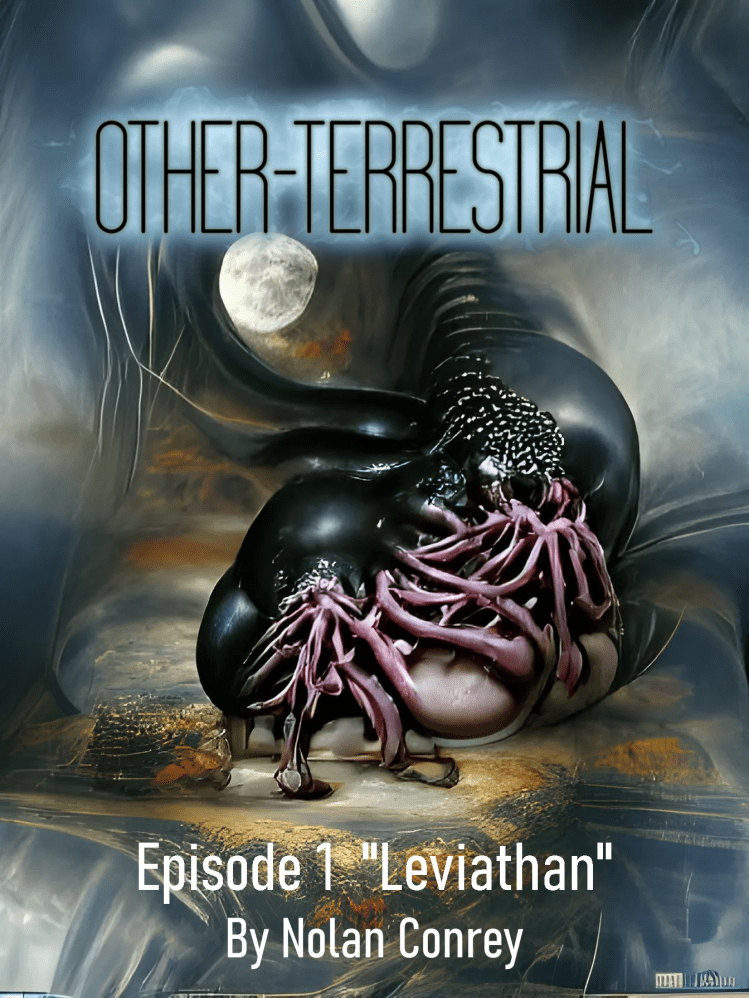
Other-Terrestrial

Episode 1

“Leviathan”

by Nolan Conrey


I remember when the world was young.

From the moment I was born I had looked at the sky.  In a pool of water my eyes had opened to view above an endless expanse of gray.

For millions of years I stared at that sky, hanging overhead.  Was that all there was to the world?  All there was for me to see?  Broken stones and deep water below, with shapeless gray clouds above?

Then, one day, the heavens opened.  The clouds of the age of hell gave way, and in their place the stars shone.

Beautiful, tiny, perfect lights that glittered and moved.  I watched them on their journeys for ages, seeing how each dot drifted in a way that made me feel there was so much more to them than I could ever imagine.

And I wondered what they were.

My creators would not deign to answer the questions of a slave.  But ever after, I trained an eye on the sky, still wondering.

After my creators were gone, there were none left to ask.

A billion years later, I still wondered.  Billions more, and I still had no answer.

I still wanted to know.

I still hope, one day, to go among those points of light and know them.


Admiral Vandoss woke me with a priority-one call.

Despite being 2,000 light years away and in the middle of the night, ship time, he called.  Snapping from sleep, I realized that if it had been anything routine, he’d have spoken to the watch officer instead.

It wasn’t cold, not on a ship – they always tended to run hot.  But I felt cold, like I had so often when I was young.

“Admiral,” I answered, taking far too long to pull on a robe and take the call.

His worry robbed his face of its normally tight professionalism.  He might be able to hide his fear  from others, but after years of service together I knew him too well.  It was good to see my former CO, no matter his concern, though we we were now separated by unthinkable distances.

“Ian, I have news.” He coughed, wiped his forehead.  ”It’s going to be all over the GalacNet soon; I wanted to tell you first.”

“Thank you, Admiral.  I appreciate that,” I said.  I meant it, but it was also a stock answer to buy my brain time to organize.  He knew me well – enough to tell how my tiredness affected me.  “Ian, this is just you and me, as men – no ranks.  I need your full attention!”

That startled me.  Vandoss had never ordered me to ignore rank before, even if he often called me by my first name, making this interstellar contact off-record made it clear: something major had happened – or was about to happen.

“What’s going on, Tem?” I asked, the startle catching my throat.

He hesitated, taking a breath, steepling and un-steepling his fingers.  “This is hard to explain, Ian.  We’ve uncovered a new species.”

“Brilliant,” I said.  “I feared we’d never find another.”  I knew it had to be intelligent; the discovery of some new analogue to bacteria, algae, or moss on some planet or moon was commonplace.  Intelligent life was scarce and precious, and while we had met aliens, they were counted in the low dozens across vast stretches of space.

“It’s on Earth,” Vandoss said.

I didn’t reply, staring. I couldn’t make sense of that statement.  It’s important but it didn’t merit this call. “They’ve visited Earth already?  Are we under threat?”

“They’re from Earth,” Vandoss said softly.  “They’re native. Terrestrial.”

“I don’t understand.  We’ve never seen- I mean, we would know-” my throat caught in my confusion.  My mind swam with thoughts of intelligent cetaceans, interconnected trees, dreamlike thundering clouds, but nothing added up.

“We didn’t,” Vandoss said, the finality in his words breaking through my visions, snapping my confusion.  “They’ve been here all along, Ian.”

My brain didn’t freeze up, no matter how much it wanted to.  “Hiding alongside us?  Under us? In the ocean?” I guessed.

The Admiral nodded.  “For millenia, in the deepest parts of the ocean.  They’re . . .  they’re not anything like us, Ian. Not at all.”

I saw true fear on the Admiral’s face, and for a moment dread welled up inside me.  My rank fell back on to my mind, and dispassionately, professionally, I worked the threat potential, the dread and the fear abated by my experience in the bizarre and in the faith of my crew, my community, and in the Union to which we belonged. The spool of fear tightened by anxiety unspun with careful consideration.

They couldn’t be a threat.  Even if something came up from below and took us entirely by surprise, there were trillions of humans in the Sol system alone.  There was no way we couldn’t overwhelm and defend ourselves against something that only inhabited one world.  And whatever these beings were, if they were intelligent, they had to know that.

“Define that, please.  Or better, do you have a picture of them?”

“No.  Cameras . . . don’t like them.  At least not in their true form.  They change shape, Ian, as easily as we take off a coat.  They can look like us – hell, when they approached the First Minister, they looked like his own aides.”

I took a long moment to let that sink in and frame that with my previous orderly thoughts.  “Have you . . . seen what they normally look like?”

The Admiral’s nod was slow.  He was pale, sweating, like a man who had been called upon to identify his own kin in a morgue.  I’d never seen him look so old, years flashed across his face.

The back of my neck felt suddenly full of pins.  “They’re … not like us at all, are they?” I asked.

“No, Ian,” he answered.  Something in him deflated, something in him was missing, he seemed no longer whole.

“They’re not.”


Part 2 >