Episode 12 – “Exodus” part 2

New to Other-Terrestrial? Check here! Or if you need to, jump to the beginning of the episode here!


“Three months ago, we noticed strange perturbations in the orbit and albedo of the third planet of the Bror System,” Ambassador-General Callirrhoe Abashidze began.

They sat in the Executive Meeting Room, which was much more finely appointed than most; the table was not simply functional, but made of pseudo-wood and embossed with the emblem of the Sapient Union.

“Bror 3’s atmosphere is believed to be capable of supporting human life,” Y said.

“That is correct,” the Ambassador-General replied.  “There were even considerations of investigating it for colonization in the past.  Terris changed that, and so we had no reason to look more deeply at the system.”

“Until you noticed those changes,” Brooks said.

“Yes.  We sent probes, which discovered two important details about the planet, which we now know as Ko.”

Y leaned forward slightly, the significance of the wording not being missed.

“We now know as?” Brooks said, putting words to the thought.  “Is this the native name?”

The Ambassador-General nodded.  “You are correct.  Ko has a native sapient species.”

Urle looked to Brooks excitedly.  “I was wrong, I can’t believe it!  Do we know what they call themselves?  Have we made contact?”

“We have made limited contact,” the Ambassador-General replied.  “We have adopted a name for the species as a whole from the first such group we’ve spoken to, the !Xomyi.”  

The ambassador clicked her tongue for the first part, and Brooks tried saying it himself.

“!-oh-my-ee,” he said slowly, committing it to memory.

“Your pronunciation is good, Captain, speakers of most languages have trouble with alveolar clicks,” Abashidze said.  “While this is only the name for the species from the first group, other groups have responded to it mostly with acceptance, though they of course have their own local names for their people.”

“Sapient species are an incredible rarity,” Urle said.  “So why wasn’t this announced?”

“Because of their state of development,” the Ambassador-General continued.  “The people of Ko are still in an early stage of economy.  Most groups consist of less than 100 individuals, living at a hunting and gathering subsistence level.  Only a few groups in particularly fertile areas have begun to even experiment with agriculture.”

“Incredible,” Urle said.  “But Union policy is to not interfere with species in such a stage.”

“I agree,” Brooks said.  “You said that there was a second major discovery made.  I imagine that is the situation with the moon?”

“Yes,” the Ambassador-General replied.

A holographic image of Ko and its moon appeared.

“We have dubbed the moon ‘Omen’.  It is Ko’s only moon of any size.  The !Xomyi have numerous names for it; it has been highly visible across most of the planet for all of their history.”

“Its chemical makeup suggests that it is a captured planetlet,” Y said.

“We believe so.  It is only barely a geoid, its gravity is weak and we do not have long.”  She sighed.  “Omen is already starting to come apart, and once sizable pieces start to come down, the !Xomyi will be doomed.”

Urle slumped back into his seat.  “It’s going to rain hell on that world when it breaks up,” he said bleakly.

“Yes,” Y agreed.  “It is not a massive object – but it is large enough.”

“I can’t sugarcoat this; we expect total devastation of the biosphere,” the Ambassador-General said, her face grim.  “It will frankly be a miracle if even bacteria survives.”

“From what I have seen, I estimate a thirty-percent chance of survival of at least some microbes in extremely deep locations,” Y said.  “After that, I predict it will be approximately one hundred million years before complex life will re-emerge.”

“So,” Brooks said.  “We are on a mission of mercy.”

“That is correct, Captain.  We have had teams on the ground for the last few months.  Thus far, we have contacted and successfully evacuated around 1,000 !Xomyi from two dozen bands.”

“How many !Xomyi are there?” Urle asked.

“We estimate there are 1.7 million across Ko,” the Ambassador-General said.  “Split into approximately 21,000 bands.”

Brooks took a moment, feeling a cold helplessness wash over him.

This was a colossal number.  If one had a few large carriers, it was doable – but getting them up off the surface was the problem.

Ko had no infrastructure.  Every lift-off would have to be with heavy rocket boosters.

He did not need fantastic math skills to know they didn’t have enough time.

And that was if the !Xomyi could even be convinced to leave.

“Where will we put the people we bring up?” Brooks asked.  “Your cruiser and the Craton won’t be enough.”

Ambassador Abashidze nodded.  “We have a heavy transport heading this way.  Unlike the Craton, it will take at least a month to get here.  It is being modified en route according to the best data we’ve gathered, and they’ll be able to feed half a million !Xomyi for a year on board the ship.”

“Half a million,” Urle said.  “Is that all we can hope to get off?  I was hoping we might have more cavalry coming.”

“You are the cavalry, Executive Commander,” the Ambassador-General said.  “The Union has been doing everything it can to get what we need, but our next supply ship is due in six weeks.  They will only have a fraction of the boosters that we would need for a full evacuation of their population.  The majority of the Union’s planetary-lift rockets are tied up in colony-relief efforts and can’t be drawn out of circulation and brought here fast enough, nor can we amp up production in such a short time frame.”

“It is a difficult situation,” Y said.  “But I believe there is another problem.”

Ambassador Abashidze nodded, and Brooks knew where they were headed.

“This is the other reason I wanted you, Captain,” she said.  “You have a reputation for high-stress diplomatic situations and a very good head for command.  We have over two thousand diplomats here, and yet it is still not enough.  I need everyone who stands a chance of success to go down to Ko, and help us convince the !Xomyi that they have to leave their homes forever.”


< Ep 12 part 1 | Ep 12 part 3 >

Episode 12 – “Exodus” part 1

New to Other-Terrestrial? Check here!


Captain’s Log:

The Craton has been rerouted from a political event on Lincoln 5 by an emergency request from the Diplomatic Corps.  We have been temporarily put under their command and ordered to a distant system whose host star is called Bror.  The third planet from that star is known to be a garden world, much like Earth, but that is all I know of it.

The nature of the emergency has not been explained yet; the message from command was brief, and I was told only that time was of the essence.

Once in-system, we will be meeting with Ambassador-General Callirrhoe Abashidze, who is commanding the operation.

I have a suspicion that gives me great interest in this assignment – the suspicion that there is intelligent life upon Bror 3.

I have never been involved in a first contact before and I hope that I will have the chance here.  They are among the most difficult and dangerous of all encounters one might have in space exploration, and one whose ethical boundaries are still not fully explored.  One’s actions could easily put them into history as the one who brought friendship between two species – or as someone who poisoned such relations, perhaps for millenia.

Well, now that I’ve thought about it, perhaps I should hope not for such a weight on my shoulders.


“We have surfaced in realspace,” Ji-min Bin called.  “We are in the Bror system.”

External visuals appeared and the command deck crew were greeted to a startling sight.

They had surfaced near the third planet of the system; the garden world of Bror 3.

It was a lovely world; they saw at the moment vast oceans and some land near the equator, hidden behind clouds.

But what was more startling was the glow around the planet.

“What’s causing that?” Brooks asked.

“It is dust, Captain,” Cenz answered.  “The planet has an immense amount of debris around it.  The vast majority appears to be extremely fine material not exceeding 100 microns in size.  They are shedding energy into heat as they fall towards Ko, however, and that – along with the reflection of light from the system’s star – is the source of the glow.”

Brooks sat back.  “What’s the cause of the dust?” he asked.

“Captain,” Urle said.  “Look at that small moon.”

It was just coming out from behind the planet, rising into the light along with the dawn of the world.

The sliver had just barely been visible, but the Craton‘s computer system lightened up the body, bringing it into full view.

It was far smaller than Luna, but it was not tiny, either, at several hundred kilometers across.  And it was far, far closer than Luna was to Earth.

It was falling into its parent world.  Everyone on the deck who knew anything about bodies in space could see it.

It would not be a single, cataclysmic impact; no, there would be many.

For every natural object in space orbiting a larger object, there was a boundary, known as the Roche Limit.  If the smaller body strayed within that limit, the parent body’s gravity would tear it apart.

Once that happened to the moon – as it had arguably already begun, with the dust – its pieces would continue to spiral in closer, eventually shedding so much energy that the atmosphere itself would burn.  Long before the moon was gone, all life would be dead.

“The planet itself is 15,000 kilometers in diameter,” Urle commented.  “That moon is barely even that far from it. . .”

“What’s the exact distance from planet?” Brooks asked.  The bridge was otherwise silent.

“The moon is . . . 10,447 kilometers from the planet’s surface,” Cenz replied softly.  “That is . . . it is just on the Roche Limit, Captain.  That moon will break up in . . .”  He went silent.

Turning in his seat, he seemed to struggle for words for a moment.  “I will have to get back to you on the calculations, Sir,” he said.

“Captain,” Eboh called.  “We are being messaged.  It is the Diplomatic cruiser, Entente.”

“Take it,” Brooks said.

An image appeared in a box on the main screen, of Ambassador-General Callirrhoe Abashidze.

There were signs of stress on her face, along with exhaustion, but her eyes were sharp.

“Captain,” she said.  “It is good you have arrived.”

“Thank you, Ambassador,” Brooks replied.  “We are here to help.  But I have to say – I’m not sure if we can stop a moon.”

“I see you’ve noticed the situation,” Abashidze said, smiling wanly.  “Fortunately, I am not expecting you to deal with the moon – though, believe me, we have considered that possibility.  There are, unfortunately, too many factors working against us.”

“I would imagine that building a zerodrive onto a moon that large would simply take too long,” Cenz said.

Brooks gestured.  “This is Commander Cenz, my Science officer.  He is a veteran of multiple terraformings and the relocation of the Dwarf Planet Xohhes.”

Abashidze looked to Cenz.  “You are correct Commander, we have done assessments and we lack the time.  There’s so much loose debris around the moon that we’d lose too many shuttles going in and out.  If you have any other thoughts, however, I would like to hear them.”

“How long do we have?” Brooks asked.

Cenz turned so his screen was facing both Brooks and the Ambassador-General.  “I have finished my calculations, Captain.  We have approximately seventy-three days.”

The Ambassador seemed amused.  “You are in agreement with the science division.  It took them nearly two days to make that estimation, however.”

“Cenz is good with numbers,” Brooks said.

“So you see the problem and our time frame,” Abashidze continued.  “But there is something that makes this problem much more complex.”

“Which is?” Brooks asked.

“We will speak in person, Captain,” she replied.  “I am on my shuttle already, and will launch momentarily.  I will be there in approximately forty minutes.”

Brooks nodded.  “I look forward to it.”

The call ended, and he looked to the command officers.

“Opinions?” he asked.

“I suspect we are on a cataloguing expedition,” Cenz said.  “If Bror 3 has a complex ecosystem – which it certainly does, given these atmospheric readings – then it is Union doctrine to catalogue the species.  With the time crunch, I expect our focus will be on capturing genetic information.  We may be able to restore this world’s biosphere one day.”

“That would usually be under a Science command,” Urle said.  “Not the Diplomatic Corps.”

“Normally this is the case, yes,” Cenz replied.  “But the Diplomatic Corps at times takes command of these, just in case a native sapient species is encountered.  As well, the Bror system is outside of the Sapient Union in Unclaimed Space.  If another government’s ships arrive, diplomacy will be vital.”

“But then why be so secretive?” Jaya asked.

“Doomed worlds attract vultures,” Brooks replied.  “We may simply be running security in case smugglers come to take samples for sale at Gohhi.  Many of the rich collectors there will pay huge amounts for the last of a species, especially if it’s a large predator.”

“I suspect,” Y said, “That they have discovered a sapient species.”

A silence fell; they had all been thinking of the possibility.

“Respectfully, that seems unlikely,” Urle replied, picking his words carefully.  “As exciting as it is to consider, intelligent life is just so rare.  There are just over a dozen species in the Sapient Union and we believe it to be an unusual density for reasons we poorly understand.  Besides, there are no cities or geographical alterations we can see – if they’re down there, they’re staying pretty quiet.”

“Not all species are technologically advanced,” Brooks noted.  “We only have been smelting metals for eight thousand years, after all.  All of humanity’s time before that was living as simple bands of hunter-gatherers.”

“And that is precisely what I think has been discovered down there,” Y said.

Silence fell again, and Brooks stood.  “Urle, Y – you’re both with me.  Let’s get ready to greet the Ambassador-General.  Jaya, you have command.”


< Ep 11 Epilogue | Ep 12 part 2 >

Episode 12 Update and Cover

Just a brief update – Episode 12 is about 2/3 finished at this point, and over 59,000 words. I am writing thousands of words each day, multiple scenes. This is not to say I am rushing, but this story is already written in my mind, and so I must just put it on my screen!

Soon I’ll share more about Ko, but I’ve been exhausted since my crazy work week last week, followed up with a lot of housework. Anyone who has a family knows how it can be!

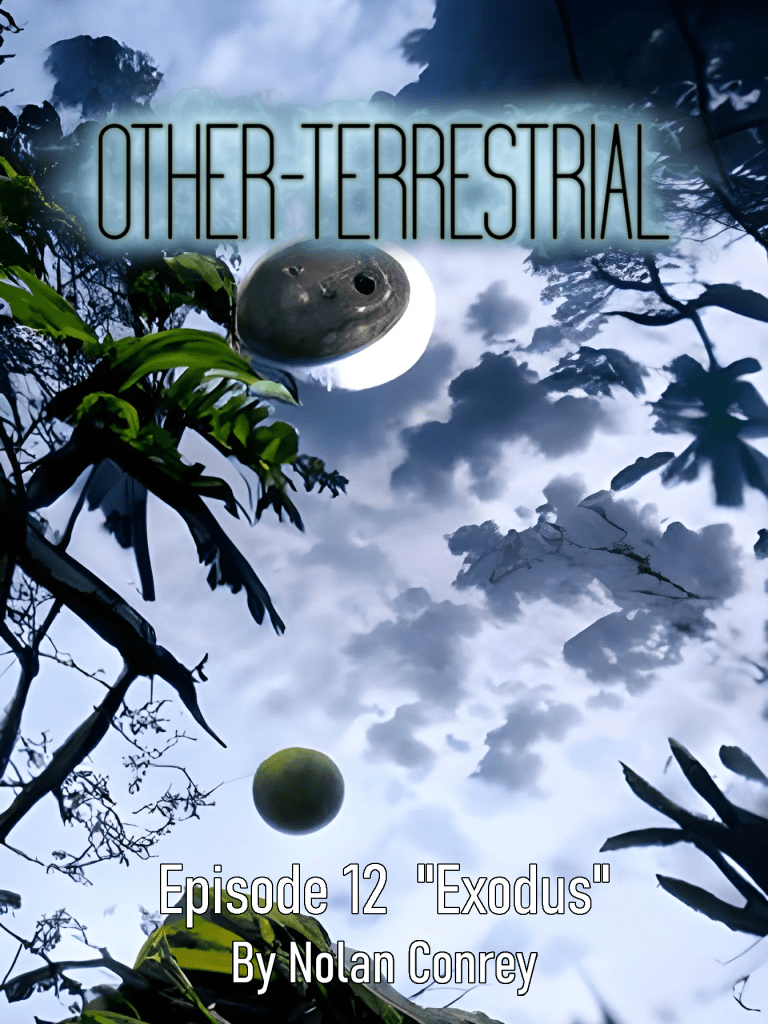
Here is the cover for Episode 12 – Exodus!