Just a brief update – Episode 12 is about 2/3 finished at this point, and over 59,000 words. I am writing thousands of words each day, multiple scenes. This is not to say I am rushing, but this story is already written in my mind, and so I must just put it on my screen!
Soon I’ll share more about Ko, but I’ve been exhausted since my crazy work week last week, followed up with a lot of housework. Anyone who has a family knows how it can be!
I think for most science fiction stories concerning spaceships, the primary ship of the story is probably something that is very quickly and readily created.
I’ve taken my time at it, for reasons of not being that good with that sort of medium (at least not to the level I like), but I have finally created an image on GIMP!
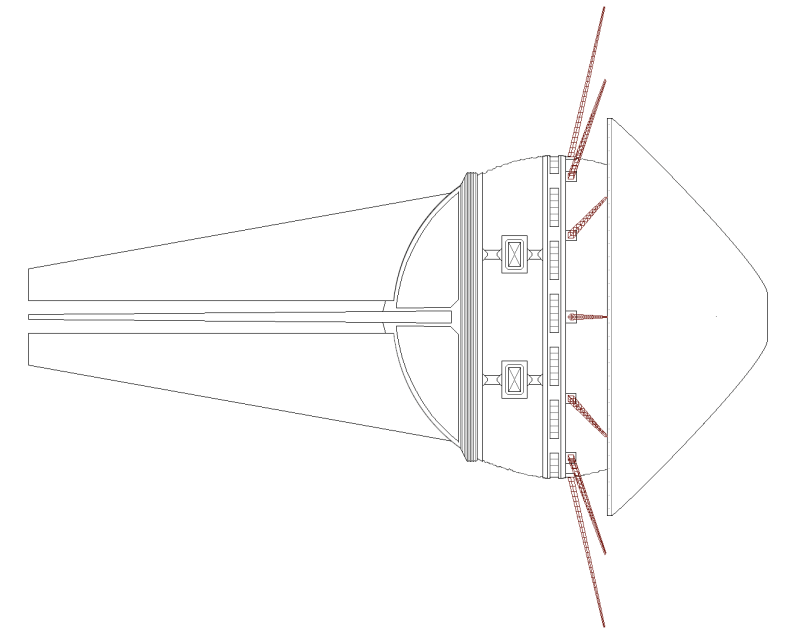
The central sphere was constructed from a cratonic asteroid that was 1070 meters in diameter; it was, oddly for an object of its size, a proper geoid, despite not possessing enough mass to do so under the effects of gravity. Much of that asteroid still exists, resulting in the “bumpy” edges of some parts. This outer shell is approximately 50 meters thick – and given the strength of cratonic material, this provides those inside the ship with ample protection from cosmic rays and enemy attacks.
At the fore is the armored cone that protects from enemy attacks (though largely is just for absorbing micro-meteor impacts). Such shields would be common place on any ship in space that doesn’t possess any kind of fantastical energy shields or something to that effect. This will always face the direction of travel. At the center of this are the apertures for the three massive coilguns that run most of the length of the ship. They have covers that are quite thick that close when not in use, to protect from any random object (or missile) from being able to fly inside.
You may notice the small dots around the rim of the cone; these are covers for the retracting point-defense cannons. The preponderance of them are on the rim to give them the best arcs of fire, though there is a secondary ring of additional PDCs further back to cover the rear of the ship better. These are purely-military in function, and can be used to shoot incoming enemy missiles or to attack soft targets at extremely close range. There are 120 of these point-defense cannons, though each “individual” cannon would actually be groups of gatling-style multiple-barreled weapons that would fire thousands of rounds per minute. When you have massive swarms of missiles coming in, your goal is not going to be single precisely-placed shots, but to put out a veritable wall of counter-fire to make sure you kill that missile.
The red towers contain sensors but also powerful navigational lasers. Another feature that any spaceship would possess if it can afford the power (and heat cost), these will always be active, targeting objects heading towards the ship. Tiny objects can be incinerated, while larger objects can be targeted on one side, which would cause the object to change course as heated material blasts off. There are twelve towers in total, each holding four lasers for a total of 48. I have not yet crunched the numbers to determine how powerful they are, but I will get around to it. These lasers are, incidentally, just as effective against incoming missiles.
The ring behind this is the famous Equator Ring! The collections of four boxes are actually the lovely transparent titanium windows, which are quite large at 30 meters in width.
The two blocks behind the Equator Ring are the main landing bays of the Craton. There is one more on the other side, and these are 40 meters by 80 meters.
The rings behind that are the Craton‘s zerodrive. While it is necessary for part of these to be external, they don’t do anything exciting visually when activated. I’m sure if there was ever a film of my stories, though, they’d probably glow and make a wum-wum noise as they charged up.
Finally, the long fins are radiators. Any spaceship would require these. When you have massive reactors pouring out incredible amounts of energy, you will have to get rid of that heat somehow – and in space the only way you can do that is by radiating the heat away as light. That means that these fins will usually be glowing a faint red at any given time, and during times of very high activity (like after a jump or in combat) they would glow more. There are three of the fins, which is the most efficient arrangement.
The Craton does have small maneuvering thrusters (not shown), but largely moves by thinning the veil between realspace and zerospace in front of it; the gravitational attraction of zerospace pulls the ship towards it. The ship does this repeatedly many times a second, creating a generally constant pull. It can also position this field in any direction around it! Though this does not dump its current inertia, it does allow it to alter course quite smoothly, and also rotate freely while moving as it wishes. This means that if the Craton is being chased, it can rotate to bring its coilguns and frontal cone to bear on its pursuers while still moving away from them or rotate to give a nice broadside as it passes an enemy ship!
Incidentally – this form of gravity engine is totally a physics violation. They are aware that this contradicts known physics within the setting, and have created “neo-physics” to attempt to explain this all and understand the universe better.
They are unaware that they are trying to see to the bottom of the sea by peering at its surface, and a deeper truth, the eldritch truth, lies beneath.
Despite how good some of the art has turned out, there’s a lot of trial and error. I was mostly doing this when I was too tired in the evening to edit properly, and it turned out to be fun, even if most attempts were misses. Here’s some memorable ones (with a few others on Apollonia’s post).
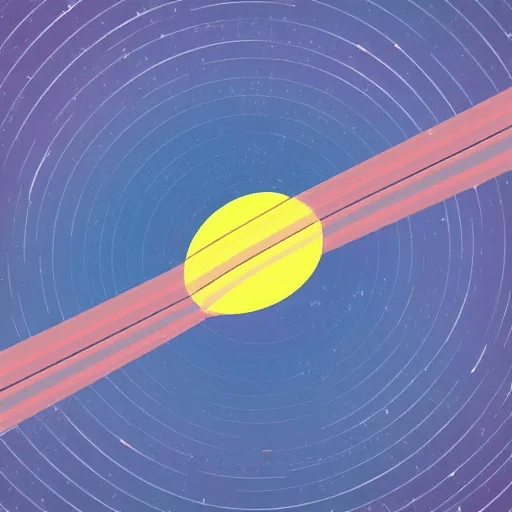
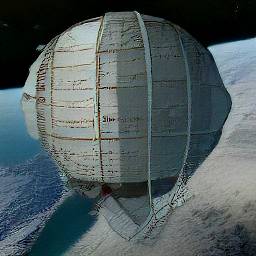
Attempts at the Craton have never turned out well.
I have no idea why it’s just a yellow technicolor sphere.This one is somewhat closer, though still not great. A least it looks like a ship! The general shape is right, though the Craton has very long and thin towers with lasers on them (navigation lasers for incinerating space debris or incoming enemy missiles), and trailing heat radiators. The front also has a large shield cone and there are visible surface areas that are still rock from the cratonic asteroid it was created from.
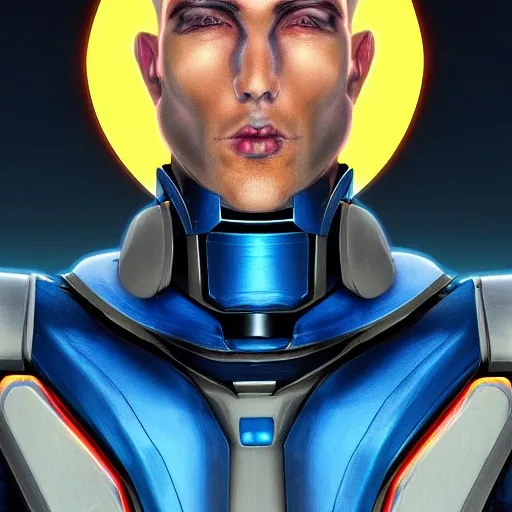
Attempts at Urle have gone one of two directions.
Excessively handsome face on a fully-robot body OR
Fully cyber robot-code-machine man.
None of these are quite what Urle looks like.
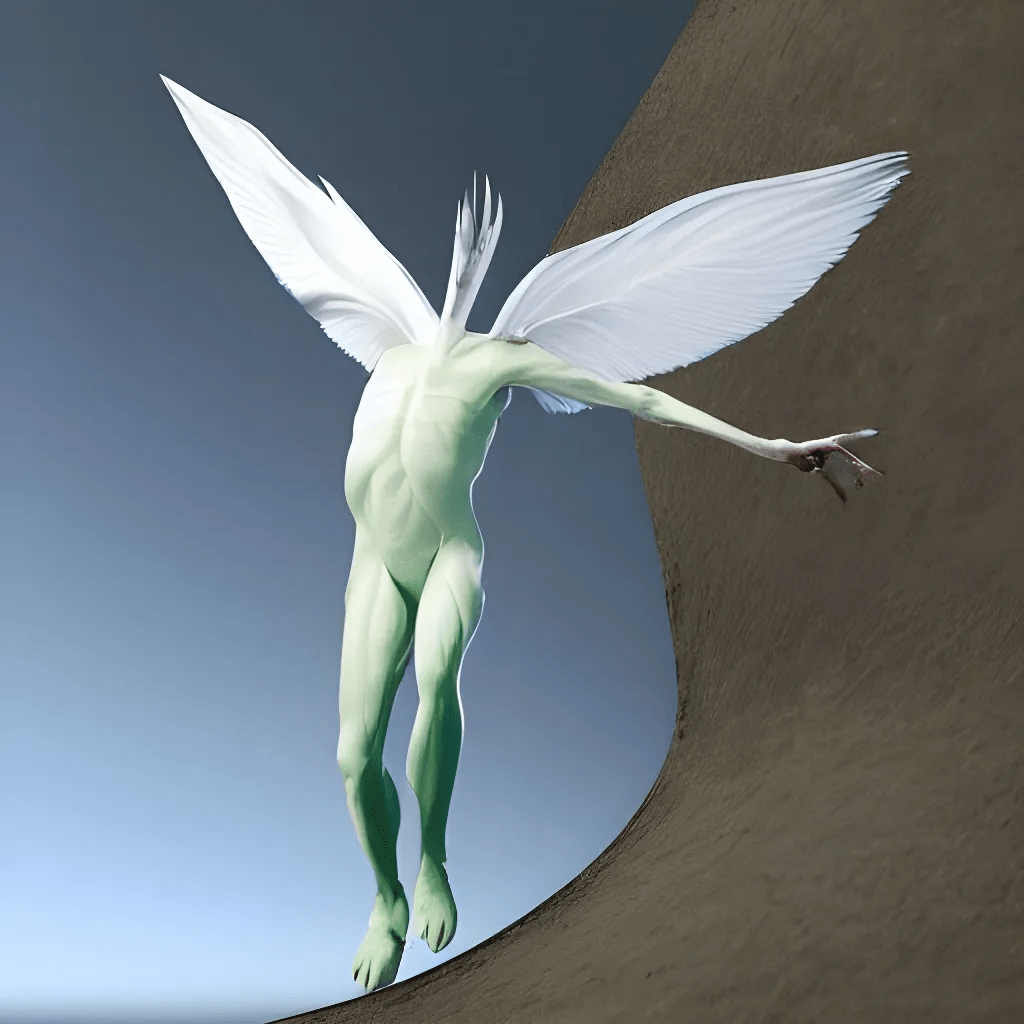
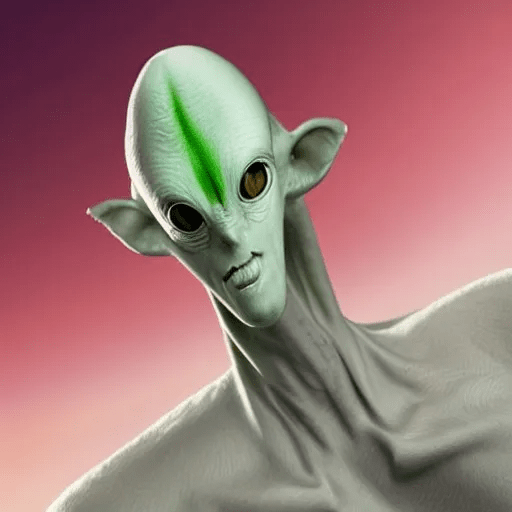
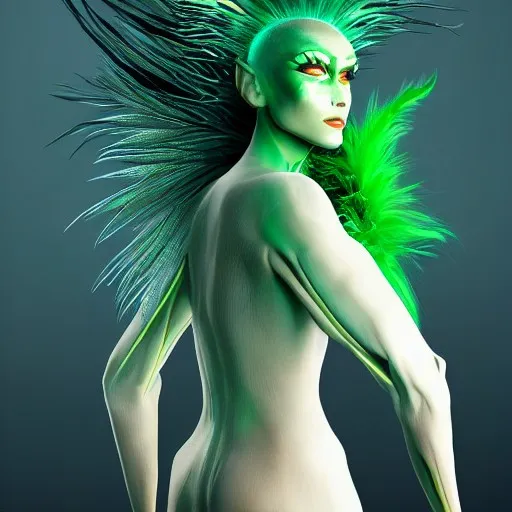
Attempts for Pirra have all been doomed to failure, but this one is interesting.
I rather like the general elements of the body. It looks inhuman and neat, though Dessei are much thinner than humans. However, the general coloration is quite good. The lack of head, though . . .This one at least got a head, though it looks like some kind of alien goblin.The AI went full avant garde.It got too obsessed with feathers for awhile and really wanted to make Pirra human even though I did not include words implying that.This is fairly close, though Pirra’s head is not this human-like. It’s almost perfectly round, to be honest, and she has no noticeable cheeks like this. Or ears. Or lips. Okay, this is nothing like her.
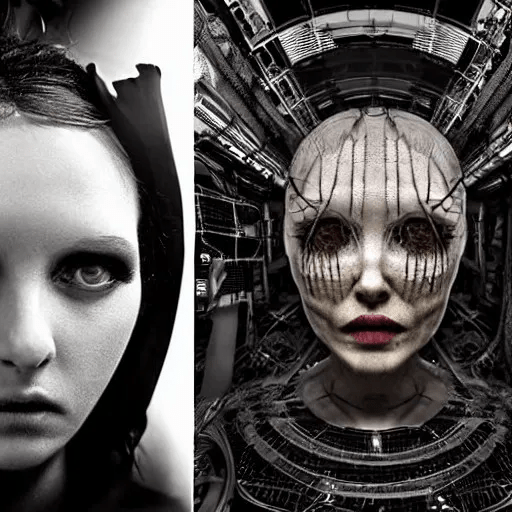
Finally I’ll throw out a couple more Apollonia rejects!
This one reminds me of a young singer/actress who worked for Disney, though her name escapes me.This one is real nightmare fuel. And I have no idea why it started to create a second image on the left.
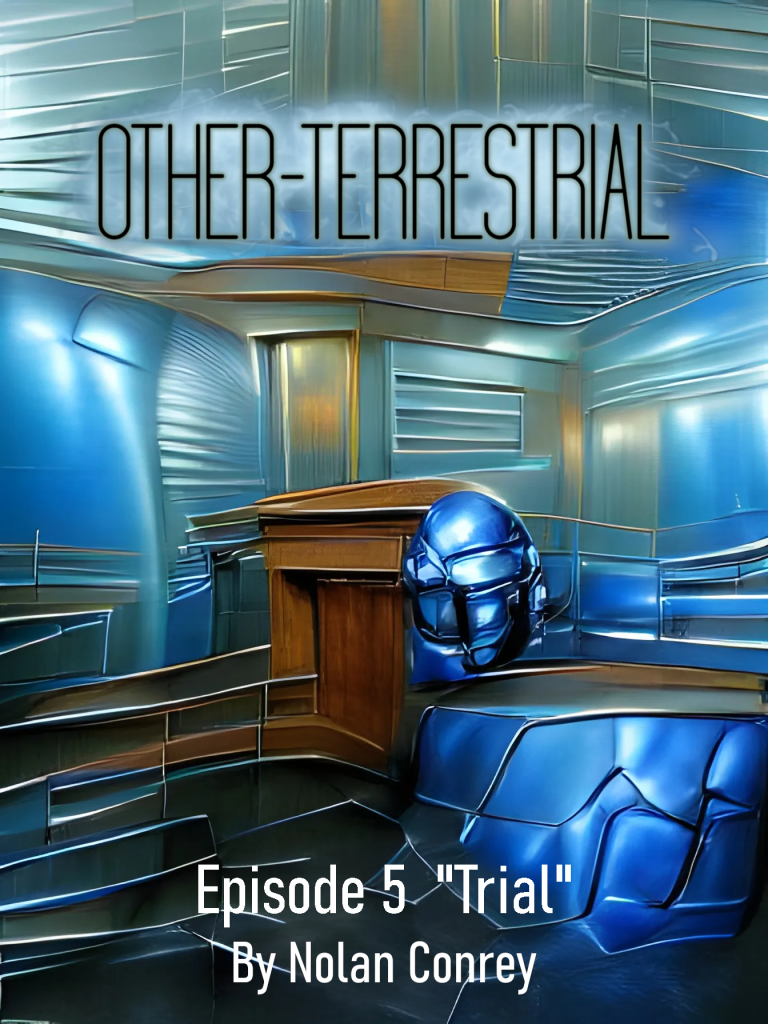
Okay, tomorrow will be the cover reveal for Episode 7! Stay tuned!
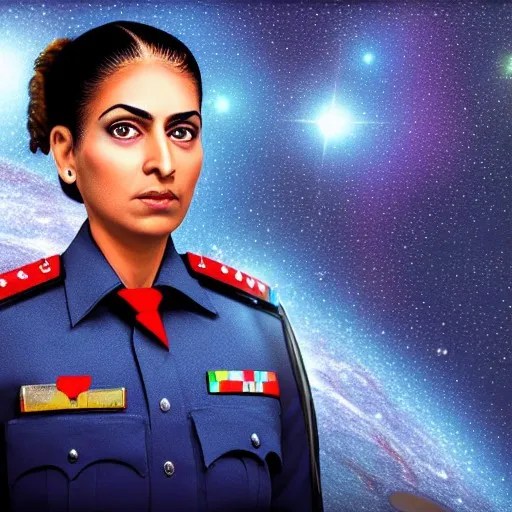
This one came out excellent, really capturing the character well – as well as having a fantastic space background! This really has future “photo day background” vibes.
As per usual, I should add that the uniform is not accurate to the SU, just the best the AI could do with generating a blue space uniform. It really is impressive how good it does, though, even if we get odd things like a red tie turning blue and becoming buttons.
This image was a close runner-up:
Though it does not quite look . . . human.
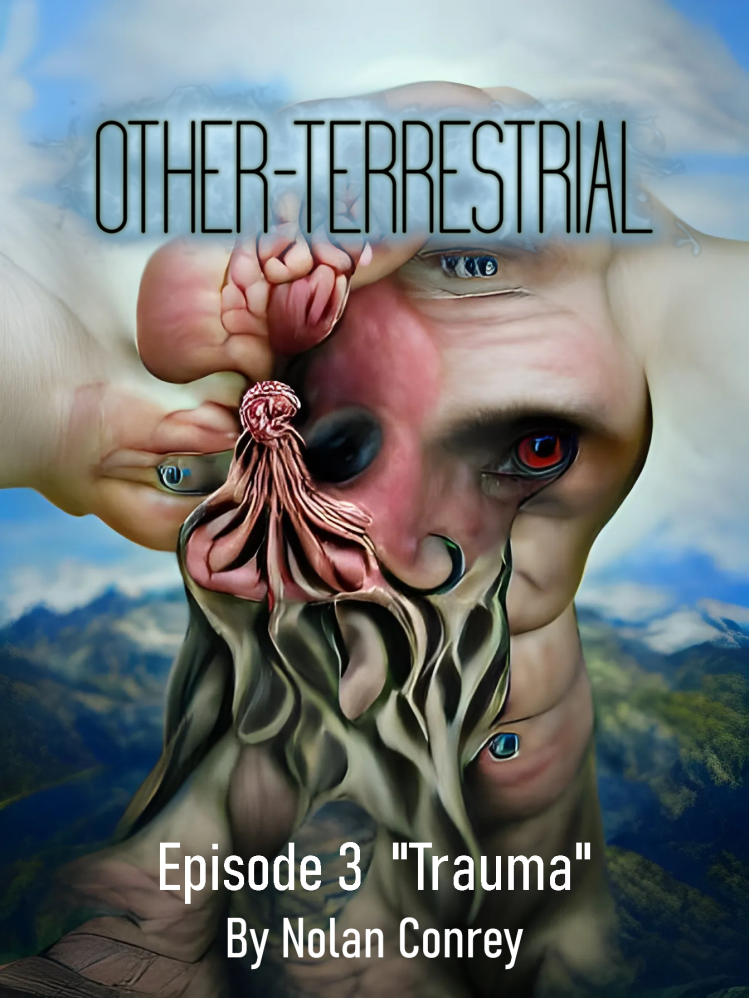
Tomorrow, as a treat, I will show off some of the more horrifying results I got . . . including my attempts at Urle, the Craton, and Pirra! Trust me, they’re not great.
Continuing in showing the AI-generated images I’ve created of characters, here is Apollonia!
She’s in her purple phase.
Admittedly this one came out too perfect, almost model-like. But the angularity of her face and her tired eyes seem spot-on for someone who has been malnourished and living on the margins all her life. I told it that her eyes were violet, but the AI translated this into her hair and lips . . . I suppose she could take on this look, but she’s actually much more plain.
The AI put her outside in space, not me, I swear.
This image is probably closer in some ways. Apollonia is not beautiful, and her hair is very dark. She is very pale, but not . . . paper white as above.
It can be surprisingly hard to get decent images out of the program. I had a lot of them turn out in very disturbing forms, like this.
Another interesting, slightly less disturbing (but still inaccurate image) is this one:
As yet, I’ve had very little luck with characters who are different than normal humans, IE Urle with his cybernetics or alien characters. Or the Craton itself, for that matter! I’m going to have to find a good artist who can do spaceships for that . . .
I’ve been trying to create quite a number of images, to be honest










 Other Terrestrial
You must be logged in to post a comment.