The Craton – A Tentative Deck Plan

This is my working map of the Craton’s interior. It’s a massive image, because I tried to make it all to scale as best I could in GIMP. One pixel is half a meter, approximately.

I wanted to share it, so I wrote out some of my thoughts on this.

You may notice some tiny little lines; those are scale markers, showing heights of 1 meter, 1.5 meters, and 2 meters. I hoped they would give some concept of the size of a human within the ship.

This is far from an exhaustive map; I’m sure many floors would be sectioned differently, extending up or down or otherwise conjoined. And of course this is 2D map of a 3D object, so a lot is lost that way! It’s more intended to get across some ideas.

I do try, when writing, to keep an idea of what decks are used for what. But this is a necessarily vague and messy thing.

Now.

1 – Front Cone
The frontal cone of the Craton is composed partially of ground-up bits of the original asteroid mixed into a concrete. This shield is massive and very heavy, but is important for defense, both in combat and in travel. A small object, traveling fast enough, will have the energy of a bomb, so you need something to protect from that.
I will admit something I have not calculated the optimal shape and size of the cone. I will have to do that sometime, and correct this image accordingly. Right now it’s just what I thought looked good.

2 – Coilguns
The Craton possesses three massive coilguns that are almost as long as the ship itself.
These weapons use electromagnetic coils to move objects to a very high speed and shoot them out. A railgun is similar, but by this point railguns would have fallen out of use, as they damage their own barrels by arcing electricity.
The Craton’s coilguns are extraordinarily efficient; perfect conductors and other advances in materials science has made these, while not wasteless (as that’s an impossibility), freakishly close. A tiny, tiny fraction of a percent of the energy is wasted in the form of heat.
However, the exact power of these railguns is something I’ve left fairly vague so far, though they can vary quite a bit; either doing a slow launch of a shuttle or shooting a bus-sized projectile to a fraction of c. They’re not only weapons.
The tip of the barrel of the three coilguns are covered at most times by very heavy slabs of the same material that the front cone is made from; there are several spots down the barrels that can close. This does create a slightly higher risk of failure, but is deemed wise since it’s a tube that runs down the heart of the ship.

3 – Cone Rim Defenses
Each of these dots show the location of one of the Craton’s Point-Defense Cannons. These are complex arrays that have banks of minigun-style weapons that spit out bullets as fast as possible. At the scales of ships like these, the damage they could do are minimal, but they are an essential tool against enemy missiles. Varying up your defensive options makes defending against both more difficult.
These are not the actual PDCs, incidentally – they are kept under protective shields most of the time and are lifted up and out to fire. This is a quick process, andd missiles can be detected from very far out, so this is not typically an issue.
Missile launchers are not shown here; they are on the main body of the hull, as the missiles can change course. Each missile battery can fire a variety of ordnance of various sizes and powers; warheads are small and nuclear in nature. Conventional explosives just have too little power.

4 – Fusion Reactor 1
The Craton has seven fusion tokamak-style reactors. I wanted to use this classic style, though we don’t know for sure if tokamaks will end up being the proper shape (they are by definition a toroid). I’ve heard of a lot of hopes about a peanut-shaped fusion reactor.
The plasma inside the Craton’s reactors reaches massive temperatures (over a hundred million degrees, probably many hundreds of millions). Obviously that’s pretty hot, but the materials science of the Sapient Union is extraordinary; perfect heat radiators are something they long-ago created, and simply take for granted.
They likely don’t use simple hydrogen fusion, as that produces a lot of neutron radiation. The fuel for their reactors are something rarer that is likely “mined” from gas giant planets and processed on the ship prior to use (similar to Ultra-Dense Deuterium). Any system possessing a gas giant would be stocked for extreme time – and most systems have gas giants.

5 – Outer Hull/Mantle
The cratonic asteroid that the Craton was made from was a very unusual rock.
While many asteroids are essentially mountains of pebbles weakly held together by gravity, cratonic asteroids are solid. They are composed mostly of nickel-iron, but with a third added ingredient, a kind of inert tenkionic matter that has a very high mass and forms extremely solid bonds. This form of matter is safe for mundane life to be around, even for long periods, and is found to be drawn towards zerospace.
For unknown reasons, cratonic asteroids are always found as geoids, despite their small mass. These asteroids are extremely ancient, possibly the first solid matter that formed in the young universe. One thought is that this time the tenkionic matter was more active with their form of radiation, kratonic radiation. In that time, the mass of the object would have been far higher, causing it to collapse into a geoid, almost regardless of size.
Cratonic rock is also extremely strong, and these two qualities have led to many of the cratonic asteroids that are found to be converted into ships.
Carving out the asteroid was extremely difficult, but in the process, ground cratonic rock slush was produced, which was mixed with a tough concrete to resurface parts of the finished ship. This mixture has a distinct appearance from the material of the frontal cone, appearing like the original asteroid, for aesthetic purposes.
Under this artificial layer is some of the original, unaltered asteroid – 50 meters of it. Even with the direct openings like the hangars and Equator Deck, which reach the surface, cratonic rock has been left behind and around them as much as possible.
This cratonic rock layer is a potent defense for the Craton, being harder than any other ship armor in wide use, and also serves to insulate the crew from radiation.
Because the cratonic rock is drawn to zerospace, the Craton is also able to enter that quasi-realm far easier than most ships of larger size.

6 – Equator Deck
The location of many scenes, the Equator Deck is angled differently than most of the decks. Artificial gravity is a requirement to allow people to walk on the “walls” and gaze out at space above them.
On a ship like the Craton, an area dedicated for recreation is a must, and so it was made a key feature of the vessel. Small businesses run by civilians of the ship provide many services, create luxury items, and . The Equator is the major hub of this, but other locations on the ship can be made impromptu art alleys or serve as small markets.
These small owners are not capitalists; the resource allocations for these shops are based on civilians applying for and demonstrating an understanding of certain skills, such as organization and of course the functions of the shop. They may then take on apprentices who earn Exchange Credits for their work. The owner and workers all earn their Ex based on their hours of work.
The Equator Ring has massive windows made of transparent titanium. These serve, through sheer thickness, of protecting people below from radiation, but are an incredibly resource-intensive product, being atomically perfect. There are shutters for them as well, which close before a zerospace jump.
Funny note about eating in this time; dishes are not washed and reused, but recycled and 3D-printed. The fusion generators of the Craton generate so much power that this is more efficient than wasting a lot of water with cleaning.
They probably would look back at us re-using dishes and think it gross and unsafe.

7 – Zerodrive Generator Ring
Zerodrives are large rings that are able to poke holes in reality as we know it. Through these holes, or portals, one enters zerospace. The zero, incidentally, is due to the common thought that this is the “zeroth” dimension.
The force of gravity is stronger in zerospace, and so a small amount of mass is able to do a lot.
The Craton is somewhat unique in being able to make zerospace jumps at such a small size*. Most vessels require 21+ very large reactors to generate enough power, but the Craton’s special nature allows it to do so far more energy-efficiently.
“Speed” is not a very useful term in zerospace, but it is known that velocity increases with time. Three days is the safe limit for time spent submerged, both for the crew’s mental health and for ease of return. If too much velocity is gained in zerospace, it cannot be safely shed to allow a return to realspace, which its harsh rules about going faster than the speed of light.
These engines also can create “thinnings” instead of breaches for a smaller fraction of the energy. This is how the Craton moves in realspace – by opening a portal that draws the ship towards it gravitationally. This means that, unlike most ships, more mass actually has benefit for the Craton in moving itself.
The acceleration is good, and both inertial dampeners (yes, that old scifi trope) that function off cratonic technology, and the nature of cratonic rock, the stresses are spread evenly across the ship’s cratonic structure, preventing it from pulling itself apart.
This behavior has led to conclusions that the cratonic matter behaves akin to a single atom, holding itself together with the strong nuclear force. And physics is left crying.
The extra gravitational energy produced by the zerodrive is called pseudogravity, as it does not propagate infinitely like true gravity does, but goes only a relatively small distance before somehow “sinking” back into zerospace.
Even the Craton’s inertia is subject to this, and over time, if the engines are not used, the ship will lose energy until it has left only the inertia it initially had! This could, theoretically, lead to strange situations like the ship beginning to drift in the opposite direction of its original direction of travel!
Thus, despite the ship being able to move itself, energy is ultimately conserved – yet another way that the Craton seems to defy physics.
In practice, the zerodrive always has thin white rings of lights that face towards the back (which is actually just a polite way of indicating to other vessels which way it’s going), and these would grow brighter as it activates, though it’s not particularly dramatic.
More positively, the ring is always active to some extent so long as there is power, making it hold itself together very well against damage. So they are a target, but not an easy target.

*I have, in the story, mentioned a few examples of other small ships that can do this; special scout ships that are basically all just reactors, and very, very expensive massive capacitors that allow a vessel to store enough charge for a jump or two.
It’s also possible for a ship to

8 – Command Center
At the heart of the Craton, the Command Center is where much of the action in the stories takes place. It is not literally in the center, both because of the coilguns and because it’s never a good idea to make your ship’s brain’s location be too predictable.
The Command Center’s layout has been described, but I really want to do an image like this for that specifically, so I won’t go too much in it.
The Command Center is actually heavily isolated from the rest of the ship in terms of personnel access. It has an attendant section of offices and support rooms, with limited access to other personnel. All traffic in and out is monitored and screened (which is really true on the entire ship, but nowhere moreso than here).
The main center itself has only two entrances on two different decks, and their layout is designed for defense. This makes attempts to capture the ship more difficult.

9 – Main Hangars
The largets hangars on the Craton, they are 70 meters wide and 45 meters tall, and extend nearly 100 meters into the ship. These are specialized for use for accomodating larger vessels, and the ship has other airlocks and several smaller hangars.
These large hangars do have decks within, but these only extend part of the distance from the wall, and can be retracted if need be, though “curtains” of strong material can also be used to cordone off areas, and the doors can open in sections.
Several large wall offices are also visible that are for hangar personnel.
There are no magic forcefields; when the hangar doors are opened they are open directly to the vacuum. Very tricky techniques are needed to get as much oxygen as possible out in case they do need to be opened.
The doors have blocks of transparent titanium embedded in them, usually covered with armored shutters. These can be iris opened and so the hangar is more often used as a grand observatory than its intended purpose.

10 – Coilgun Base
You may remember this from when Jaya oversaw the manual loading of a coilgun shell in a drill, the seven-ton projectile fell to the floor, and a crewman was almost crushed.
The coilguns don’t extend fully to the aft of the ship, and Reactor 7 below it is its primary power source, though any of the reactors can be used for this task if necessary. Reactor Seven is slightly offset in a different axis than we see here, just in case.
Coilgun shells can range from small, accelerated to massive speeds, to bus-sized shells of tungsten alloy that achieve only modest velocity, but will transfer more of their energy to the target.

11 – Radiator Fins
The Craton’s fusion reactors create a lot of waste heat. Getting rid of that so the ship does not melt itself into a glowing orb is very important, so the ship possesses massive radiator fins. The consist of a heavy, solid matrix filled with channels of heat-transferring conductors.
These would glow a dull red most of the time with heat, and may turn even brighter as the ship does more.
The ship also probably takes advantages of more exotic heat regulation, like stringing heated magnetic beads along electromagnetic lines, cyling them in and out of the ship to increase their heat-dissipating surface area.
The fins are thick so that they can also be something of a heat sink in an emergency.

12 – Navigation Laser Tower
The most common threat the Craton may encounter is flying space debris. This can be tiny, something that is just absorbed by the front cone, or could be big and fast enough to be dangerous.
The Navigation Lasers are tasked with destroying small debris before it hits the Craton. They are placed at intervals on 450-meter tall towers, to give them a clear line-of-sight on incoming debris, along with sensors – both those related to their command and control and other, general-use sensors.
As lasers travel at the speed of light, they are the first line of defense of the ship after an incoming threat has been detected. Outside of maintenance, they are always active and watching in all directions.
In times of combat, these lasers are effective against incoming enemy missiles, drones, or small ships. While very powerful, against large ships they are only going to deal small pin-points of damage, thus in such cases are only good for targeting specific weakpoints.
The mix of Point-Defense Cannons and Lasers is considered to be important, as it makes enemy missile designers have to contend with multiple avenues of threat.

Hope this was an interesting read for you. In this series, I have always wanted to respect physics, and allow only for the limited use of a specific family of technologies to break that for writing convenience. I also wanted my non-physics technology to come with its own drawbacks, limitations, and caveats so that as little as possible had to be handwaved.

I will be posting about upcoming stories more soon! I’ve had a long and unpleasant bout of covid, and the long-term symptoms have caused me a lot of issue. This, along with my co-writer having some issues has slowed things down.

But I will bring some positive news soon, I promise!

A Writing Consideration

I was writing a line for episode 16 (yes I’ve started it while still working on 15).

“Enope lived in a system more active than most, with the orbital perturbations of its gas giant Jeea showering asteroids into the inner system every 12,000 years.”

Which is a line that got me thinking. Are these Earth years, for the reader’s comprehension? Or is it Dessei years?

It matters because I have, in fact, modeled the systems and homeworlds of the major species and places. The Dessei come from the planet of Enope III (yes, like Earth, Enope is the third planet in the system; if you’re making Earth-like systems it usually works out this way), but Enope has a shorter orbital period than Earth. It also has a different rotation period!

So an Enope year is only 0.74 Earth Years, equivalent to 270.29 Earth Days, 324 Local Days.

So do asteroids come in every 12,000 Earth years? 12,000 Enope years? Does it actually matter???

Yes, it does matter (at least to me).

Well, these sorts of questions have forced me to adopt a policy, which is basically ‘assume the numbers are translated into Earth years unless otherwise stated’.

I hope this has been at least mildly interesting.

Planet Ko

I’ve been very busy (still writing every chance I get), but I thought I might share some background information on the world I have created for the new story!

Here is my (admittedly simple) art of the world, Ko.

Ko is a very warm planet, slightly larger than Earth, with a mass 1.34x Earth’s, and a radius of 1.17 earth radii (or 7,454.07 km). This makes it slightly less dense than earth at 4.59 grams per cubic centimeter, and with a surface gravity of 0.97 that of Earth. Its atmosphere is 1.6x as dense as Earth, which is heavy, but still breathable for humans. It has a rotational period of about 27 hours, so it has longer days.

Due to its atmospheric makeup containing more water vapor, Ko has an average temperature of 22 C / 71.6 F, which is much warmer than Earth (which averages 15 C / 59 F). This is why the majority of its land mass are very warm climates (aside from those smaller islands far to the North).

I only show this hemisphere because the other one has only one small landmass, near the equator, which is devoid of intelligent life. The fact that all the continents are collected like this has several big implications.

Firstly, the free-flow of water north and south helps keep the planet warm – Ko has no glaciation. It also means that the winds that whip over those oceans have nothing to slow them down, causing the winds and waves to get very, very strong!

Ko orbits its host star, Bror, at 1.14 astronomical units (one AU is the average distance from the Earth to the Sun), and there are seven other planets in the system, which would mostly be familiar to us, except for the frozen water world that orbits outside the hospitable zone at 3.2 AU. This similarity to our system is coincidental, btw, I rolled a D10 for how many planets the system would have!

I could go on all day with other details about its neighboring planets, the star Bror, and things like Ko’s axial tilt (it’s not as tilted as Earth) . . . but I imagine you get the picture!

Figuring out all of these details of Ko (and there are plenty more; I even figured out the makeup of its atmosphere to help with elements of the story) was a fun and challenging process. I used a variety of books (such as World-Building by Stephen Gillett), scientific papers (such as the incredible Habitable Planets for Man by Stephen H. Dole), and youtube channels (like the excellent Artifexian) to help me in this process.

I put a lot of work into the background of each story, to make sure that the science is as good as I can make it. I have a number of friends who are mathematicians or engineers who kindly help me with this process (and who frequently check my math). If you’d like to know more background stuff like this, want to know more specifically about Ko, or just want to know more about how I do these things, please let me know!

As for Episode 12, it is coming soon, I promise. 🙂 I am writing thousands of words a day.

A First Look at Episode 12

Today, we’ll take our first look at the upcoming Episode 12 of Other-Terrestrial.

Titled “Exodus”, the episode will involve a new species of aliens, who come to be called the !Xomyi. The ! at the start of the name represents an postalveolar click sound, which is a type of click that appears in only a handful of human languages in Africa, and in one ritual language in Australia. It is created with a downward motion of a concave tongue.

The ! sound exists in the word because the !Xomyi are a species descended from nocturnal ancestors who were able to use a form of echolocation. Clicks and other sounds are common in their languages – of which there are many! It exists in the names of specific groups, such as the !A!amo, in animals such as keko!un (a type of predator), he!pa (a type of animal the !Xomyi hunt), and the ko!go (a bird-like animal).

The !Xomyi are not a united people, but exist still as hunter-gatherers. There are many scattered groups of !Xomyi across their homeworld of Ko.

While normally the Sapient Union would be quite happy to leave such a people to their own devices, to allow them to develop in their own way, there are still events that may force contact . . .

I’ve done a lot of work on this, and soon I’ll share some other background material, like my map of Ko and the cover art for the episode!

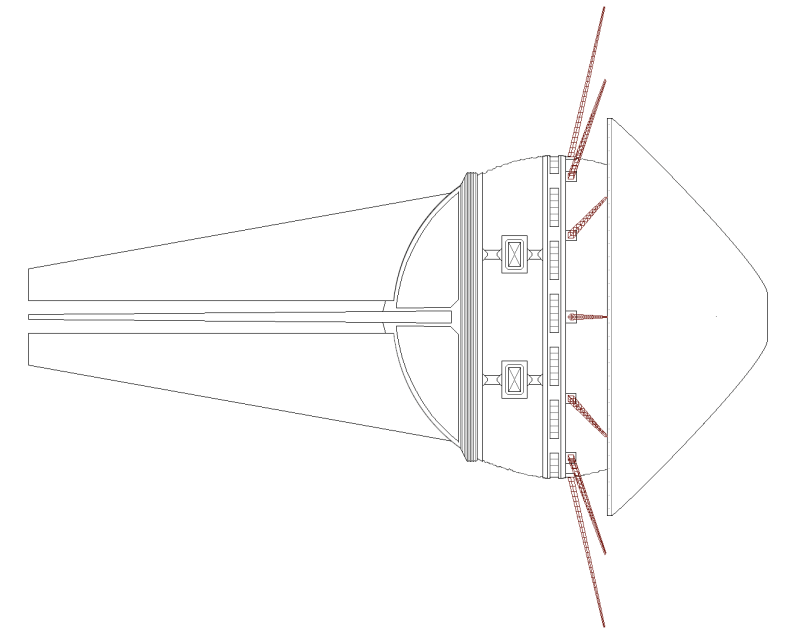
The Craton

I think for most science fiction stories concerning spaceships, the primary ship of the story is probably something that is very quickly and readily created.

I’ve taken my time at it, for reasons of not being that good with that sort of medium (at least not to the level I like), but I have finally created an image on GIMP!

Length: 2540 meters
302 Decks
7 KL221-B Fusion Reactors
3 Custom 900-meter Coilguns of Adjustable Diameter
12 Navigational Towers
48 Tower-mounted navigation lasers
120 Multi-barrel PDC emplacements
55 Magazine-fed Missile Launch Systems with 5-missile capacity

To lay out some specifics;

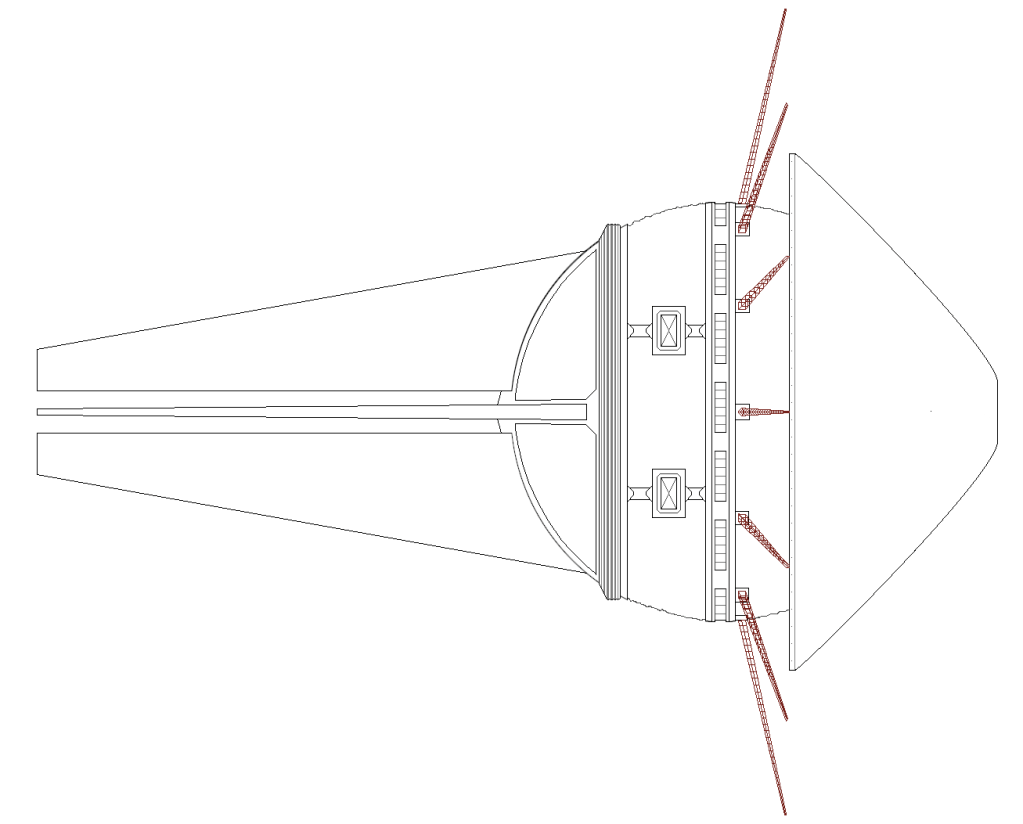
The central sphere was constructed from a cratonic asteroid that was 1070 meters in diameter; it was, oddly for an object of its size, a proper geoid, despite not possessing enough mass to do so under the effects of gravity. Much of that asteroid still exists, resulting in the “bumpy” edges of some parts. This outer shell is approximately 50 meters thick – and given the strength of cratonic material, this provides those inside the ship with ample protection from cosmic rays and enemy attacks.

At the fore is the armored cone that protects from enemy attacks (though largely is just for absorbing micro-meteor impacts). Such shields would be common place on any ship in space that doesn’t possess any kind of fantastical energy shields or something to that effect. This will always face the direction of travel. At the center of this are the apertures for the three massive coilguns that run most of the length of the ship. They have covers that are quite thick that close when not in use, to protect from any random object (or missile) from being able to fly inside.

You may notice the small dots around the rim of the cone; these are covers for the retracting point-defense cannons. The preponderance of them are on the rim to give them the best arcs of fire, though there is a secondary ring of additional PDCs further back to cover the rear of the ship better. These are purely-military in function, and can be used to shoot incoming enemy missiles or to attack soft targets at extremely close range. There are 120 of these point-defense cannons, though each “individual” cannon would actually be groups of gatling-style multiple-barreled weapons that would fire thousands of rounds per minute. When you have massive swarms of missiles coming in, your goal is not going to be single precisely-placed shots, but to put out a veritable wall of counter-fire to make sure you kill that missile.

The red towers contain sensors but also powerful navigational lasers. Another feature that any spaceship would possess if it can afford the power (and heat cost), these will always be active, targeting objects heading towards the ship. Tiny objects can be incinerated, while larger objects can be targeted on one side, which would cause the object to change course as heated material blasts off. There are twelve towers in total, each holding four lasers for a total of 48. I have not yet crunched the numbers to determine how powerful they are, but I will get around to it. These lasers are, incidentally, just as effective against incoming missiles.

The ring behind this is the famous Equator Ring! The collections of four boxes are actually the lovely transparent titanium windows, which are quite large at 30 meters in width.

The two blocks behind the Equator Ring are the main landing bays of the Craton. There is one more on the other side, and these are 40 meters by 80 meters.

The rings behind that are the Craton‘s zerodrive. While it is necessary for part of these to be external, they don’t do anything exciting visually when activated. I’m sure if there was ever a film of my stories, though, they’d probably glow and make a wum-wum noise as they charged up.

Finally, the long fins are radiators. Any spaceship would require these. When you have massive reactors pouring out incredible amounts of energy, you will have to get rid of that heat somehow – and in space the only way you can do that is by radiating the heat away as light. That means that these fins will usually be glowing a faint red at any given time, and during times of very high activity (like after a jump or in combat) they would glow more. There are three of the fins, which is the most efficient arrangement.

The Craton does have small maneuvering thrusters (not shown), but largely moves by thinning the veil between realspace and zerospace in front of it; the gravitational attraction of zerospace pulls the ship towards it. The ship does this repeatedly many times a second, creating a generally constant pull. It can also position this field in any direction around it! Though this does not dump its current inertia, it does allow it to alter course quite smoothly, and also rotate freely while moving as it wishes. This means that if the Craton is being chased, it can rotate to bring its coilguns and frontal cone to bear on its pursuers while still moving away from them or rotate to give a nice broadside as it passes an enemy ship!

Incidentally – this form of gravity engine is totally a physics violation. They are aware that this contradicts known physics within the setting, and have created “neo-physics” to attempt to explain this all and understand the universe better.

They are unaware that they are trying to see to the bottom of the sea by peering at its surface, and a deeper truth, the eldritch truth, lies beneath.

A Deeper Dive: The Universe of Other-Terrestrial

The Sapient Union

A coalition government formed by multiple species.  The primary species of the Sapient Union are (sorted by population size):

Bicet
Commonly called Beetle-Slugs, these hive-minded insectoids have a biological caste system and are among the oldest of known space-faring species.  Their small size, precise manipulation ability, and strong work ethic make them pre-eminent engineers, though they move somewhat slowly and are not physically very strong.
The Bicet are, by far, the most numerous species in the Sapient Union.

Sepht
Commonly called Squids or Parthenogenes, these aliens move on a tripod of strong tentacles, possessing cup-like hands at the end of arm-like upper limbs, and heads of moving tentacles.  In war, they are generally viewed as somewhat defensive species, and they have been relatively slow in expanding through space, preferring to thoroughly exploit a system before attempting to move on to a new one.  Their populations, though, can grow quickly, as most of their species are female and are capable of bearing twin children every few years with no functional menopause, in the case of having no males around – by producing functional clones.
There are three sub-species of Sepht; the smaller and colorful Vem em, the large and powerful Nolem and the transparent and ghostly Pelan.

Dessei
Commonly called Moth Owls, these humanoid aliens descend from gliding predators that caught fish-like prey in the ocean.  Their regal bearing, bright plumage, and explosive bursts of violence lend them a reputation for possessing a very strong martial spirit.
Some rivalry exists between the Sepht and Dessei.

Qlerning
A very neutral gray humanoid species with no other nickname, the Qlerning are a contemplative and reasonable species.  Few have strong issues with them, and aside from the arts they do not stand out strongly as a species.

Humans
Only joining the Sapient Union fifty years prior to the start of the story, humanity is largely united and classless by the 30th century.  Having settled thousands of worlds, they still are far behind the other primary species in terms of numbers, but are viewed generally positively by the others.

Other member alien species, important but not as numerous, include:

Corals/Polyps
A colonial species from a watery world, groups of them inhabit a rocky shell connected by strong special unintelligent muscle polyps.  They are capable of swapping out their members to see other points of view better, causing them to be a very peaceful species.

Ehni
A species of artificial intelligences, the Ehni are the most technologically advanced species in the Union, and the most intelligent.  Though their true numbers are not known, very few Ehni choose to leave their society and go into others.
The Ehni are not hostile to life; if anything, they believe that it is a transitory phenomena that poses little risk to them, and should be observed while it exists.

An Abmon

Abmon
Commonly called Rock Pillars, they are a stocky, rocky like species from a high-g world.  They look somewhat akin to barnacles with rows of tentacles around the mouth on their top.  They are slow, despite possessing five legs, but very strong.  They are rather few in number compared to other species.

A Star Angel

Star Angels
Beings of plasma that live in the corona of the star Yia.  They are an intelligent but non-technological species that communicates via radio waves and enjoy the conditions inside of fusion reactors.  Only recent members, they have not yet colonized any external star systems.

Shoggoths
Not much is known of this mysterious species from Earth, who only recently revealed themselves to humanity and by extension the other species of the Sapient Union.  They are able to change their shape to look like others and claim to live extremely long lives.  Their true numbers are small, but believed to be in the thousands rather than million.
There is a strange connection between them and the beings known as Leviathans . . .

The member species of the Sapient Union share information and believe in collective defense with open economic borders.  Originally founded by the Bicet, Sepht, and Dessei, other species have joined over time, allowing mutual prosperity.

Matters pertaining to a single species are viewed as internal matters and other species generally avoid getting involved.

Collaboration happens very freely between the member species, biology allowing – the largest barrier to ships with large populations of multiple species tends to be that each is comfortable in slightly differing conditions (Sepht, for example, prefer a much higher humidity than other species and their skin secretions are irritating to human skin; Bicet prefer smaller spaces than humans fit into, as examples).

Humanity were first contacted by the Bicet in 2903 and joined the Union only a few years after.

All members of the Sapient Union agree to collective ownership to the means of production.  They therefore have a classless communist society, where people are paid in Exchange Units, non-transferrable tokens that represent their labor.  While conditions have advanced that everyone can be guaranteed the basic needs of life without working (food, water, air, shelter, medical care), few choose to live at such a level without working.  The efficiency of their system means that one need only work a few hours a week in order to afford other items they may desire, and most people don’t have many useless goods sitting around their home.  Consumerism simply does not exist when most common things can be easily 3D printed at home in a short time or borrowed from a well-maintained local lending library or community center.

Other Governments and Factions

Aeena/Fesha
An extremely xenophobic species, the Aeena have never been seen in person by another species (as far as is known).  Operating largely through their client species, the crystalline Fesha, the Aeena once warred with the Sapient Union.  They view the universe as theirs and all other species as thieves; their genocidal desires have been put on hold, however, as they realize the scale of opposition.

Though no longer openly hostile, their current goals and plans are unknown.

Glorians
A violent faction of humanity that has taken control of several hundred systems, they are violently opposed to the Sapient Union.  A highly militaristic government, they have warred with humanity, though the other species of the Sapient Union view it as an internal issue and refuse to get involved.

Gohhi
A multi-species territory in interstellar space, Gohhi is at a key location in known space, making it a mercantile center.
Controlled by Lord Executives, the heads of companies that are insanely wealthy, Gohhi is only loosely united and one of the last remaining bastions of private property.
All sorts of beings come to Gohhi seeking a fortune, but few ever find what they want.  For many, their dream ends in poverty and a slow death.

Latarren
A mysterious species that warred briefly with the Sapient Union in 2927.  Though the war was not large, the Latarren remain wary of the Union.

Hev Clans
Appearing like humanoid rodents of various sizes, some even armored, this species has spread widely across space, both known and unknown.  Their external colonizations took place in three major waves, and differing waves are known as Yellow, Blue, or Red.  The Yellow are generally viewed as more peaceful and settled into galactic culture, the blue are more ambitious but mainly mercantile, while the Red are the most expansionistic and violent.

Independent Systems
For every known interstellar species save the Bicet, there are systems that have elected to be independent.  They may remain in relative isolation and obscurity, though others join together in coalitions of systems that seek greater political leverage through collective bargaining.

The Sapient Union does not force any errant system to join its member states, and attempts to maintain friendly political and economic relationships with these systems.

This list is by far exhaustive, and when it becomes relevant, more will be added!

Alien Life

Life is common in Other-Terrestrial, so long as you mean something like single-celled lifeforms.  Our own solar system has several places with native life, though only on Earth did they grow larger than microbes.

On very few worlds have conditions been conducive towards life growing complex.  Complexity is not a goal, after all, but simply something that occurs if conditions make it advantageous and allow for it to occur.  It can only start if single cells find it advantageous to stick themselves together into a biomat and cooperate (a sheet of cells stuck together is what defines biological tissue).  Once these start forming into a sphere (the most efficient shape for a cell mat to take if it’s not attached to a surface), cells can begin specialization and life may start to grow complex.

Yet remember that life on earth existed for billions of years before this occurred.

On even fewer worlds has life developed complex intelligence, civilization, and tool-making.  Even on those worlds where this occurred, the conditions to actually escape their world were not always present, or the biology of the species may not have allowed for space travel.

Thus, while the Milky Way contains 100 thousand million stars and there are over 260,000 within a 250 light-year radius of Earth, and nearly all of these likely have multiple planets there are very few civilizations – likely less than 200 across the entire galaxy.

The majority of life encountered is carbon-based and requires water.  While other biologies can occur (such as the Star Angels), carbon has the great advantage of working very well as the basic building block of life and being far more common than its next nearest competitor, silicon.  Likewise, water as a solvent offers many advantages over similar liquid solvents that might work with silicon (one option being sulfuric acid!).  Like carbon, hydrogen and oxygen are very common elements in the universe.

Technology

In the 30th century, technology has advanced in incredible ways.

Fusion reactors are a robust technology that produce prodigious amounts of energy with very common fuels.

Artificial intelligence systems utilizing vast networks of data can seamlessly translate languages with such nuance that most don’t even realize that others speak a different language.  This works as well for exotic alien communication systems as it does for human languages.

In medical fields, nearly all ailments we know are treatable.  The common usage of sensors to monitor a person, the analysis of their genetic data, advanced simulations, storage and processing ability mean that changes in a person’s body are known before they even feel them.  A full understanding of each individual’s body also means treatments can be specifically tailored to the individual, all-but eliminating bad side-effects.

New methods of administering treatments like nano-technology allow pin-point treatment against cancerous cells, and the ability to reseal cut flesh means that deadly wounds and operations both can be fully repaired easily.

With senescence being pushed back to 120 years, humans can naturally live up to 150 years.  After this, our own biology simply limits lifepsans, but replacement organs and limbs can allow an individual to survive an indefinite period of time; the maximum lifespan of a human that opts to go more and more transhuman as their body fails has yet to be established.

Materials technology is perhaps the unsung hero of this new age; the ability to construct materials atom-by-atom perfectly means that an engineer can simply set the parameters they wish of a material and build it to match.

Yet limitations remain; teleportation is a pipe dream, power storage has sharp limitations, waste heat is a huge hazard for a ship, and most ships require vast amounts of reaction mass to move, making every gram matter.

And nothing can go faster than light.  Yet new physics allow intelligent species to circumvent this iron law . . .

Gravity Engine
For traveling through space, there is no method except for Newton’s third law; for every action there is an equal and opposite reaction.  The only way to move in a vacuum is by pushing material out of your vessel.  The more energetic it is, the more acceleration a ship can receive in return.  This means that, while advanced fusion reactors can easily heat up that mass, there still must be mass to eject.

Until gravity engines.  A unique feature of cratonic vessels as of yet, this technology allows a ship to thin the veil between our reality and the strange subspace known as zerospace.

With zerospace’s physics being in many ways different from our own, pseudo-gravity is created.  Though this force is not true gravity and decays, it is able to create enough force that a massive vessel can be pulled along.

For many ships, the uneven stress of such a pull could be catastrophic; on a cratonic vessel, however, the matter of the strange asteroid it was originally made from is able even out this force, allowing the ship to move without straining its structure, and without reaction mass.

This miracle technology has even greater applications, however.

Dashgates
Even within our solar system, most vessels take months or even years to reach a destination with traditional technologies.

But in Other-Terrestrial, humanity first defeated this problem through the creation of Dashgates.  These gateways used the same technology of later zerodrives to slip a ship “between” realities (at least to use layman’s parlance).  Though this cannot propel a ship faster than light, it can cut travel time from the fringes of a solar system down to mere hours.

This typically requires a gate at each end, though many ships will contain a one-time use dashbreak that will pull the ship back to normal space in case of a catastrophic failure.

This technology still remains in wide use within solar systems, as faster technologies come with other drawbacks that make their use near habitable spaces far less desirable.

Zerodrives
By far the most miraculous (AKA physics-defying technology) that has been discovered is the zerodrive.

By opening a hole to a subspace realm called zerospace, a ship is able to “dive” beneath reality and circumvent the speed of light.

Zerospace behaves in an extremely unpredictable way; even the best of neo-physics attempting to study it is largely speculation.  What is known allows for interstellar travel, however.

As a ship opens a zerospace portal, it is pulled forward by a force dubbed pseudo-gravity, and once it crosses the threshold this force continues, naturally increasing the ship’s speed far past the speed of light.

The reality of zerospace is not compatible with normal matter, requiring that the vessel create around itself a very powerful electromagnetic field.  While the ship may be shielded from this field, its presence outside of it is required or the ship’s matter will instantly disintegrate.  This electromagnetic shield is so robustly built in that most scarcely think about it, and a ship’s computer will automatically abort an attempt to jump if any errors are detected.

Zerospace possesses massive gravitational objects; some of these match up with phenomena in realspace, but others do not.  Through gravitational slingshotting, a ship may move towards its target exit point.  The distances it must travel in zerospace vary relative to the actual distance it seeks to cover in realspace.  Thus, travelling ten light years may take two hours or two days.

Certain paths have been found and remain consistent for unknown reasons; this creates ‘highways’ in zerospace are commonly traveled and certain locations (such as Gohhi) are located at the nexus of many common routes.

When a ship wishes to leave zerospace, it opens another portal, this time allowing it to return to realspace.

The interaction of the portal with realspace allows the ship to shed huge amounts of speed, and by the time it emerges it is under the cosmic speed limit.  Any remaining momentum it obtained from the zerospace travel is a “pseudo-force” and decays rapidly, meaning that within a fraction of a second of re-entry the ship is left only with the momentum it had before jumping.

A final, important caveat exists to zerospace travel; a ship may not stay ‘under’ for more than 70 hours.  Due to the fact that a ship continually accelerates in zerospace, after this point it attains a velocity so high that it cannot adequately shed that speed when it comes time to leave.  If a ship cannot reduce its speed to less than light speed, it cannot re-enter our reality.

One ship cannot detect another in zerospace.  They have no sensor range, therefore it is impossible to actually know what happens to a vessel if it remains in zerospace for longer than 70 hours.  This fact is calculated, and seems to be consistent with tests that had probes stay under longer than 70 hours.

For this reason, a ship rarely stays under for more than two days, and often takes several days before it submerges again.

Which is fine, as most ships do not even have their own zerodrives; only major governments or massive conglomerates typically are able to operate ships large enough to carry the multiple reactors necessary to power a zerodrive.  Most ships require at least seven reactors, and to charge the appropriate energy may take several days.

Cratonic ships, due to their unique makeup, are able to use significantly less energy to open zerospace portals, allowing them far greater freedom in a smaller size.  Nevertheless, they may still take many hours to charge for a dive.

For ships without their own zerodrives, zerogates can launch them to a destination where another gate can catch them, or a special transport vessel known as a ringship can open vast portals able to allow entire fleets to travel through zerospace.  Though they are ring-shaped, vessels do not fly through their ring; this is only the most efficient shape known for opening such vast portals.

Various strange health effects are known from zerospace travel, such as the Pavlona Shivers, submersion euhporia, and given longer-term trips even psychological instability.

All windows are covered and external sensors are deactivated while in zerospace, and the computers of most ships will not let crew change these facts.  Those who have managed to view zerospace despite this offer contradictory descriptions; some describe strange lights, others pure blackness.  Still others offer far more fanciful stories of demons, monsters, and visions of the past.  The idea that all would be black is most commonly stated by scientists, as there is no light as we know it in zerospace, thus there is no way to see anything.  However, some vocal physicists say this entirely wrong and offer many mathematical explanations why.

Research into this is banned by every government; the primary reason is the high proportion of researchers in this area who become suicidal or even homicidal.

Common wisdom is simply that minds of our universe did not evolve being able to comprehend something they cannot comprehend.  However rhetorical the statement is, few can argue with it.

Communication with a ship in zerospace is a very expensive thing; however, opening tiny zerospace portals to send messages to distant antenna is a well-developed technology.  Certain forms of signals are still able to propagate in zerospace, and so long as the receiver opens a portal at the appropriate time (or simply opens and checks for an incoming signal once every few seconds; military starships do this), it can receive instantaneous information from across known space.

Oddly, no one seems to comment on the old idea that this could allow causality-breaking.

Weaponry and Defenses

Space combat takes place in three specific zones.  In this, Other-Terrestrial obeys the laws of physics.

Streaking missiles

Long Range
Primary Weapons: Missiles and Lances
Light-minutes or hours out, your latest intelligence on enemy movements will be old.  You cannot know what way your enemy might maneuver in this time, so dumb weapons are nearly useless.  Only intelligent missiles that can correct their course have a decent chance of hitting the enemy.

Missiles are typically launched in massed volleys to help overwhelm defenses and ensure hits.  The launchers, therefore, are built with this in mind and load magazines of missiles that can be quickly ejected, then fire off together.

These missiles will be highly maneuverable, able to change course and jump in very randomized ways to help defend against counter-fire.  Nevertheless, only high numbers will be able to get through defenses and land hits.  These requirements mean that they will tend to be small and designed to be as cheap as possible.  If you’re going to firing hundreds in the hopes of a few getting through, you don’t want them all to cost exorbitant amounts.

The warheads will be nuclear, may carry submunitions, or have no warhead at all; travelling at a high enough velocity will give the projectile itself more energy than any chemical weapon.

Lances are another variety of weapon that are used at times; these heavy rockets contain a nuclear shaped charge.  When detonated, a plate of dense material is turned into a hyper-energetic shot of plasma.

Lances can be detonated at great ranges and still have a powerful effect upon their target, but suffer some key disadvantages; they are typically larger and more complex than most missiles, and are therefore easier to identify.  Once identified, they can be targeted with interceptor missiles or long-range lasers and destroyed.

Medium Range
Primary Weapons: Coilguns, Lasers
Within ranges of a few light-seconds, lasers become viable weapons.  While most ships are effectively armored against a laser cutting through their hull, attacks on soft targets such as sensors or weapons is viable – even if not enough to destroy these systems, they may effectively blind them.

Notably, these lasers will not be continunous beams, but intense pulsed beams.  Rather than melting, they will explosively convert the surface of a target into plasma.  The effect would be more akin to an explosive shell going off on the surface of the target.

Incidentally, lasers also make a great method of communicating privately at long ranges!  Unless your lasers are poorly shielded and others can read the heating and cooling of the commmunication laser and parse it out, hmm . . .

Coilguns, which use a coiled electromagnetic to accelerate projectiles to incredible speeds (up to an appreciable fraction of lightspeed) will be incredibly effective.

Due to both weapons travelling so quickly, dodging them is nearly impossible.

A coilgun shell will be mostly an intert lump; the acceleration they experience is so extreme that so any complex technology inside is unlikely to survive.  Some specialty rounds do exist, however, such as splitter shells, which use precise materials science to allow the shells to break apart in somewhat-predictable ways at a given distance; this long-range shotgun can be used for bracketing an enemy ship in lot of smaller pieces, though more often it is used to counter massed missile barrages.

The energy of a coilgun shell will be so great that no armor can stop it.  There is, effectively, no defense but to avoid being hit.

These weapons will come in different scales; the three massive coilguns built down the Craton’s centerline could launch a bus-sized projectile (or, at sane speeds, a Response Team shuttle!).  Smaller, shorter weapons could be turret-mounted, though they wouldn’t be able to launch projectiles to as nearly high speeds.

Close Range
Primary Weapons: Point-Defense Cannons, Dumb Shells

Within a few kilometers, even “slow” projectiles will be able to hit enemy targets.  Point-Defense Cannons, normally a defensive systems for intercepting enemy missiles, can be used to fire upon enemy ships.  Despite being energetic, against very large warships these will have very little effect – but could be effective at targeting specific soft points, such as sensors or other weapon systems.

Dumb-firing artillery cannons are still possible weapons for space combat at short ranges!  Firing explosive shells, they could bracket and tear holes in an enemy vessel, though deeper penetration might be problematic.  These weapons would, however, have one very great advantage; they would be cheap.

Combat drones ready for launch

Active Defenses
Various forms of defenses will exist for various weapons.

Drones will be a major component of space defense; these autonomous vehicles can be centrally controlled, have mother drones with lots of “dumb” babies, or can possess a simple AI – or all three to some degree.

Some will possess weapons of their own and will attempt to shoot down enemy missiles or even put themselves in the path of projectiles if necessary.  These drones will also be extra eyes and ears for the ship, or be able to effect in-battle repairs if necessary.

In close-range, drones can attack enemy ships directly through kamikaze or strafing key targets.  However, their size will mean they are also very easy targets.

A ship can only carry so many drones, however, and they are a valuable resource.  To lose your drone defenses will leave your ship highly vulnerable.

For dumb-fired weapons, simply avoiding being hit is an option, and even outside of battle many ships will make small, erratic course changes in case an attack is already on its way and just hasn’t been seen yet.  As ranges shrink, though, maneuver becomes less viable as a defense; a coilgun or laser simply moves too fast to be avoided if the enemy is within proper range.  Missiles, however, would be nearly impossible to avoid; in real life, they simply are far more manueverable than any ship could be and will catch the target if not interfered with.

Against missiles, Point-Defense Cannons and lasers will be the main form of defense, with defensive coilgun rounds being a secondary option.  Lasers can destroy a missile at a touch, meaning that the main thing holding them back is how quickly they can orient to the next target (though missiles would jump about erratically with maneuvering thrusters to make themselves harder targets).

But lasers also generate a lot of heat; getting rid of this heat is extremely difficult in space, so lasers can quickly get overwhelmed by targets.  For use against space debris, however, they are perfect, and any ship that is going to travel a decent distance would carry them.

PDCs are better weapons against missiles, able to bracket them with large volumes of projectiles, tearing them apart and destroying them.

Passive Defensives
There are no ‘energy shields’ in Other-Terrestrial.  No physics has been discovered to allow these to exist, and even despite hundreds of years of scientific advancements (and a few non-scientific ones), these remain in the realm of fiction.

Likewise, stealth is an impossibility in space; ships generate so much heat that parts of them will literally glow.  Disguise, however, as a friendly or neutral vessel or even as a derelict, may be possible.

Almost all ships that spend time out in the Dark will be equipped with an armored nose cone.  This is simply a conical disk of armor that you will point in your direction of travel (or in the direction you expect weapons to come from).

On other parts of the ship will be something called a whipple shield; this consists of multiple layers of thin armor.  When small objects (<1cm) hit the shield, they will pierce the layers, but break up and disperse in the process, allowing the armor underneath to better withstand the impacts.  These are in use today in the real world!

Underneath the whipple shield will be heavier layers of armor; on the Craton, this area is largely made up of cratonic rock; parts of the original strange asteroid.  This matter is extremely durable, and as so much was available from hollowing out the asteroid it was readily available for use as armor.

Other vessels without cratonic rock will use heavy plates of layered materials; the layering will matter, because some cosmic rays could radioactive certain materials.  The most embarrassing way to die in space would be because your own ship became radioactive and killed you!

The Eldritch

There is, of course, one last aspect to the universe of Other-Terrestial, something that sets it apart.

The eldritch.

The Sapient Union calls these entities ‘Leviathans’.  They refer to matter of this type as tenkionic, and have named the force-carrier particle the krahteon.

Yet they do not understand its true nature.

These are not concepts of physics like we can understand, Leviathans are not simply a novel form of life.

There is no word for them but gods.  They are beings that exist on both higher and lower planes; like an iceberg that extends deep into the sea but also so far into the sky that the top is invisible.  They may present before us as physical beings or be nearly impossible to detect.

Around each of them, reality itself is warped and twisted; normal matter coming within this radius, known as the Reality Break Shadow, is itself altered.  Metal may crawl like spiders or flow in strange directions like water, human minds shatter, and bodies can be twisted or become riddled with cancerous tissues.

They dwarf us.  We are insgificant to them.  They are a force of a nature we can never understand, that we will go mad trying to know.

Across the universe, they have left marks, some of which we can find, other times that we do not understand the significance of.  Some of them have whispered into the dreams of beings since they could first see the light of a dawning sun and understand its significance.

They were there when the first star flared to life and will be there when the last dims.  They are waiting.

But for what?

Uplifting Dogs

In this week of Other-Terrestrial, we get to meet spacehounds.
This future breed are enhanced genetically and technologically to be at a level of intelligence where they can follow instructions clearly, without specific training, and even communicate in simple sentences with a computer box on their collar.
I am far from the first futurist to suggest uplifting animals, however.
How great would it be to have man’s best friend live longer, be smarter? If you ask him to fetch, he might ask back ‘what do you want?’.
Yet this is obviously much bigger than these sort of lighthearted thoughts.
It’s a big question, ethically, as well as in many other senses. What would it mean to “uplift” an animal, exactly? We still do not fully understand the nature of our own intelligence at this point, so how could we give that to another lifeform? Is it right to do so?
While understanding the true nature of intelligence and sapience is, of course, a huge deal, and worthy of huge amounts of discussion – for right now, let’s stick to the doggos.
There are likely ways to increase dog intelligence; from genetic code tweaking to the incorporation of technology to simple selective breeding aided and controlled on a large scale to produce higher intelligence.
Notably, there are going to be a lot more complicated technologies involved in the whole process – like making sure the animal can get enough calories to be able to do engage in its normal range of behaviors while also fueling its now more metabolically costly brain. But increasing the efficiency of digestion, either with alterations to genes or even the insertion of modified bacteria to gut biome to aid this are also technologies I expect will get a lot of attention. How much easier would it be to feed everyone if people just wasted less calories? And of course we might be able to make more energy-packed foods.
But this wouldn’t answer the question of ethics. On the one hand, it is not too dissimilar to having a baby – creating a new life that cannot consent to having been created. We don’t know what unique mental and physical health problems they get. The process could become a nightmarish affair.
The ethics of humanity and the Sapient Union would, at their current state, probably not engage in this for exactly those reasons. But that does not mean that uplifted dogs or animals wouldn’t exist at all – because they might have already been done in the past.
At that point, you may have animals with far higher intelligence simply existing – and once they exist, they may very much wish to continue to existing. So this may be an inherited aspect of society that humanity must simply accept and deal with.
This is how I imagined it for Other-Terrestrial.

The Future of Law

The courtroom of the future will, of course, be quite surrealist

Just a short thought for today; putting out for consideration the future of the law.
I am no legal expert, though I did look into a number of different law systems and how they function around the world for writing this episode.
An interesting thought occurred to me that the future basis of the law may be entirely different than what we know now. The flaws of our own criminal justice system suggests that major revisions may one day be implemented. How will AI function within this? What about brain-scanning? We cannot be sure that either of those technologies will ever become as powerful as they are in Other-Terrestrial, but they also may.
Do you think that the fifth amendment will still exist and be applicable? Will we still use juries of citizens? Will AIs serve as judge, jury, and potentially even executioner?
While in OT AIs do not hold that much power, they are definitely involved in the process (outside of special cases like in this episode!).
Esmon Chung, the 351 year old Master of Law, was heavily involved in the reform of law on Earth, long before contact with outside colonies was re-established in any meaningful way. It is another wrinkle to consider how law systems might diverge from each other across a thousand colony worlds – not to mention alien worlds!
For an alien species, certain things might be completely normal that we’d find abhorrent – and vice versa. While it does seem likely that there will be many overlapping concepts of “justice”, we cannot say for sure.
Still . . . conflict does not truly arise from simply ‘differences’ in outlook, but almost always have a material cause. With the infinite vastness of space, and the (seeming) rarity of (intelligent) life making it precious in our universe, we can hope that one day, even if we meet aliens, we will be able to find a solid ground upon which to form unity and peace.
Unless they are so alien that we cannot even comprehend them . . .

Korolev Station and Gagarin Station

Korolev Station is the seat of government for united humanity of Other-Terrestrial.

The station is a large collection of habitat cylinders (rotated for gravity), and maintains a permanent population of seventy-five million people, with a transitory population of nearly double that.

Maintaining such populations in health and safety is a challenge, though Korolev is not self-sufficient, relying on numerous other stations dedicated entirely to food production – though Korolev does have its own gardens that grow food.

As this is socialism, no part of the station is owned privately, and even exalted members of government live relatively humble lives; their housing is not much different from anyone else’s, nor do they get much in the way of extra side-benefits.

Gagarin Station is another important station, and was founded as one of the first large human space stations, at the La Grange 1 point between Earth and the Moon – that is, the point of gravitational balance between them. This positions it closer to the Moon than Earth. Though L1 is not perfectly stable it is still easier in practice to keep a stable position in this location than in others.

Through centuries of use, Gagarin Station has been refitted, repaired, and even replaced several times – much like the Ship of Theseus.

Both stations are named for some of the most important figures of early spaceflight – Sergei Korolev and Yuri Gagarin.

Sergei Korolev, the father of practical astronautics, was born in 1907. Korolev was fascinated with the idea of flying since childhood, he designed his first aircraft at the age of 17. By the time he graduated from the aviation technology school he had designed, built and flown a number of successful light planes.

However, his real fascination – “rocket planes” – struck him when he acquainted himself with the works of Tsiolkovsky and met Tsander who was leading a chemical rocketry research group. Following the successes of that group the government established a Jet Propulsion Research Institute that would go on to become famous for their “Little Katya” rocket artillery design among other things.

Unfortunately, one of the superiors of Korolev in that institute led an anti-state sabotage cell that operated by leading research effort down dead-end paths effectively stalling weapon development and adoption. Korolev was sentenced to 10 years of prison labor as part of that cell’s operations. However, a year later he was recalled to work at the special design bureau formed from repressed aviation engineers, where Korolev continued his work under Tupolev.

Korolev was released from imprisonment on Stalin’s order in 1944 and proceeded to work on the captured German rocket research materials that became available in 1945, eventually designing a series of successful multistage ICBMs while also working at his own newly created Design Bureau #1 on the rocket that would eventually launch the first artificial Earth satellite – Sputik – as well as the N-1 rocket that was supposed to take Soviet cosmonauts to the Moon.

After leading a spectacular career, Korolev unfortunately succumbed to cancer and died at age 59. The upset this caused in the Soviet Space Program likely contributed to America landing a man on the moon prior to the Soviet Union.

Among Korolev’s many firsts in space, though, was putting the first man in outer space, Yuri Gagarin.

Gagarin was born in the village of Klushino in 1934 on a collective farm. His father was a carpenter, and his mother a dairy farmer. Yuri himself worked as a foundryman for a time in his teens. During the fascist invasion, his village was taken over by the Nazis. Losing his home to a Nazi officer, forced to live in a hovel, the Nazis even burned down the local school.

While his brothers were taken away as slave labor, Yuri fought back by sabotaging German equipment, and after the Nazis were routed helped Soviet engineers locate the land mines they had left behind.

Gagarin was a modest man, who disliked bawdy jokes and had a very strong imagination. He was possessed of great perseverance, and could solve even complex mathematical problems with ease – science and physics had been his favorite topics in his youth.

His flight in Vostok 1 took place on the 12th of April, 1961, setting off with a call of Poyekhali! – Off we go!

The orbit lasted 108 minutes, and when Gagarin landed, he had ushered in a new age of mankind.

No matter what the future holds, where mankind goes, we will always know that the first man to see the Earth from space was not a selfish billionaire going on a joyride, not an oligarch from any nation. He was the son of workers, and a worker himself.

They can never take that from us.

The Future Ecology of Redwoods

For writing the scenes of Apollonia in the Sequoia Cloud Forest – which is simply a renaming of the modern Redwood National State and State Parks – I researched these magnificent trees in detail.
I’ve been lucky enough to see them once, and it was a spectacular sight; I do hope to see them again one day.
I cannot claim to be an expert on them, of course, but if asked, will they survive into the far future – my answer might be rather grim.
Despite being the tallest trees and some of the largest lifeforms on Earth, the trees are far from immortal. Even besides intensive logging – which could potentially grow worse if environmental regulations are undone in the name of fascist capitalist greed – changing climate could have devastating effects upon them.
In the short-term, the additional carbon in the air has actually benefitted the trees, allowing them to attain greater mass. Trees do, after all, actually pull much of their mass directly from the air to form their bodies.
But changing climatic patterns, especially droughts, threaten them. As soon as 2030, Redwoods around San Francisco may begin to face droughts they cannot weather.
Changing fog patterns and wildfires are also a major concern. While trees as large as the redwoods have substantial resistance to fires, they do cause severe stress, and fires can become intense enough to kill even them.
Unfortunately, these changes are highly likely to get worse, due to the volatile nature of a more energetic climate.
There may be ways that they can be saved, however. As human intervention caused climate change, so too can we act to save the redwoods. This involves fighting climate change and actively managing the conditions for fires in the forest.
Like many aspects of climate change, this is something we should have begun decades ago, and now we have a limited window. ‘Green’ capitalism is, at this point, a mere band-aid, and more severe action is needed if future generations – like Apollonia – will ever get to see the grand majesty of these trees.