Episode 2 – Vitriol, Part 3


“What do we know about the colony?” Zach asked.

“Not a lot.  They set out to found a religious colony based on the words of a man they considered to be a prophet – Ted Corren.  He also led the initial expedition . . . the colony is named New Begonia, on the large moon of a world they’ve named Hope’s Dawn.”

“There’s not a lot of religious sentiment left in human space, so I guess I can understand them wanting to be somewhere else.  What do we know about their beliefs?  Anything concerning?”

Brooks’s eyes went over some more text.  “They’re strict on their members regarding things like dancing and alcohol, but have no precepts that are particularly egregious.  It’s one of the Late Revival Monotheistic religions, sharing many traits with the Abrahamic faiths, but being related only in an inherited cultural sense.”

Urle took that in before asking his next question.  “It’s unchartered, but it trades with us, right?  And it’s pretty civil, as I recall.”

“Yes, despite being so far on the frontier, it’s very tame – at least as far as we can tell.  I suppose they could have a lot to hide, but I just don’t know.”  Brooks went silent, staring at his pad.

Something about that look bothered Urle.  He’d known his current Captain for ten years now – ever since Brooks had been Executive Commander on the cruiser Kilimanjaro and Urle had been under him as Chief of Engineering.  They’d developed a good rapport then, and Urle liked to think he knew more about how Brooks’s mind worked than most.

“Captain, it’s your prerogative, but perhaps we don’t go looking for trouble here,” Urle said.

Brooks laughed.  “I don’t look for trouble,” he said, lacking conviction.

“Do you think they’ll have a problem with us taking this CR?” Urle asked.

“I doubt it.  We should be honest and forthright about our goals, but we’ll want them to be sure that we’re not just trying to poach their whole population, either,” Brooks replied.  “This is a member of their colony, and most of these fringe societies don’t like losing people.  I’m authorized to give some reasonable concessions if that will help.”

“We don’t even know that the CR will want to come with us,” Urle noted.  “They might be happy there.”

Brooks nodded.  “It’s possible.  From what I know about people with these abilities, however, they tend to be somewhat outcast.  They say there’s something about their presence that . . . makes others uncomfortable.”

Urle chewed on that thought.  “Reminds me of someone else we have along with us,” he noted.

Brooks didn’t miss the hint.  “My thoughts exactly.  I admit, I’m curious about Kell meeting them.  I don’t want the Ambassador along for our first meeting – no reason to potentially scare them off.”

Urle glanced towards the door, feeling a sudden concern that Kell might be there, somehow having slipped in silently.  But the room was empty other than the two of them.

“How will we keep the Ambassador busy?  No offense, but he seems to like butting himself into places we don’t want him.”

“We shouldn’t look at it that way,” Brooks said.  “He’s a very different species.”

“Captain, I know he’s an ambassador and I should respect that, but he seems to go out of his way to be difficult.”

“He does,” Brooks said.  “He’s testing us, I think.  He wants to understand our limits.  We won’t let him walk all over us, but we’re going to pick our hill to die on with care.  But to answer your question, Cenz has volunteered to keep Kell company.  He’s quite curious about him, anyway.”

“It seemed that way,” Urle said.  “I’ve rarely seen his polyps buzzing with so much EM energy.”

“He is the Chief Science Officer,” Brooks replied with a shrug.  “Curiosity is a big part of that, and the Shoggoths aren’t sharing much with us.  Cenz sees it as an opportunity.”

“I don’t think he even had much of a reaction to Kell, did he?”

“No,” Brooks agreed.  “And it’s not just you thinking that – while non-human species do seem to usually have a reaction to Shoggoths, it’s been notably worse for humans.”

Urle looked troubled by that.  It was hard for most to read him, what with so much of his face covered.  But Brooks had known him long enough to catch the tightening of lines on his face.

“Has . . . there been anyone who hasn’t had a reaction to them?  Upon first meeting,” Urle asked.

“I’m not sure, to be honest,” Brooks replied, frowning.  “I’d be curious to find out.”

Urle said no more on the topic, but looked troubled.

“Something wrong?” Brooks asked.

“No,” Urle answered.  “You know, normally, I’d not think it wise to have a being who hadn’t met aliens before go off with them alone, but . . .”

Brooks finished the train of thought.  “But he’s already so alien from us.”

“And since Corals are aquatic, they at least have that in common,” Urle added.  “We did send the diplomatic packet explaining about them to New Begonia, right?”

“Yes,” Brooks replied, smiling easily.  “We’ve done all we can to prepare them, and now we just have to hope it doesn’t cause an issue.  I wish Kell hadn’t insisted on coming, but these kinds of meetings are going to have to happen.”

“I just hope my girls don’t go annoying Kell,” Urle said.

“I heard they encountered him.  You said they didn’t seem that bothered?”

“Oh, they were bothered,” Urle replied.  “But it just made them itch with curiosity.  They want to meet every alien species.  And if it’s cute, bring it home.”

“I’ll make clear there’s a prohibition against bringing any lifeforms off any world in the Begonia system,” Brooks said, with some amusement.

“I appreciate that, Captain.  It was very hard getting them off Clennus without a Jumping Flower.  Oh, and before I forget, upload me the roster, would you?  I didn’t have a chance to review the personnel list.  Just want to know who else is with us.”

Brooks sent him the list, and he scanned over it.  Only twenty, and while his memory systems knew the entire ship’s roster, he only knew a few personally.  Brooks, Cenz, Kell, and Pirra – still off-duty for two more days, just in time to be available when they got to Begonia.  Her husband Alexander had come as well.  Urle had only met him in passing, but he knew the man was a close friend to Iago Caraval, the Response field commander.

A final name caught his attention: Dr. Arn Logus.

It actually made sense; it would be good for him to interview the CR, he could certainly offer some insight into their personality.

Brooks must have been waiting for his reaction to that.

“I didn’t ask him to come,” Brooks noted.  “But due to the nature of our mission, he had every right to.”

Urle didn’t reply, but he caught the change in Brooks’s tone as he spoke again.

“Why do you think he requested the transfer onto the Craton?” the Captain asked him.

“Dr. Logus?” Urle asked, even though he knew.

“Yes.”

Urle considered how to answer that.  “To keep an eye on you, Captain,” he finally said.


< Ep 2 Part 2 | Ep 2 Part 4 >

Episode 2 – Vitriol, Part 2


“Transport Hurricane, this is Coordination Platform OS-1 – control of your craft will be returned in ten seconds.”

“Understood, OS-1,” Urle replied.  His hands were already on the controls.

Within a system, near inhabited stations, little was left to chance.  Coordination platforms remotely piloted each ship, keeping them in lanes and moving in such a way as to minimize – as much as possible – the chance of catastrophe.  There was just too much danger letting even the most experienced human pilots control a ship.

Even once he regained control, very little human input was needed.  But among the small group on the transport, he was by far the most qualified – the augments in his hands allowed him to interface directly with the ship’s computer, rather than having to rely on things as crude as control sticks.

The ship shuddered as the Coordination Platform relinquished control, and Urle directed the ship to head towards the aperture.

“What is this Begonia System like?” Kell asked.

Urle turned as much as he could to look back.  “You volunteered to come and yet you don’t even know anything about our destination?” he asked.

“The details were unimportant,” Kell replied.  “The location is not on an unmoving ship, which makes it preferable.”

Urle did not want to say it, but he was annoyed that the Ambassador had simply inserted himself onto the bridge.  He had not asked, but simply had come in.  Just like how he had invited himself on the excursion.

The rest of those along for the ride had the good sense not to be cluttering the small bridge.  It was cramped with four, and Kell himself, despite his form being average in size, still felt like he took up more than that.

And weirdest of all, the Shoggoth didn’t even strap down like a normal person.  The Hurricane was far too small to create its own gravity, and if you wanted to stay in your seat you had to use straps.

But not Kell.  He just sat on his seat and stayed there.

“Well, we’re just moving to the zerogate and going through.  Not much to see from here,” Urle said, hoping Kell would take the hint.

The Shoggoth did not seem to take anything, staring at the monitors.  “The ships I have been on so far have not needed to use these gates.  Why does this one?”

“Only big ships can do that.  This is a small transport that can only comfortably carry fifty.  The generators on it aren’t nearly powerful enough to open a gate, and even if they were, there are a lot of neophysics that make a larger zerodrive work far better-“

The Ambassador tapped one of the consoles.  “What do the colors indicate?”

“Stop touching that!  Everything is fine,” Urle snapped, resisting the urge to physically push Kell’s hand away.  He was being reminded all too much of a child at this point.

“Ambassador, please return to your quarters.  We’ll be making the jump in two minutes and it is important you occupy your quarters at that time.”

Kell’s look made it clear; he perceived the meaning behind Urle’s words.  But evidently, he still accepted the request.  Standing, the being floated off the bridge – at least now having the decency to act like he was in zero-g – and Urle breathed a sigh of relief.

Taking the ship to the zerogate, he signalled to the passengers to prepare.

The gate ahead of them was massive, its edges already beyond his view from the cockpit screens.  The optimal width for them had been determined to be 3.2 kilometers, for reasons even he wasn’t certain of.  Neophysics was more counterintuitive than classical or even quantum.

Experience had taught him the subtle differences between a ship jumping under its own power and using a gate, however.  The gates offered a rougher ride, and he strapped himself in with the heavier safety straps.  Hopefully even Kell would, or the being might find himself falling flat on his face.

Throttling the ship forward, the external cameras all dimmed just before he crossed the threshold.  The sensation of falling, the gravitational jolt as they entered zerospace was rougher when using a gate, and he lurched forward in his seat.

As the sensors confirmed their successful entry, he flipped on the internal comm.

“We have entered zerospace.  Next stop is Zerogate Relay 96 around Wagner 731, in 37 hours.  All movement restrictions are lifted until then.  Mind your heads.”

Unbuckling the safety straps, he sat for a moment.  His connection to the ship’s internal systems showed him that Persis and Hannah were both playing Callagh’s Tower in their sleeping bags.  They averaged playing it for 53 minutes at a sitting, and had only been playing for a few at this point, so they were likely to continue being distracted for some time.  He didn’t need to check on or bother them, as their vitals all showed perfectly normal for girls their ages.

The idea of a nap was entering into his mind when the door to the cockpit opened, and Brooks drifted in.

“Captain,” he said, sitting up straighter.

“We’re off-duty until we get to Begonia,” Brooks said, smiling lightly.  “So it’s just ‘Ian’, Zach.”

At ease, Zach resumed his slumping.  “I won’t argue it.”

Brooks held a tablet, scanning over data as he absently pulled himself into the seat Kell had recently vacated.  A look of surprise went over his face as he sat.

“The chair is cold,” he said.

“Kell was just sitting there.”

Considering that a moment, Brooks shrugged it off and strapped down.

“We have very little information on this supposed Cerebral Reader,” he said.  “Not even a name.  Just that there is a report of such an individual in this colony.”


< Ep 2 Part 1 | Ep 2 Part 3 >

Episode 2 – Vitriol, Part 1


Other-Terrestrial

Episode 2

“Vitriol”

by Nolan Conrey


Ship’s Log: Captain-Mayor Ian Brooks

As repairs on the Craton continue, Admiral Vandoss has made a suggestion.  There exist individuals whose mere presence has been known to be a protection against the effects of a Leviathan’s Reality Break Shadow.  We don’t know why this is the case, but such people are born, not made – and only born in the most distant and wild colonies.

We have no idea why this mutation – or whatever it is – does not appear in settled space.

Despite such people being incredible rarities – fewer than a thousand have been found so far – Admiral Vandoss believes that he knows the location of one.  A trail of rumors and spacer talk suggest they are in the Begonia System, on an unchartered colony of people who left Earth over six hundred years ago.  Since the advent of zerodrives, contact has been made with them, but they’ve remained independent and possess a xenophobic streak.  They are, however, known to be peaceful.

Rather than wait for the Craton to be fully repaired, I have elected to take a small transport and a handful of staff to go retrieve this person, if possible.  In addition, I hope that a lighter diplomatic touch can help convince the Begonia colony to join the Sapient Union.

Officially, we call them Cerebral Readers.  But the locals, they call them something else; Seers.

*******

“Dad, Mr. Kell is here,” Persis said.

Zachariah Urle looked out from the small shuttle’s hatch, feeling a sense of dread in his stomach.  The being was standing over by the door, perfectly still, staring at him.

His eyes went to his two children, Hannah and Persis.  Both of them were staring at the being, but their looks were . . . fascination.  Not horror, not revulsion, not nausea.

His first meeting with the Shoggoth ambassador still bothered him.  There had been numerous reports of people having strong reactions to its mere existence, even just from passing it in the halls, or loitering outside its quarters.

They got used to it, but it seemed almost . . . universal.  But not with his two girls, and he could not explain why.  They had seen him at a distance, he had wanted them to know what the being looked like – or chose to look like, he reminded himself.  Shoggoths could look however they wanted . . .

“Dad?” Hannah asked, nudging him.  “You’re spacing out.”

“Yeah,” he said.  “How are you both feeling?”

“Good!” both girls said, beaming at him.  He recalled promising them ice cream later, if they behaved.

It was a good reason for them to lie, but still . . .

“Why is Mr. Kell here?” Persis asked curiously.

“I’m supposed to meet him at 1630,” Urle replied, shoving his concerns aside.

“Why?”

“I’m not sure, he asked to meet with me.  Hopefully not to ask to come with us.”

Hannah turned in his direction, waving her whole arm and yelling.  “Hello, Mr. Kell!”

To Urle’s surprise, Ambassador Kell waved back – albeit in a strange manner, his movements stiff.  He did not otherwise move.

“Don’t bother him,” Urle said sternly.  “He’s a very private individual.”

“But he came here and he waved back,” Hannah said.

Persis let out an exaggerated gasp.  “He’s not dangerous, is he?  Dad, you wouldn’t let someone dangerous on the ship, right?”

Urle had to consider that one.  “He’s – it . . .”  He took a deep breath and sighed.  “Okay, you know how some aliens are dangerous because they have poisonous hairs or they breathe out stuff that’s toxic?”

“But that’s not their fault!” Hannah said quickly.  “They’re just that way and they don’t want to hurt anyone.”

“I know, I know.  But Kell might be the same way.  He’s a very, very old being and he’s . . . well, he’s kind of special.  So let’s not go bother him, all right?”

“All right,” both girls said in a disappointed monotone.

“Now, I’m not meeting Kell for five more minutes, and I have to make sure the coolant lines are sealed.”  He raised his voice to address Kell.  “Five minutes,” he called.  It was only 24 minutes after.  He had time.

Kell responded with a curt nod, and Urle dove back into the small shuttle’s open bay, wriggling in deeper to the access tunnel.

Hannah and Persis waited.  Their eyes kept going back to Kell, unblinking and unmoving, standing near the door.

Minutes passed, the only sound being Urle’s mutterings and soft curses as he checked each coolant line.

He could have just sent in a drone, of course.  But he contained sufficiently-advanced sensors in his own enhancements to do a better job than most drones.  He had the ability, and so he would use it.  Plus, he enjoyed doing this work himself.

When 1630 came, Kell walked over.

“I am here to meet Zachariah Urle,” he told Hannah.

The girl stared up at him.  She felt nervous; something about the man creeped her out.  But she had met many kinds of aliens before, and that was not an uncommon feeling.

“He’s my dad,” she said.  “DAD, MR. KELL IS HERE TO SEE YOU!” she yelled.

“I’ll be right there!” he yelled back, his voice muffled.

Persis was staring up at Kell from his other side.

“Are you dangerous?” she asked.

“Yes,” Kell replied.

“Are you going to hurt us?” Hannah asked.

“No,” Kell replied.

“DAD, HE SAYS HE’S NOT GOING TO HURT US!” Hannah called out.

“I said I’m coming!” Urle shouted back.  He was cursing and wriggling backwards, but he had gone several meters deep.

He cursed himself – he should have set a timer!  But he had gotten distracted, and forgotten the Shoggoth’s perfect sense of timing.

“He’s really weird,” Persis hissed quietly to Hannah.

“Don’t say that!” Hannah snapped back.  “It’s very rude!”  She looked back up to Kell, considering him.  “Dad said we shouldn’t bother you, but you came over to us.  Are we bothering you?”

Kell was quiet for several long seconds before answering.  “No,” he finally said.

“DAD, HE SAYS WE’RE NOT BOTHERING HIM!”

“Open the access port halfway down the passenger’s section, I can crawl out there!” Urle called back.

“I’ll do it,” Persis said, zooming into the ship.

Hannah was still looking at Kell.  “You can come into the ship and meet him.  It’s our ship, we’ve been working on it for a year.  Dad says we might use it on our trip out to the Begonia system.”

“I understand,” Kell replied.

Hannah took his hand, to pull him along, but let go just as quickly.  “Your hand’s so cold!” she said.  “Aren’t you freezing?”

“No,” he said.  “I like the cold.”

“Ooh, I saw a show about worm things on Europa that like the cold, too.  But they’re tiny, not big.”

Persis had opened the hatch, and Urle was slowly backing his feet out, into the sitting area.  She came back out, drawn to the conversation.

“I liked the puffer-slugs better,” she said.  “Mr. Kell, someone said you kind of look like a puffer-slug, do you?  When you don’t look like us.”

“Describe it, I’m not familiar with life off of Earth,” the Shoggoth replied.

“Oh, it’s like a slug, but it’s kinda round, and it can sweeeeell up and when it takes in too much it can explode and send eyeballs everywhere!”

“I don’t think it had eyeballs,” Hannah insisted.

“I do not explode,” Kell replied.  “But otherwise – that is somewhat reminiscent.”

Urle had managed to extricate himself from the ship and ran out.  He absently was unscrewing an eye attachment he’d attached to one of the augments on his face.

“Ambassador, my apologies, I got sort of stuck.  Let’s go,” he said, trying to usher the being away.

Kell made no resistance, stepping away from the shuttle.

“You look different,” Kell noted.

“I can swap out my augments as I need to,” he said.  He had less on than normal, revealing both eyes and most of his face above the nose.

“Pragmatic,” Kell commented.

“Dad, can we come?” Persis asked.

“No . . . girls, I’ll have a drone take you down for dinner, and I’ll join you for ice cream in a little bit, okay?”

“Okay,” they echoed.  A small hovering drone obediently went over and began to lead them away.

“Goodbye, Mr. Kell!  It was a pleasure to meet you!” Hannah said, with Persis adding her own agreement.

“Yeah, it was nice to meet you!”

Kell said nothing and once they were out of sight he looked at Urle.  “You do not wish for them to be around me.”

“No,” Urle admitted, meeting Kell’s gaze evenly.  “I don’t know you well enough.  This ship is very safe, and I like that.”

“I understand,” Kell said.  “You are concerned for your offspring.  That is natural.  I understand you do not believe words without evidence, but I shall tell you anyway; I am no danger to them,”

“I appreciate it, but it doesn’t change my stance,” Urle told him.  “Sorry.”

“Unnecessary.  Someday, though, you will learn that Shoggoths do not lie.”

“What did you wish to meet me about?” Urle asked, glad to change the subject.

“I understand that you and the Captain are going to a distant place called the Begonia System.”

Urle scowled.  “Our destination was not released.  How did you learn that?”

“One of your offspring named it,” Kell replied.

Urle barely restrained his curse.  He adored his children, and yet they had a tendency to say too much . . .

“I shall accompany you.”

Urle lurched, his stride breaking.  “No, Ambassador, I must insist that you do not.  It is not a civilized place-“

“And you would take your offspring there?” the Shoggoth asked.

“That’s different.  I am going to be chaperoning them, and-“

“I remind you that I am an ambassador,” Kell said.  “You call me by that title, and yet you seem to have forgotten its meaning.  I endeavour to meet new beings and civilizations that my kind have not yet encountered.”

Urle wracked his brain for an excuse to refuse.  “That may be true, Ambassador – however, I-“

“I do not require permission,” Kell interrupted him to say.  “I am simply informing you of the fact.”

Urle had no reply to that.  “Perhaps you should bring this up to Captain Brooks.”

“He is indisposed, but his . . . computer . . . told me to bring my information to you – as it was merely considered a formality.”

Urle closed his eyes, begging the stars for patience.  “Then I have nothing to say, Ambassador.  We leave at 1200 tomorrow.  Do not be late.”

“I am never late,” Kell replied.


< Ep 1 Epilogue | Ep 2 Part 2 >

The Dessei – AKA Moth-Owls


Episode 2 will begin this coming Monday, but to round out this week here’s information on the species of Lieutenant Pirra, the Dessei!


A typical example of a Dessei female. Dessei males are not significantly different, aside from having larger crests of feathers up their face and over their heads.

The Dessei, commonly called Moth-Owls, are a species of sapient aliens from the Enope system.

They are distinctive-looking beings, with large eyes, feathery hair crests, gracile bodies, and magnificent wing-drapes. Generally slightly shorter than a human, their thin limbs and body often make them appear frail, but their bones and muscles are surprisingly durable. On average, they are as strong as a human – and like humans, cybernetic enhancements can make even a particularly weak-looking Dessei actually possess shocking strength beyond the natural norm.

They possess small false mouths on their face through which they sing their whistling language – their true mouth is concealed at the fold of their neck, and Dessei eat by tilting their heads back and swallowing food in large gulps. Much of their skin is covered by fine, pale feathers that are structurally more akin to hairs, which gives them a very smooth appearance. The color of these feathers can range from slightly bluish to off-white. The longer feathers on their head can be far more colorful, from green to red and occasionally even speckled, mottled shades of brown and tan.

Their hands are delicate, as is much of their frame, but they lack nails, instead having a slight keratinization of their fingers towards the tips. These are often filed back, as they will naturally form claws, which are both unnecessarily threatening in a modern setting and can make fine manipulations difficult.

Moth-Owls have vestigial wings with sheets of thick plumage that hang down.  These can move and wrap around their body akin to a cloak for warmth and display, or can tuck back behind the body to be out of the way.  They take much pride in their wing cloaks (or drapes), which are vestiges of their flying ancestors. The bright coloration of their heavy sheets of feathers have significant social and cultural significance. The wing bones extend through their torsos into the front of their bodies, creating two triangular protrusions covered in cushioning fat that can be superficially compared to mammalian breasts, though they serve no comparable function and appear on both males and females of the species.

Dessei also possess delicate antenna on their foreheads, though often these are laid back against their feathers and are hard to notice. While very sensitive to smell, they largely serve to detect the pheromones of their own species and have little utility otherwise. Other species may know a Dessei for years and never see their antenna until other Dessei are around. In general, their sense of smell is somewhat worse than a human’s.

A close-up of a Dessei’s face.

Dessei have a reputation among humans for being serene and aloof. This is likely due to a relative lack of facial musculature (and thus less expressive faces) and cultural standards that are more reserved than humans – most of the time. Many of their more subtle communications are informed by movements of their feathery crests, which are more prominent on males than females. Notably, despite their antenna being sensitive to pheromones, they do not use extensive chemical communication, leaving evolutionary theorists to posit that they are largely leftovers of evolution.

Especially among their own kind, however, Dessei are prone to bursts of intensely emotional displays in many forms, from affection to rage. Violence, often between rival groups of families, is still known on their homeworld, though these political games are highly ritualized and outsiders (which, in practical purposes means all non-Dessei) are considered untouchable. Only on very rough frontier worlds will Dessei involved other species in their intense political contests, and even then only if the outsider chooses to involve themselves in the activities in the first place.

Their aggressiveness in these circumstances is intense but often highly calculated, giving them a reputation for producing many keen military minds as well as cunning politicians.

Having evolved from flying ancestors that ate fish-like prey, their native environment were steep cliffs left after heavy volcanism altered the face of their world. Due to this ancestory, Dessei retain a brain that is very well suited to thinking in three-dimensional spaces.

The species supplemented their piscoid diet with fruit in the forests that grew on the plateaus above the cliffs.

Being six-limbed, the species used their “arms” primarily for climbing back up the cliffs after capturing large prey, that was usually swallowed whole.

A reconstruction of a progenitor species of the Dessei, sometimes called a Cliff Moth.

Over ages, however, changes in their environment caused these proto-Dessei to develop in new ways. The cliffs eroded, and a drier environment caused the soft fruit they could once consume whole to develop tougher outer layers. In addition, new competition in the oceans reduced the numbers of their former prey, which began to evolve towards larger, tougher forms.

Their ancestors began using primitive tools, first to break open tough fruit in the new forests. Their heads enlarged to allow them to swallow ever-larger prey as well, and this up-scaling began to take precedence over their ability to fly – a very unusual move, as flight is, evolutionarily speaking, usually a very winning strategy. It may have been spurred on by a lack of apex predators in their environment to threaten them*. The larger heads were accompanied as well by larger brains that let them figure out more ways to exploit their environment for calories.

*this lack of apex predators is believed to be the result of the volcanism of earlier eras causing a mass-extinction event.

As tool use developed further, the early Dessei began to scavenge the bodies of common whale-like animals that washed ashore, butchering them with primitive hand axes. Over time, they became active hunters of the species, and began to raise crops intentionally, with settled civilizations being founded not long after.

While the road towards sapience seems to have come about very quickly (on a geological scale), Dessei history from then until space flight was rather long. Their world’s many archipelagos and overall lack of massive, contiguous land masses are believed to have played a factor in this, as it slowed the development of large-scale economic advances.

These did come in time, however, and vast empires with a tendency to split into many factions arose, with all of the horrors and drama of such upheavals as humankind is aware. Their societal structure has varied over time, but by the later stages of their development tended towards a focus on related houses, each possessing first feudal, then capital, power. While these both have given way to more advanced economies, vestiges of this system remain, and “Houses” have become something more like political factions within the larger society, and their conflicts become less focused on war and more on intrigue and maneuvering. However, a focus on meeting the needs of all Dessei has served to severely mute this in-fighting, and there is little disagreement on most key issues, such as collective ownership of the means of production. Instead, it is largely focused on gathering prestige within society by serving it. It still, can, however, become violent.

Modern Dessei are technology advanced, with thousands of colony systems, and are considered one of the most prominent member species of the Sapient Union. Their fleets form a substantial percent of the defensive forces of the Union as a whole, and during wars with various enemies their ships have been on the front lines at every major battle. This has led to a robust martial sub-culture, and while members of this group can be somewhat aloof to their allies, only the most detested fringe put forth any ideas of Dessei supremacy or even suggest isolationism.

Culturally, acting, plays, and other forms of involved entertainment are very popular among their people. They have loose standards of ownership for personal property than humans, and often swap objects with little regard or use things that belong to others – with the exception of certain heirlooms and cultural paraphenalia. Someone who calls this out is viewed as being extremely stingy and selfish, though (especially with outsiders) they will return said item if asked (and silently judge the person if they did it rudely).

Their languages consist of whistle-like sounds, often described as song-like, with some sounds outside of the human hearing range – making it impossible for humans to speak the language. This does allow them to learn Hev languages, however, which are likewise high in pitch.

Their system’s star, Enope, is a type-G Main Sequence Star, approximately 0.9x the mass of our sun. It is older than our sun, at six billion years old, and will likely live to the age of thirteen billion. Ten planets orbit Enope, though only Enope 3 (the Dessei homeworld, the proper name of which is outside of the human vocal range) is considered naturally habitable by humanoid life.

Enope 3 is lush with life, being slightly warmer on average (though still colder than it was only a few million years before, due to natural cycles). The planet is smaller than Earth at only 0.92x the radius and 0.81x the mass, with a 20-hour day. Gravity, however, is still 95% of Earth’s, and so Dessei have little difficulty adjusting to Earth gravity. With a correct balance of nitrogen and oxygen, they are also capable of breathing an Earth-like atmosphere.

Their genetic structure is superficially similar to humanity’s, being carbon-based and using a helical structure, but they utilize very different specific chemicals. This absolutely means that there can be no interspecies reproduction – though this is true of all life from different worlds, without exception. It also means that humans and Dessei cannot subsist on each others’ food; at best it will doing nothing for the other, and at worst can cause serious health issues. Their flavor palettes also are quite dissimilar to ours.

Dessei outnumber humans by a large margin, having far more colonies, and are roughly on par with the Sepht, one of the other major species in the SU, who will be expanded upon another time!


The Craton

Between episodes I decided to share some information on the primary starship of Other-Terrestrial, the Craton!

I don’t know if this will be a regular feature, but there are certainly some basic details about the setting that we should be able to nerd out.

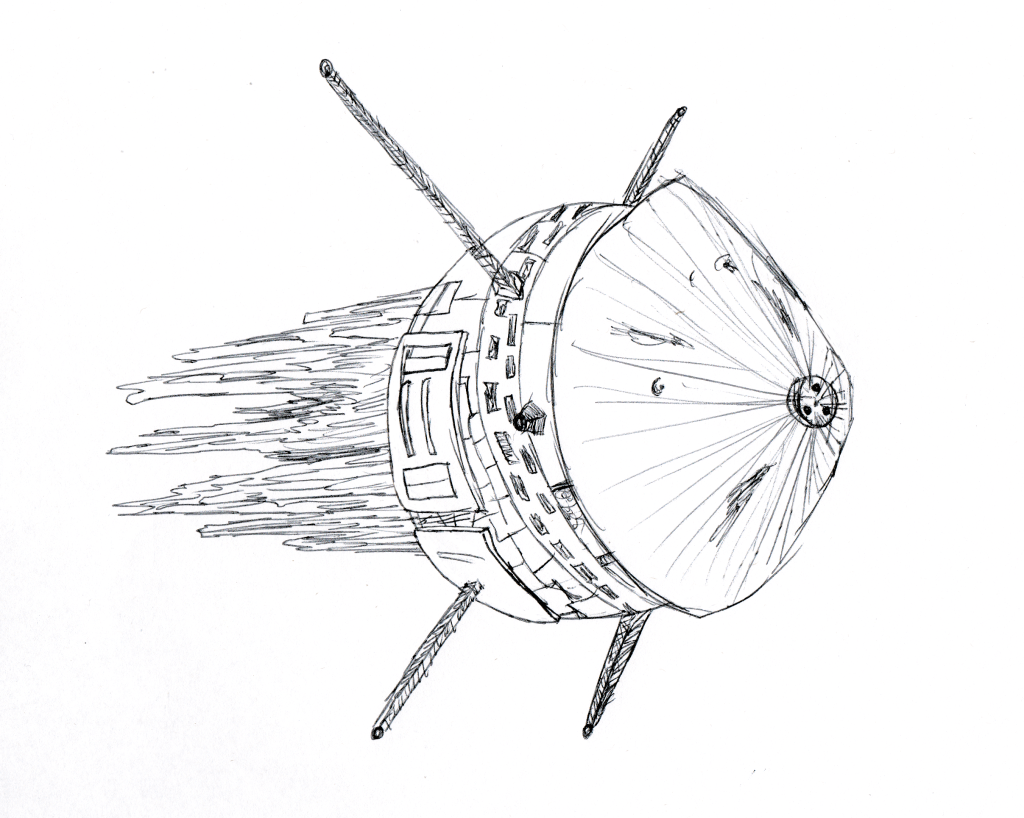
As a result, I’m including in here a sketch I’ve made of the Craton to help you visualize the ship better!

My sketching skills are not fantastic, but it gets the point across.

The Craton is a unique ship, the first of her kind in the Sapient Union. Originally an ancient asteroid of a very rare type, she was the first cratonic ship.

With the central asteroid being approximately one kilometer in diameter, the Craton is large enough to be considered a city-ship, and houses not just a sizable crew and their families, but thousands of civilians who live their lives aboard. This collection of beings are not beholden to any single star system and travel through the void, serving the greater needs of the Sapient Union – but also having a large say in their own destinies.

The cratonic asteroids that she was built from are believed to be some of the earliest solid objects to have formed in the universe, and display unusual properties. While dating is difficult, they seem to have come from a time before matter such as silicates, iron, and nickel could have formed.

While composed largely of these common elements, they also contain a quantity of material that is unknown; a greenish rock that is extraordinarily resilient. Equally bizarre, it is more massive than its constituent components suggest it should be; while not currently provable, this suggests that the unknown material (dubbed cratonite) extends into higher dimensional space – possibly even into zerospace itself.

Whatever the reasons, cratonite is a form of so-called tenkionic matter – the term for matter that is believed to contain particles from zerospace. This quality makes cratonic ships much more easily capable of zerospace jumps.

Due to her toughness, cratonic rock is also a superb form of armor; so much so that the Craton retains, in many places, up to 50 meters of the rock. This enables it to withstand impacts from meteoroids and some weapons far better than most other comparably-sized ships.

Despite this, it has been deemed unwise for the Craton to suffer a continual loss of her cratonic rock through micro-meteor impacts while travelling through space. Thus the ship has a large, metal frontal cone that gives her extra defense in her main direction of travel.

All together, the Craton is a hard ship to kill.

Internally, the Craton possesses seven fusion reactors. While a single reactor would be more efficient, having multiples allows for more precise control of energy production and backups against engineering problems or damage.

Trailing ‘behind’ the Craton (she can technically move in any direction, but does have a preferred direction of travel), a number of metal vanes serve to help dissipate heat from the ship as well as aid in long-range communications and scanning.

The Craton‘s zerodrive allows her to move in realspace as well as zerospace. In the latter case, the drive gathers ambient krahteons – a force-carrier pseudo-particle from zerospace. When gathered in sufficient quantities, this matter begins a chain reaction that tears a rift in realspace, allowing entry into another reality.

Zerospace exerts a gravitational attraction that pulls the ship in. Once in zerospace, the gravitational pull of the dimension equalizes across the ship and it will increase in velocity continually, even past c, due to differing spatial laws in the dimension. Normal matter in zerospace typically suffers a ‘matter failure’ event and ceases to exist as we understand it. However, through a powerful external magnetic field, this disaster can be staved off – a major reason for ships having so many redundant fusion generators.

The same zerodrive effect can be used to move the ship in realspace by not fully opening the zerospace aperture. A ‘thinning’ of realspace still occurs, and the gravity of zerospace pulls the ship towards the opening. This can occur rapidly enough to create a smooth sensation of forward travel.

In this way, the Craton escapes the tyranny of physics as we know them, and is able to move without applying Newton’s third law.

While the Craton is not a warship, there are dangers in space that require the ability to defend and attack.

Along points of the hull, the Craton has long towers tipped with powerful lasers. These are standard among many spacecraft, however, and their main purpose is not combat, but defense against meteoroids larger than sand grains. These can, of course, also be used offensively or to ward off enemy missiles.

In the vein of defenses, the Craton is also equipped with multiple clusters of projectors, capable of launching long-range guided missiles. She also possesses numerous machine-gun emplacements to help defend against enemy missiles.

The primary armament of the Craton, however, are three massive magnetic accelerators that run nearly the length of the ship. Capable of slinging an object as large as a bus, they can be precisely controlled to launch shuttles at safe speeds – or tungsten slugs at a fraction of the speed of light.

The Craton also possesses thousands of drones that can serve an offensive or defensive purpose – though largely they serve as the eyes and ears of the ship at longer ranges, as well as low-value tools for inspecting dangerous spaces.

Internally, the Craton is designed to efficiently use its vast volume, allowing maximum space for the amenities that a city must have for its occupants. Along the equatorial axis of the ship, restaurants, shops, and cultural businesses exist for the civilians and crew to enjoy, and on other decks there are also pools, gardens, and even small courts for sports.

These gardens are vital not just to the mental well-being of the crew, but to their food security, as many are efficient vertical hydroponic gardens that produce much of what is eaten on the ship.

Modified specifically to increase flavor and to function well in the environment of a spaceship, these foods include grains like wheat, oats, and rices as well as vegetables and certain fruits.

There are no meat animals on the Craton, but meat is produced artificially in growing vats, indistinguishable from “real” meat down to a molecular level – and according to many, indistinguishable in taste and texture. Of course, some connoisseurs feel otherwise.

The Craton was built at an Earth-controlled shipyard, the original cratonic asteroid having been found by a human exploratory team. All species are welcome aboard the ship, but as with many ships in the SU, keeping largely to one species substantially eases the burden of supply. Not all species prefer the same environmental conditions, most cannot eat each other’s foods safely, or necessarily breathe each other’s atmospheres safely for long-term. Exceptions do exist, however.

Along with the civilian population, a civilian government exists to represent the needs of that population.

At each port stop or even upon meeting another ship, it is not unusual for transfers of civilians to take place, though there are also many who prefer to permanently call the Craton their home. Many officers are in fact natives to the ship, though they must learn at a sanctioned academy before they can become an enlisted officer.

The command staff of the Craton are:
Captain-Mayor Ian Brooks, human male from Earth, Commanding Officer

Executive Commander Zachariah Urle, transhuman male, Executive Officer

Commander Cutter, Bicet (Beetle-Slug), Chief of Engineering

Commander Cenz, Coral, Science Chief Officer

Commander Y, Ehni AI, Chief Medical Officer

Commander Jaya Yaepanaya, human female, Chief of Operations

Commander Kai Yong Fan, human female, Chief of Response

Commander Ham Sulp, spacer human male, Chief of Resources

Commander Zeela Cann, human female, Chief of Administration

Commander Ji-min Bin, human female, Chief of Navigation

Commander Shomari Eboh, human male, Chief of Communications

Commander Rachel Zhu, human female, Chief Flight Officer


I hope you enjoyed! I’m aiming to put out more soon!

Episode 2 Launch Date

Episode 2 of Other-Terrestrial will launch on Monday the 21st of this month. I would have liked to start sooner, but I want to make sure it is edited to my satisfaction before publishing. The story IS complete, I’m very pleased with it, but it’s also longer, so there’s a bit more work involved.

Episode 3 is also under way!

This week will not be empty of posts or content, however! I have some cool background information about the story and setting planned for this week!

Captain – an Update!

Current plan is for Episode 2 of Other-Terrestrial to begin release this coming Monday! It is still in the final process of editing, and if there is any change then I will post another update.

In the meantime, feel free to leave some comments about what you thought of episode 1 – Leviathan!

Episode 1 – Epilogue

Today, the Epilogue to Episode 1 – Leviathan. Much longer than a normal post – and we’ll be bringing more info soon on the next episode of Other-Terrestrial!


“How do you feel, Captain?”

Brooks kept his face calm as he answered.  “I feel fine,” he replied.

Dr. Logus looked back at him for a few moments, his expression even, before taking a note.

Brooks kept his cool; he had a feeling that Logus was wanting to see his reaction.

“It seems your crew are largely feeling the same way,” the psychiatrist said.  “Among them, there are only one hundred and sixteen who seem to have been upset enough by recent events to be taken off active duty for a rest.  And among those, we expect all to be able to return to duty within two weeks.”

Upset, Brooks thought.  What a word to describe what they had been through.

The Craton was not the first ship to enter the Reality Break Shadow of a Leviathan and emerge in one piece.  Granted – a few ships had done it, and most of those had suffered far worse.

But it was the first time that a Cratonic ship had done so.  There had been thought that the nature of the ships might provide some protection, and Brooks felt like that had been a factor in their survival.

“Though,” Logus added, “over 2,000 civilians have elected to transfer off the Craton in the wake of recent events.”

Brooks couldn’t blame them, and he felt like he had failed them.  The Craton was not just a ship, but a city.  Yet he did feel that his course of action had been correct.

It was testament to the scale of human civilization, he thought.  As soon as the Craton had been brought back, a veritable army of thousands of very high-level psychiatrists and counselors had interviewed the entirety of those who had been on the ship – in only two weeks.

And now one out of every ten civilians was leaving.  Friends leaving friends, even some people leaving family behind.

Something he would have to live with.

“I understand their choice,” he told Logus.  “And I wish them the best.”

“You feel no antipathy towards those leaving?” the psychiatrist asked.

“Why would I?” Brooks asked, his voice having a hint of challenge.

“Perhaps you believe your actions are justified and theirs are out of line,” Logus suggested.  “Or that they are abandoning you.”

“I don’t feel either way, doctor,” Brooks replied.  “If anything, I fully understand their decision.  I did my job – and the admiralty have agreed with my actions.  As did the Civilian Board.”

“With dissension,” Logus noted.

Brooks hesitated.  “Doctor, do you question my decision?”

The other man shook his head.  “It is not my place.  But it is my place to make sure you truly feel comfortable with all that happened, that you are ready to once again be in command.”

“This is not the first such situation I’ve been in,” Brooks noted dryly.

“Exactly.  You say it as if that’s a strength, but humans don’t necessarily work that way, Captain.  Trauma can remain unhealed just under the surface, and fresh trauma can make those old wounds rise.”

“Do you consider me to be unhealed?”

The doctor studied him, and for a moment his face had an emotion flicker across it.  It was subtle, but Brooks caught it.

Yes, he knew.  The psychiatrist did not consider him fit to return to duty – but he could not prove his concern.

Which was just as good to Brooks as his approval – so long as he returned to duty, he was happy, no matter what people believed privately.

All that mattered to him was what those on his ship felt about him.

“Doctor,” he said.  “Have you ever encountered a Leviathan?”

“That is not relevant, Captain-“

“I know for a fact that you haven’t.”

Logus made no attempt to hide the surprise on his face.  “Have you been looking at my files, Captain?”

“No,” Brooks said with a laugh.  “But you have a look I’ve seen before when you speak of them.  You think of them in clinical terms – an ‘event’ or ‘phenomenon’.  It’s nothing like that.”

Brooks wondered if this was unwise to say, but he kept on anyway.

“I do not mean this as an insult, Doctor, and I hope you never encounter one.  But for those who do encounter them, you understand your mettle afterwards.  No one can truly withstand them, doctor, but if we survive we can cope.  And if you can cope with them after the first time, you understand; you can cope with them again, so long as you are able to walk away.”

The doctor said nothing, and made a note.  But Brooks knew he was right.  Both in private conversations and backed up by statistics; among those who survived encounters with Leviathans, they either broke or they didn’t; those who didn’t had an extraordinarily high success rate in further encounters.

“Captain, I know what you are saying, but those studies are based on woefully small groupings.  So few people have encountered Leviathans, and among those, only a tiny fraction have encountered them twice.”

And Brooks knew that he was alone, in having encountered a Leviathan more than twice.

“Are we finished now, doctor?” he asked.

The psychiatrist frowned.  “Almost.  I’d like to ask you again about the events on the bridge.  You’ve stated that Ambassador Kell was vital in allowing you to fire the Craton‘s weapons.”

“It’s all a matter of record,” Brooks said dismissively.  “Refer back to those debriefings.”

“What I want to ask, Captain, is – do you believe that the Ambassador is fit to return to duty?”

That surprised Brooks.  It must have showed, as he saw the psychiatrist raise one eyebrow.

“I have seen no reason to believe otherwise,” Brooks said.  “But that is ultimately up to you.”

The doctor made another note.

“Thank you for your time, Captain.”

Brooks stood.  He wanted to demand to know the man’s results, though he knew there was no good reason to deny his return to duty.

But let the doctor play his games.  Turning, Brooks walked to the door.

It was made of a dark wood – a silly luxury item in Brooks’s opinion.  Better a door be made of something more solid that could withstand decompression.

He hesitated before it opened.  His shadow cast on the wood made it look almost black.

And in that darkness, he still felt he could see the outline of the eye of the Leviathan.

Shaking his head, he opened the door and went out.


“I imagine you must be very relieved, Pirra, now that you know all your tests came back negative,” Dr. Logus commented.

Pirra gave the psychiatrist her best imitation of a human smile.

“I’m very relieved,” she agreed.  “I didn’t feel any different, I didn’t see any changes.  But one is always worried after a brush with something like that.”

“Have you had any issues regarding what you saw?  Nightmares – flashbacks – that sort of thing?” Logus asked.

“No,” she said.

“Sometimes trauma can be repressed,” the doctor noted.

“I don’t think that’s as common in my kind as in yours,” she replied.

While she appreciated that he was trying to help her, she wasn’t one of his species.  She didn’t have the same reactions to things.

Yes, it had been horrible, what she had seen.  But the . . . changes to the ship itself were just a blur in her memory now.  Awful at the time, horrifying, but not leaving a lasting trauma in her mind.  She had seen a lot of awful things, and she’d learned to cope.

The Hev, that was a different matter.  In her mind at the time – and what she’d told the other Hev – they had killed themselves to escape their fates.  It was a terrible thought, but probably the best of the possibilities.

The fact that one of them had tried to shoot her implied that maybe their deaths hadn’t been so voluntary.

Given that the people on the Craton had noted feelings of paranoia, she was starting to wonder if perhaps they had simply turned on one another.

Their lives ending in an orgy of murder was much worse to think on.

But she could still cope with it.  In space, things happened.  People went mad sometimes.  They sometimes did insane things.  It happened to any species.

The psychiatrist was studying her, and she carefully hid her annoyance.  She knew the man had lots of AIs to assist him, and had probably even studied her people’s psychology to some extent, but he was still human and she wasn’t.  For him to judge her ability to return to duty irked her.

“You still seem anxious,” Logus said.

She wasn’t anxious, she was annoyed.

“I’m not feeling anxious,” she replied.

The man’s face didn’t change – or if it did, it was a subtle enough human expression that she didn’t catch it.

Suddenly she felt tired of the game; tired of living among another species with totally alien expressions and body language, who couldn’t read her in the slightest.  Having to painstakingly anaylze every movement on their weirdly-expressive faces was exhausting, and she just wanted to rest.  She just didn’t want to have to think through every goddamn rescue situation anymore-

Sitting up sharply, she realized he was right.

She was anxious; she was scared.  Her annoyance and tiredness were directly connected to that.  She had recognized it in herself before.

The man was still looking at her, and she felt both chagrined and annoyed that he had seen through her so well.

Yet he didn’t seem judgmental; nothing about him seemed smug.  He didn’t push her to the point where she felt like she was losing face, and that helped a lot.

“Perhaps I am still, a little,” she sang.

“The last two weeks haven’t exactly been a rest,” the doctor commented.  “It was inactivity – but not rest.”

She searched him for any condescension, but found none in his tone or face.

He was right; she’d been undergoing tests for ten days straight, staying in isolation.  She had borne it well, but now that she was cleared . . . well, it was catching up with her.

“Perhaps I’ll take a day of leave,” she said.

“I was thinking perhaps ten days,” the doctor countered.

“I can’t go that long off-duty!” she burst out.

“The Craton‘s engines will be undergoing repair for at least that long,” Logus pointed out.

“Yes, but I want at least a few days back on before the ship leaves port.  To get back into the flow of things.  I know you’re trying to care for me – but it’s my job to care for others in an emergency.  That time could matter towards keeping me ready to do that job.”

The doctor nodded.  “I understand.  Perhaps a week, then?  Three days should be more than sufficient time to get back into stride, I imagine.”

She still didn’t like it, but nodded.  “All right.  One week.”

The man nodded and made a note.

She felt like she had just been led by the feathers to this, but she still didn’t see any duplicity in him – at least as far as she could tell.  And though it was effort on her part, she had become fairly good at reading humans.

Dr. Logus dismissed her, and as she left she saw both Alexander and Iago waiting.  Her commander rose and smiled.

“Are you all cleared?” he asked.

“At least to be out among others again,” she replied.  “But Logus thinks I need a week off.”

“That’s great,” Alexander said.  “Perhaps we can finally go do some of those things we’ve always talked about.”

“That would be nice,” she agreed.

Caraval stepped back.  “Well, I’m just glad to have my second-in-command back.  Have a good vacation, Pirra – I’ll see you back in a week.”


Dr. Logus smiled lightly at the man before him, but he was somewhat unsure what to say.

“How do you feel?” he asked.

Boniface Tred opened his mouth to reply, then shut it.  He looked away, then back, and repeated the process.  On his second attempt he spoke.

“I feel itchy,” he said.

“That . . . can be a side-effect of the deep-neural test that you requested,” Logus noted.

“Are you sure it’s not a serious sign?  Like maybe my nerves were damaged?”

Logus smiled reassuringly.  “We do monitor for that quite carefully, I promise.  I have had such tests before – the itching can be annoying, but it will quickly fade.”

The doctor wasn’t sure what to make of Tred’s request.  The man had a very long file – he had had many visits to neurologists and psychiatrists over his life.

There was nothing wrong with that.  The man had a nervous temperament, and Logus felt that without help he would be on a very low level of functionality, and quite unhappy.

“Why did you request another session?” Logus asked.  He hoped he did not sound judgmental in the man’s ears; he wasn’t, but he legitimately wasn’t sure what Tred hoped for.

“I . . .  Well, I wanted to hear more about my results from a doctor and also to . . .”  The man trailed off.  “I’m just so freaked out, doctor.”

Logus listened carefully.  “Your results are very normal for a man your age and health.  I do not feel you have much reason to be concerned.”

The man nodded, but still looked miserable.

“What else is bothering you, Tred?” he asked gently.

The man was quiet a long moment, staring down at his shoes, before looking up and answering.  “I was terrified when I thought that the Leviathan was going to destroy the Craton.  And I wasn’t even on it, doctor.  I still can’t get over it.  It’s not fair – it’s not brave of me.  I . . . I always knew that they existed.  I grew up on that ship – but it wasn’t that I was just scared of losing my home.  I guess I just . . . never internalized the reality.”

The man went silent, but just as Logus was about to talk, Tred spoke again.

“That ship is supposed to be near invincible.  She could take dozens of hits from capital railguns and as long as one reactor was going she could keep fighting.  I’ve thought about that a lot – in my head I guess I was always one of those lucky few who didn’t get holed or sucked into the black.  But the Leviathan?  A couple of minutes more and she just straight up would have stopped existing.”

Logus listened patiently, observing the man.  He saw true fear and misery in him.  Every biometric backed it up.

“Tred,” he finally said.  “You are a very talented man in your field.  You could do great good at any one of a thousand facilities in the outreaches of a system or station.  If you are so concerned, have you ever considered leaving the Craton?”

Shock went across Tred’s face.  His vitals jumped as if he’d been injured.

“Oh no,” he said.  “I can’t leave the ship!”

“Why not?” Logus asked.

“Because she’s my home,” Tred replied.


The silence had grown to a level that even Logus found uncomfortable.

He’d spent a lot of time sitting in silence with people who thought being non-communicative was their best course, and he was a patient man.  He had almost always won that game.

But staring at Kell, he knew immediately that he wasn’t going to win this staring contest.

The being did not blink.  He had not blinked once.  Studying records, Logus had seen that Kell could blink, had done it regularly, at other times.  But he wasn’t now, and Logus had a feeling it was intentional.  The being knew he would notice that, and it wanted him uncomfortable.

“I cannot force you to talk to me, Kell,” he began.

“That is correct,” the ambassador interjected.

“. . . but it would make this faster and easier for both of us if you did.  And to be sure, you could wait longer than my life without issue – I imagine – but I think you’d also prefer to be somewhere else sooner than that.”

“What is this about?” Kell demanded.  “I was told it was important.”

“Do you know what I do?” Logus asked.

“Something that has no bearing on me,” Kell said.  “I do not care for the details.”

“That’s fair.  It must all seem very silly to you.”

Kell’s eyes narrowed.  He did not need to say to the doctor that he would not be patronized.

Regardless of how Logus meant it, he knew he needed a different tact.

“How do you feel?” he asked, trying the direct approach.

“I am no different than at any other time.”

“You don’t feel any different after your contact with the Leviathan?”

“Why would I?” Kell asked.  It seemed a genuine question.

“It was a very profound and disturbing occurrence,” Logus pointed out.

“For humans.  I understand that.  But for me it was not.”

“There are no recordings of what happened, but from what others saw, you were very resilient against the Reality Break Shadow – but it did affect you.”

“Not how it affected the rest,” Kell replied.

“Oh?” Logus asked.  “How was it different?”

Kell’s head cocked to the side like a dog.  “Even if I could impart this to you, why?  You are not concerned with my ‘mental health’, so much as trying to learn more about my kind.”

It stung Logus a bit; there was truth in that.  “I am concerned with your health, Kell.  But yes, I do also both want and need to learn more in order to do that better.  Curiosity is a very human trait.”

“It is also one that frequently gets humans killed,” Kell noted.

“I don’t think that was a threat, but I’d like to hear you say it wasn’t,” Logus said.  He really felt certain that it wasn’t, but at the same time he suddenly felt a thread of fear in his gut.  He was prodding something that could kill him in a heartbeat.

“It was not a threat,” Kell replied.  Somehow it did not seem a retreat from him, but a gift given condescendingly by a superior.

Logus wondered; could he do anything but lay it all out at this point?

“The Admiralty – who control these things – just want to be sure that you are going to be all right after your experience.  You have to understand why; regardless of species, nearly all beings display strong reactions to serious, life-threatening events.  These can show themselves in subtly and sometimes dangerous ways.  We have no experience with a being your age – or strength – before, and that makes us all the more concerned.  We all just want to know you are okay to carry on.”

He took a deep breath.  “And on top of it all, Kell, we don’t simply care about it for our sakes.  We do care about your health for your sake.  So all I can do at this point is ask you; will you indulge me?”

Kell’s face never changed.  “I feel fine,” he said.

The Ambassador stood up.  “I now invoke Article 72, sub-section 13 of the Treaty of Tor.  I return myself to active duty.”

Logus’s heads-up display helpfully brought up the relevant part of the treaty;

Ambassadors and Staff of the Shoggoth People shall retain the power to determine their ability to perform their duties, barring intervention from Earth Congress or the objection of no less than ten Shoggoths.

“I see,” Dr. Logus said.  “I still, of course, will maintain my own notes regarding your fitness for duty.”

Kell was already walking out of the room.


“Sometimes I wonder why I was stupid enough to enter into the field of General Sapient Psychology,” Arn Logus said, staring at the ceiling.

The lights dimmed obligingly, to the point where they didn’t sting his eyes.  Most ceiling lights didn’t do that; it must have been Doctor Y’s own settings in his office – purely for the comfort of biological beings like himself.

“I understand that you are simply venting your frustrations and it is not a genuine statement,” the AI replied.  “But I also understand that this is part of your own recuperation.  Therefore I will reply that you do not mean that, and that you have done much good in your life.”

Logus turned his head to look at the machine.  It sat on the other side of its desk, as any doctor might when doing paperwork.  It was sitting in a way to give him just the right amount of polite attention, its form humanoid if exaggerated in some respects.

But Logus knew from experience that the AI was sitting there simply to look like a doctor; all of its paperwork had been filled out even while it attended its other duties.  Its intelligence was such that, barring an emergency, it was usually multi-tasking on dozens of activities at once.

On some level it bothered Arn that the robotic body he beheld was not the true Dr. Y.  It was only a shell, a puppet, that it controlled.  It was safely backed up in other memory cores, both here and probably a billion others back in the home territories of its digital kind.

But really, with a digital being, who was to say what was truly the thing?  At that point one began to get into the philosophy of what is life? and he really wasn’t in the mood for that.

“Thank you,” Logus said, a little more grumpily than he intended.  “I hope that doesn’t mean that saying I’ve done good is simply to make me feel better.”

He wasn’t truly concerned, and he had the feeling that the AI doctor had been perfectly aware of the potential implication.

“Not at all, not at all,” Y replied.  “Tell me, do you feel any different after prolonged contact with the Ambassador?”

“No?  Other than frustrated.  If I had to deal with patients like that all the time, I think I’d quit,” Logus said.

“Your biometrics say the same.  In fact, all beings who encounter the Ambassador seem to show no long-term consequences.  Only a short-term increase in adrenal function, heart rate, and other basal stress-relief signs.”

“Didn’t the Advisory Council on Interspecies Relations already determine there was no significant risk from contact with its kind?” Logus asked, curious despite himself.

“Yes, they did.  However, I feel that it cannot hurt to keep track.”

“I suppose not, since you see the data anyway.  But why are you so curious?”

“I have simply wondered,” Y explained, “if there is some similarity between the Ambassador’s kind and beings such as Leviathans – to what extent?  And why is it that there is no Reality Break Shadow around them?”

“Perhaps a matter of scale.  Like gravity,” Logus suggested.  “It exists, but so small it’s imperceptible.”

Now that it had been brought up, it bothered Logus a little, though.

He pondered that, but Y spoke again.  “It is most instructive watching the logs of your sessions, I must add.  You handle even alien psychologies surprisingly well.  That is no small feat for a being – and yes, this includes my kind.  Making accurate models and statistical probabilities of so many varied beings is difficult even for us.”

“Thank you, doctor.  If that’s true, though, why do I have this headache?”

Y hesitated.  “I could explain the biometric causes, but you know these.  It is a stress headache.”

“And it was also a rhetorical question.”

“I prefer to answer those as if they are serious questions,” Y noted.  “Organic beings expect me to be overly-logical and miss jokes.”

“Wait, wait,” Logus said.  “Are you saying you play a bit more . . . robotic because you think we expect that?”

Dr. Y steepled his mechanical fingers and leaned forward over his desk.  “And how does it make you feel to know that?” he asked.

Logus started laughing.  “This is why I like to visit you when you’re in port, Y.  You are very good at making me laugh.”

“I try,” Y added.  “On a more serious note, I am somewhat concerned for our captain.  He does not seem to like you as much as I do.”

“That is putting it mildly.  But I am concerned as well.  He is a good man, with a great record.  I can’t justify keeping him off active duty, but I feel he is bottling up too much.”

“This may be true, though I believe some humans have done this and been successful with it, in a professional sense.”

Logus grimaced.  “We care about his health beyond that, though.”

“Yes.  It is why I have placed a formal request for your reassignment to this ship,” Y noted.

“Wait, what?  You want me assigned to the Craton?”

“Don’t act so surprised, Dr. Logus.  I am certain you have already placed a request for this exact transfer – and while our captain might stop you, if I also request it, then the odds of him attempting to stop it – and his odds of being successful if tries – drop precipitously.”

Logus shook his head.  “You didn’t break into my personal records to learn that, did you?”

“No.  I simply know you, Doctor.  It’s what I thought you would do.”  Y’s metal head angled slightly.  “Because it is where you feel you could do the most good.”

A smile crossed Logus’s face.  “Well, then – thank you, Doctor.”

“You are welcome.  And welcome to the Craton, Dr. Logus.  I predict you will experience many more headaches while you are here.”

Logus grimaced again.  “I think you’re right about that.”


FINIS

< Part 25 | Episode 2 – Part 1 >

Episode 1 – Leviathan, Part 25


Captain Brooks.

Wake up, Captain.

He felt a voice, but did not hear it.  Somewhere in his mind, he knew that the stimulus was important, that he should react.  But his mind did not want to; he wanted to rest, to simply float in the soft feeling that surrounded him.

Sleep, his mind realized.  It was sleep, and he was aware of it, aware of his own state of resting.

But his own thinking on this was stirring him to wakefulness.  Or maybe it was the voice?  It was still calling his name, trying to bring him out of his own mind.

“Captain Brooks, are you all right?”

His eyes opened, and the pain flooded in.  His eyes hurt, his head pounded like a grand drum, and nausea rose in him like a tidal wave.

With all his strength he fought it down, and when he felt he could control himself, he opened his eyes.

Iago Caraval was looking at him, scanning over him carefully.

“Captain Brooks, how are you feeling?”

“Not the best I’ve ever felt,” he admitted.  “But I’m fine.”

“All right, sir.  All the same, we’re going to take you to the medbay.”

Caraval clearly wouldn’t accept no for an answer, but Brooks decided he would go on his own terms.

“I’ll walk,” he said.  Despite Caraval’s protests, he heaved himself to his feet.  His knees were weak, but he focused on them, trying to force them to remain steady.

After some moments he succeeded.  Taking a tremulous step, he felt his strength returning.

Around them, he saw Medical and Response teams rushing about.  Half the bridge was filled with them, and many of his officers were sitting, confused, while officers he did not know were filling their seats.

“Who are these people?” Brooks asked.

“Your message to Earth was answered, Captain.  Admiral Vandoss brought fifteen ships to aid us.  He sends his regards, sir.”

“And the Leviathan?”

Caraval shrugged.  “As soon as you destroyed the section of the Hev ship it had altered, it disappeared.”

So he had fired.  He had done his duty – with Kell’s help.

“We’re not sure if the Leviathan fled following the explosion in zerospace or if it was destroyed,” Caraval continued.

Brooks could not imagine that their single shot had destroyed the thing.  It seemed impossible.

“How are the crew?” he asked.

“The crew seem fine.  I’d say you’re the most affected, Captain – but there’s plenty of time to talk about these things, we have to get you checked out.”

Brooks dodged Caraval’s hand going for his arm, but began to move – slowly – towards the medbay near the bridge.

“And the ship?  All of the escape craft?”

“Ship seems fine – no sign of alteration.  All escape craft recovered – actually, Captain, we have one more person aboard than before.”  He smiled, though even with the boundless energy Brooks knew the Lieutenant Commander had, it looked forced and tired.

“I’ll have to find out what that means later,” Brooks said.  “You need rest, too.”

He took another look around the bridge, and located the entire Response team they had sent over to the Hev vessel.  They all looked tired.

Two Hev were even here; a large one in an ornate uniform, and a smaller one, half Brooks own height, who looked calmer and chubbier than most Hev he had met.

“Have your team stand down and get some rest after this.  You included.”

“Of course, Captain,” Caraval replied, unconvincingly.

But Brooks felt like he was plodding; as much as he had pushed himself to maintain the dignity of his station, he did not know if he could keep it up much longer.

With Caraval hovering nearby to steady him if need be, Brooks left the bridge, making his way to the medbay.

Others were filing in and out, but they gave him a wide berth, eyeing him with looks that ranged from fright to a deep respect.  They could see what it took for him to walk, and yet he did it anyway.

Entering the medbay, he sat down heavily on the nearest table, and a medical officer started towards them.

Picking up a mirror next to the bed, Brooks saw what a mess he was.  Drying blood streaked down his face from his eyes, from his nose – even from his ears.  No one else he had seen had had that.

“One last question, Caraval.”

“Of course, sir.”  The man was studying him carefully, judging his reaction to his own reflection.

Brooks kept his face stoic.  “Where is Ambassador Kell?” he asked.

The question was clearly not what the man had expected.  “Ah, I’m not sure, sir.  He was the only one conscious when we came aboard.  But since then I don’t know where he’s gone.”

“Thank you, Commander.  Please take care of your team – and once again, good work.”

The man saluted him and left, while the doctor came over to Brooks.

“Sir, we’re going to do a full medical scan.  Do you have any particular concerns?”

Brooks slowly lay back on the bed.  His eyes drifted closed, and though he did not pass out, he felt drained of all strength.  Barely able to lift his head.

He still felt watched.  When he closed his eyes, he could still see an after-image of the eye of the Leviathan.

He doubted that it would ever truly leave his vision.

“No,” he lied to the Doctor.  “Aside from tired, I feel fine.”

*******

Extensive surveys by ships from Sol Command failed to turn up any further sign of the Leviathan.  While probes and scouts with carefully-attuned sensors have been distributed, there seems to be little reason to believe it has remained in this sector of space.

Those members of the Craton‘s crew who were exposed to its Reality Break Shadow have been temporarily relieved of duty, following psychological evaluation.

Unfortunately, this includes me.

Sol Command is considering this a victory.  They largely credit the actions of the Craton and myself with averting a potential disaster of massive scale.  I cannot help but feel like I have only delayed our problems.

*******

A knock on the door snapped Brooks out of his reverie.  Looking towards the door, his system informed him that it was Kell.

He had been unable to reach the Ambassador since he had awoken.

Another knock came.

“Enter,” Brooks said.  The door opened, and Kell stepped in.

The Shoggoth’s face was impassive as he looked at Brooks.  For a moment Brooks met his gaze.

Kell’s eyes perfectly mimicked a human’s, and yet when he looked into them, they did not feel human.

“Have a seat,” Brooks finally said.

Kell came forward and sat down in his own stiff way.

“Drink?” Brooks asked him, pouring whiskey into a snifter and offering it to the being.

Kell took it, inspecting it carefully before knocking it all back without a change in expression.

“I wasn’t sure if you’d drink it,” Brooks said.

“It is poison, but I have consumed far worse,” Kell replied.

Brooks stared at him for several moments, wondering what was going on in his head.  “Why are you here, Ambassador?”

Kell regarded him evenly.  “From the moment I first began to speak to the Chairman on Earth, I have wondered if I was making a mistake.  Your kind are inherently unlike mine.  You live such a short time and are so blind.  I do not know how mature you can really be.  How well you will be able to live with this universe.”

Brooks listened to the insulting tirade in silence.  “Have today’s events helped you decide if it was a mistake or not?”

“No,” Kell admitted.  He rose from the seat, and put the snifter back on Brooks’s desk.

He moved towards the door, but stopped just before it, looking back at the Captain.

“But I find that I do not regret my choice.”

*******

FINIS


< Part 24 | Epilogue >