
The Sapient Union
A coalition government formed by multiple species. The primary species of the Sapient Union are (sorted by population size):
Bicet
Commonly called Beetle-Slugs, these hive-minded insectoids have a biological caste system and are among the oldest of known space-faring species. Their small size, precise manipulation ability, and strong work ethic make them pre-eminent engineers, though they move somewhat slowly and are not physically very strong.
The Bicet are, by far, the most numerous species in the Sapient Union.
Sepht
Commonly called Squids or Parthenogenes, these aliens move on a tripod of strong tentacles, possessing cup-like hands at the end of arm-like upper limbs, and heads of moving tentacles. In war, they are generally viewed as somewhat defensive species, and they have been relatively slow in expanding through space, preferring to thoroughly exploit a system before attempting to move on to a new one. Their populations, though, can grow quickly, as most of their species are female and are capable of bearing twin children every few years with no functional menopause, in the case of having no males around – by producing functional clones.
There are three sub-species of Sepht; the smaller and colorful Vem em, the large and powerful Nolem and the transparent and ghostly Pelan.
Dessei
Commonly called Moth Owls, these humanoid aliens descend from gliding predators that caught fish-like prey in the ocean. Their regal bearing, bright plumage, and explosive bursts of violence lend them a reputation for possessing a very strong martial spirit.
Some rivalry exists between the Sepht and Dessei.
Qlerning
A very neutral gray humanoid species with no other nickname, the Qlerning are a contemplative and reasonable species. Few have strong issues with them, and aside from the arts they do not stand out strongly as a species.
Humans
Only joining the Sapient Union fifty years prior to the start of the story, humanity is largely united and classless by the 30th century. Having settled thousands of worlds, they still are far behind the other primary species in terms of numbers, but are viewed generally positively by the others.
Other member alien species, important but not as numerous, include:
Corals/Polyps
A colonial species from a watery world, groups of them inhabit a rocky shell connected by strong special unintelligent muscle polyps. They are capable of swapping out their members to see other points of view better, causing them to be a very peaceful species.
Ehni
A species of artificial intelligences, the Ehni are the most technologically advanced species in the Union, and the most intelligent. Though their true numbers are not known, very few Ehni choose to leave their society and go into others.
The Ehni are not hostile to life; if anything, they believe that it is a transitory phenomena that poses little risk to them, and should be observed while it exists.

Abmon
Commonly called Rock Pillars, they are a stocky, rocky like species from a high-g world. They look somewhat akin to barnacles with rows of tentacles around the mouth on their top. They are slow, despite possessing five legs, but very strong. They are rather few in number compared to other species.

Star Angels
Beings of plasma that live in the corona of the star Yia. They are an intelligent but non-technological species that communicates via radio waves and enjoy the conditions inside of fusion reactors. Only recent members, they have not yet colonized any external star systems.
Shoggoths
Not much is known of this mysterious species from Earth, who only recently revealed themselves to humanity and by extension the other species of the Sapient Union. They are able to change their shape to look like others and claim to live extremely long lives. Their true numbers are small, but believed to be in the thousands rather than million.
There is a strange connection between them and the beings known as Leviathans . . .
The member species of the Sapient Union share information and believe in collective defense with open economic borders. Originally founded by the Bicet, Sepht, and Dessei, other species have joined over time, allowing mutual prosperity.
Matters pertaining to a single species are viewed as internal matters and other species generally avoid getting involved.
Collaboration happens very freely between the member species, biology allowing – the largest barrier to ships with large populations of multiple species tends to be that each is comfortable in slightly differing conditions (Sepht, for example, prefer a much higher humidity than other species and their skin secretions are irritating to human skin; Bicet prefer smaller spaces than humans fit into, as examples).
Humanity were first contacted by the Bicet in 2903 and joined the Union only a few years after.
All members of the Sapient Union agree to collective ownership to the means of production. They therefore have a classless communist society, where people are paid in Exchange Units, non-transferrable tokens that represent their labor. While conditions have advanced that everyone can be guaranteed the basic needs of life without working (food, water, air, shelter, medical care), few choose to live at such a level without working. The efficiency of their system means that one need only work a few hours a week in order to afford other items they may desire, and most people don’t have many useless goods sitting around their home. Consumerism simply does not exist when most common things can be easily 3D printed at home in a short time or borrowed from a well-maintained local lending library or community center.
Other Governments and Factions
Aeena/Fesha
An extremely xenophobic species, the Aeena have never been seen in person by another species (as far as is known). Operating largely through their client species, the crystalline Fesha, the Aeena once warred with the Sapient Union. They view the universe as theirs and all other species as thieves; their genocidal desires have been put on hold, however, as they realize the scale of opposition.
Though no longer openly hostile, their current goals and plans are unknown.
Glorians
A violent faction of humanity that has taken control of several hundred systems, they are violently opposed to the Sapient Union. A highly militaristic government, they have warred with humanity, though the other species of the Sapient Union view it as an internal issue and refuse to get involved.
Gohhi
A multi-species territory in interstellar space, Gohhi is at a key location in known space, making it a mercantile center.
Controlled by Lord Executives, the heads of companies that are insanely wealthy, Gohhi is only loosely united and one of the last remaining bastions of private property.
All sorts of beings come to Gohhi seeking a fortune, but few ever find what they want. For many, their dream ends in poverty and a slow death.
Latarren
A mysterious species that warred briefly with the Sapient Union in 2927. Though the war was not large, the Latarren remain wary of the Union.
Hev Clans
Appearing like humanoid rodents of various sizes, some even armored, this species has spread widely across space, both known and unknown. Their external colonizations took place in three major waves, and differing waves are known as Yellow, Blue, or Red. The Yellow are generally viewed as more peaceful and settled into galactic culture, the blue are more ambitious but mainly mercantile, while the Red are the most expansionistic and violent.
Independent Systems
For every known interstellar species save the Bicet, there are systems that have elected to be independent. They may remain in relative isolation and obscurity, though others join together in coalitions of systems that seek greater political leverage through collective bargaining.
The Sapient Union does not force any errant system to join its member states, and attempts to maintain friendly political and economic relationships with these systems.
This list is by far exhaustive, and when it becomes relevant, more will be added!
Alien Life
Life is common in Other-Terrestrial, so long as you mean something like single-celled lifeforms. Our own solar system has several places with native life, though only on Earth did they grow larger than microbes.
On very few worlds have conditions been conducive towards life growing complex. Complexity is not a goal, after all, but simply something that occurs if conditions make it advantageous and allow for it to occur. It can only start if single cells find it advantageous to stick themselves together into a biomat and cooperate (a sheet of cells stuck together is what defines biological tissue). Once these start forming into a sphere (the most efficient shape for a cell mat to take if it’s not attached to a surface), cells can begin specialization and life may start to grow complex.
Yet remember that life on earth existed for billions of years before this occurred.
On even fewer worlds has life developed complex intelligence, civilization, and tool-making. Even on those worlds where this occurred, the conditions to actually escape their world were not always present, or the biology of the species may not have allowed for space travel.
Thus, while the Milky Way contains 100 thousand million stars and there are over 260,000 within a 250 light-year radius of Earth, and nearly all of these likely have multiple planets there are very few civilizations – likely less than 200 across the entire galaxy.
The majority of life encountered is carbon-based and requires water. While other biologies can occur (such as the Star Angels), carbon has the great advantage of working very well as the basic building block of life and being far more common than its next nearest competitor, silicon. Likewise, water as a solvent offers many advantages over similar liquid solvents that might work with silicon (one option being sulfuric acid!). Like carbon, hydrogen and oxygen are very common elements in the universe.
Technology

In the 30th century, technology has advanced in incredible ways.
Fusion reactors are a robust technology that produce prodigious amounts of energy with very common fuels.
Artificial intelligence systems utilizing vast networks of data can seamlessly translate languages with such nuance that most don’t even realize that others speak a different language. This works as well for exotic alien communication systems as it does for human languages.
In medical fields, nearly all ailments we know are treatable. The common usage of sensors to monitor a person, the analysis of their genetic data, advanced simulations, storage and processing ability mean that changes in a person’s body are known before they even feel them. A full understanding of each individual’s body also means treatments can be specifically tailored to the individual, all-but eliminating bad side-effects.
New methods of administering treatments like nano-technology allow pin-point treatment against cancerous cells, and the ability to reseal cut flesh means that deadly wounds and operations both can be fully repaired easily.
With senescence being pushed back to 120 years, humans can naturally live up to 150 years. After this, our own biology simply limits lifepsans, but replacement organs and limbs can allow an individual to survive an indefinite period of time; the maximum lifespan of a human that opts to go more and more transhuman as their body fails has yet to be established.
Materials technology is perhaps the unsung hero of this new age; the ability to construct materials atom-by-atom perfectly means that an engineer can simply set the parameters they wish of a material and build it to match.
Yet limitations remain; teleportation is a pipe dream, power storage has sharp limitations, waste heat is a huge hazard for a ship, and most ships require vast amounts of reaction mass to move, making every gram matter.
And nothing can go faster than light. Yet new physics allow intelligent species to circumvent this iron law . . .
Gravity Engine
For traveling through space, there is no method except for Newton’s third law; for every action there is an equal and opposite reaction. The only way to move in a vacuum is by pushing material out of your vessel. The more energetic it is, the more acceleration a ship can receive in return. This means that, while advanced fusion reactors can easily heat up that mass, there still must be mass to eject.
Until gravity engines. A unique feature of cratonic vessels as of yet, this technology allows a ship to thin the veil between our reality and the strange subspace known as zerospace.
With zerospace’s physics being in many ways different from our own, pseudo-gravity is created. Though this force is not true gravity and decays, it is able to create enough force that a massive vessel can be pulled along.
For many ships, the uneven stress of such a pull could be catastrophic; on a cratonic vessel, however, the matter of the strange asteroid it was originally made from is able even out this force, allowing the ship to move without straining its structure, and without reaction mass.
This miracle technology has even greater applications, however.
Dashgates
Even within our solar system, most vessels take months or even years to reach a destination with traditional technologies.
But in Other-Terrestrial, humanity first defeated this problem through the creation of Dashgates. These gateways used the same technology of later zerodrives to slip a ship “between” realities (at least to use layman’s parlance). Though this cannot propel a ship faster than light, it can cut travel time from the fringes of a solar system down to mere hours.
This typically requires a gate at each end, though many ships will contain a one-time use dashbreak that will pull the ship back to normal space in case of a catastrophic failure.
This technology still remains in wide use within solar systems, as faster technologies come with other drawbacks that make their use near habitable spaces far less desirable.

Zerodrives
By far the most miraculous (AKA physics-defying technology) that has been discovered is the zerodrive.
By opening a hole to a subspace realm called zerospace, a ship is able to “dive” beneath reality and circumvent the speed of light.
Zerospace behaves in an extremely unpredictable way; even the best of neo-physics attempting to study it is largely speculation. What is known allows for interstellar travel, however.
As a ship opens a zerospace portal, it is pulled forward by a force dubbed pseudo-gravity, and once it crosses the threshold this force continues, naturally increasing the ship’s speed far past the speed of light.
The reality of zerospace is not compatible with normal matter, requiring that the vessel create around itself a very powerful electromagnetic field. While the ship may be shielded from this field, its presence outside of it is required or the ship’s matter will instantly disintegrate. This electromagnetic shield is so robustly built in that most scarcely think about it, and a ship’s computer will automatically abort an attempt to jump if any errors are detected.
Zerospace possesses massive gravitational objects; some of these match up with phenomena in realspace, but others do not. Through gravitational slingshotting, a ship may move towards its target exit point. The distances it must travel in zerospace vary relative to the actual distance it seeks to cover in realspace. Thus, travelling ten light years may take two hours or two days.
Certain paths have been found and remain consistent for unknown reasons; this creates ‘highways’ in zerospace are commonly traveled and certain locations (such as Gohhi) are located at the nexus of many common routes.
When a ship wishes to leave zerospace, it opens another portal, this time allowing it to return to realspace.
The interaction of the portal with realspace allows the ship to shed huge amounts of speed, and by the time it emerges it is under the cosmic speed limit. Any remaining momentum it obtained from the zerospace travel is a “pseudo-force” and decays rapidly, meaning that within a fraction of a second of re-entry the ship is left only with the momentum it had before jumping.
A final, important caveat exists to zerospace travel; a ship may not stay ‘under’ for more than 70 hours. Due to the fact that a ship continually accelerates in zerospace, after this point it attains a velocity so high that it cannot adequately shed that speed when it comes time to leave. If a ship cannot reduce its speed to less than light speed, it cannot re-enter our reality.
One ship cannot detect another in zerospace. They have no sensor range, therefore it is impossible to actually know what happens to a vessel if it remains in zerospace for longer than 70 hours. This fact is calculated, and seems to be consistent with tests that had probes stay under longer than 70 hours.
For this reason, a ship rarely stays under for more than two days, and often takes several days before it submerges again.
Which is fine, as most ships do not even have their own zerodrives; only major governments or massive conglomerates typically are able to operate ships large enough to carry the multiple reactors necessary to power a zerodrive. Most ships require at least seven reactors, and to charge the appropriate energy may take several days.
Cratonic ships, due to their unique makeup, are able to use significantly less energy to open zerospace portals, allowing them far greater freedom in a smaller size. Nevertheless, they may still take many hours to charge for a dive.
For ships without their own zerodrives, zerogates can launch them to a destination where another gate can catch them, or a special transport vessel known as a ringship can open vast portals able to allow entire fleets to travel through zerospace. Though they are ring-shaped, vessels do not fly through their ring; this is only the most efficient shape known for opening such vast portals.
Various strange health effects are known from zerospace travel, such as the Pavlona Shivers, submersion euhporia, and given longer-term trips even psychological instability.
All windows are covered and external sensors are deactivated while in zerospace, and the computers of most ships will not let crew change these facts. Those who have managed to view zerospace despite this offer contradictory descriptions; some describe strange lights, others pure blackness. Still others offer far more fanciful stories of demons, monsters, and visions of the past. The idea that all would be black is most commonly stated by scientists, as there is no light as we know it in zerospace, thus there is no way to see anything. However, some vocal physicists say this entirely wrong and offer many mathematical explanations why.
Research into this is banned by every government; the primary reason is the high proportion of researchers in this area who become suicidal or even homicidal.
Common wisdom is simply that minds of our universe did not evolve being able to comprehend something they cannot comprehend. However rhetorical the statement is, few can argue with it.
Communication with a ship in zerospace is a very expensive thing; however, opening tiny zerospace portals to send messages to distant antenna is a well-developed technology. Certain forms of signals are still able to propagate in zerospace, and so long as the receiver opens a portal at the appropriate time (or simply opens and checks for an incoming signal once every few seconds; military starships do this), it can receive instantaneous information from across known space.
Oddly, no one seems to comment on the old idea that this could allow causality-breaking.
Weaponry and Defenses
Space combat takes place in three specific zones. In this, Other-Terrestrial obeys the laws of physics.
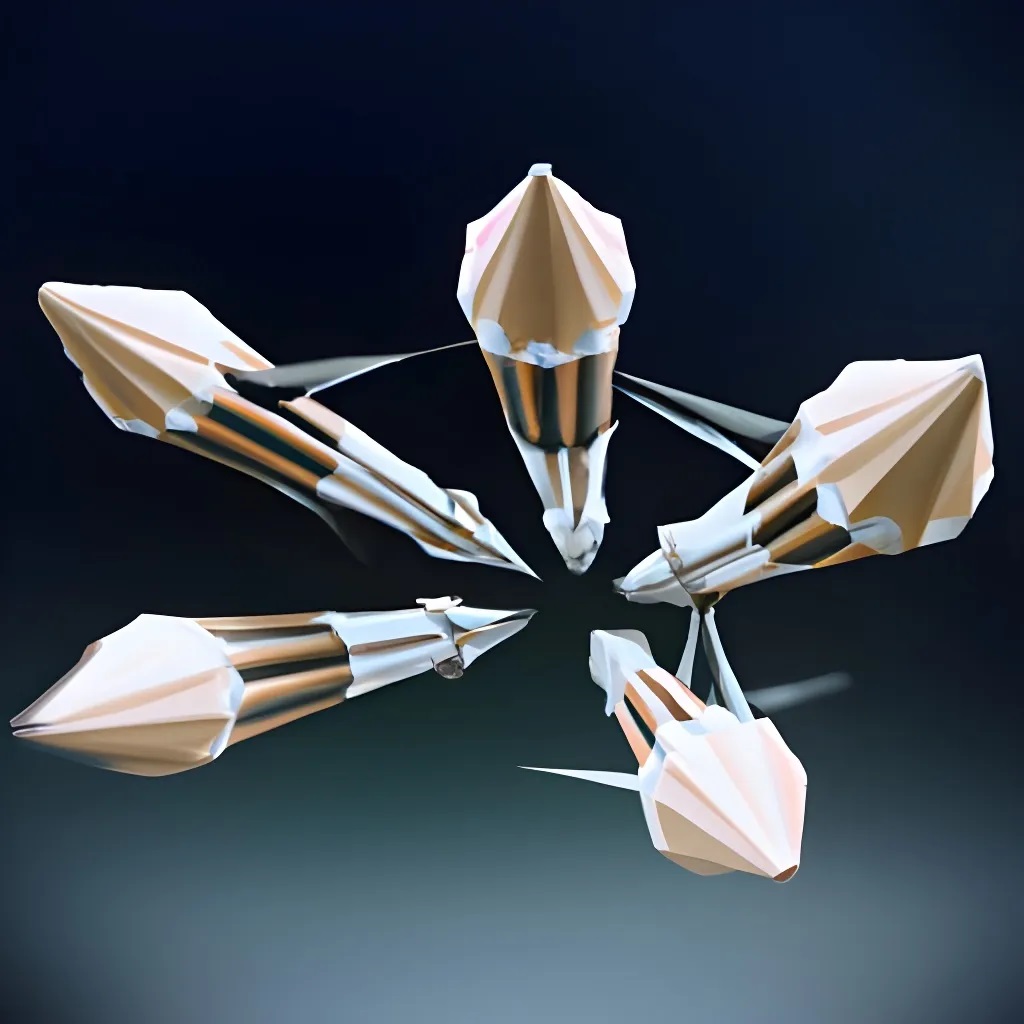
Long Range
Primary Weapons: Missiles and Lances
Light-minutes or hours out, your latest intelligence on enemy movements will be old. You cannot know what way your enemy might maneuver in this time, so dumb weapons are nearly useless. Only intelligent missiles that can correct their course have a decent chance of hitting the enemy.
Missiles are typically launched in massed volleys to help overwhelm defenses and ensure hits. The launchers, therefore, are built with this in mind and load magazines of missiles that can be quickly ejected, then fire off together.
These missiles will be highly maneuverable, able to change course and jump in very randomized ways to help defend against counter-fire. Nevertheless, only high numbers will be able to get through defenses and land hits. These requirements mean that they will tend to be small and designed to be as cheap as possible. If you’re going to firing hundreds in the hopes of a few getting through, you don’t want them all to cost exorbitant amounts.
The warheads will be nuclear, may carry submunitions, or have no warhead at all; travelling at a high enough velocity will give the projectile itself more energy than any chemical weapon.
Lances are another variety of weapon that are used at times; these heavy rockets contain a nuclear shaped charge. When detonated, a plate of dense material is turned into a hyper-energetic shot of plasma.
Lances can be detonated at great ranges and still have a powerful effect upon their target, but suffer some key disadvantages; they are typically larger and more complex than most missiles, and are therefore easier to identify. Once identified, they can be targeted with interceptor missiles or long-range lasers and destroyed.
Medium Range
Primary Weapons: Coilguns, Lasers
Within ranges of a few light-seconds, lasers become viable weapons. While most ships are effectively armored against a laser cutting through their hull, attacks on soft targets such as sensors or weapons is viable – even if not enough to destroy these systems, they may effectively blind them.
Notably, these lasers will not be continunous beams, but intense pulsed beams. Rather than melting, they will explosively convert the surface of a target into plasma. The effect would be more akin to an explosive shell going off on the surface of the target.
Incidentally, lasers also make a great method of communicating privately at long ranges! Unless your lasers are poorly shielded and others can read the heating and cooling of the commmunication laser and parse it out, hmm . . .
Coilguns, which use a coiled electromagnetic to accelerate projectiles to incredible speeds (up to an appreciable fraction of lightspeed) will be incredibly effective.
Due to both weapons travelling so quickly, dodging them is nearly impossible.
A coilgun shell will be mostly an intert lump; the acceleration they experience is so extreme that so any complex technology inside is unlikely to survive. Some specialty rounds do exist, however, such as splitter shells, which use precise materials science to allow the shells to break apart in somewhat-predictable ways at a given distance; this long-range shotgun can be used for bracketing an enemy ship in lot of smaller pieces, though more often it is used to counter massed missile barrages.
The energy of a coilgun shell will be so great that no armor can stop it. There is, effectively, no defense but to avoid being hit.
These weapons will come in different scales; the three massive coilguns built down the Craton’s centerline could launch a bus-sized projectile (or, at sane speeds, a Response Team shuttle!). Smaller, shorter weapons could be turret-mounted, though they wouldn’t be able to launch projectiles to as nearly high speeds.
Close Range
Primary Weapons: Point-Defense Cannons, Dumb Shells
Within a few kilometers, even “slow” projectiles will be able to hit enemy targets. Point-Defense Cannons, normally a defensive systems for intercepting enemy missiles, can be used to fire upon enemy ships. Despite being energetic, against very large warships these will have very little effect – but could be effective at targeting specific soft points, such as sensors or other weapon systems.
Dumb-firing artillery cannons are still possible weapons for space combat at short ranges! Firing explosive shells, they could bracket and tear holes in an enemy vessel, though deeper penetration might be problematic. These weapons would, however, have one very great advantage; they would be cheap.

Active Defenses
Various forms of defenses will exist for various weapons.
Drones will be a major component of space defense; these autonomous vehicles can be centrally controlled, have mother drones with lots of “dumb” babies, or can possess a simple AI – or all three to some degree.
Some will possess weapons of their own and will attempt to shoot down enemy missiles or even put themselves in the path of projectiles if necessary. These drones will also be extra eyes and ears for the ship, or be able to effect in-battle repairs if necessary.
In close-range, drones can attack enemy ships directly through kamikaze or strafing key targets. However, their size will mean they are also very easy targets.
A ship can only carry so many drones, however, and they are a valuable resource. To lose your drone defenses will leave your ship highly vulnerable.
For dumb-fired weapons, simply avoiding being hit is an option, and even outside of battle many ships will make small, erratic course changes in case an attack is already on its way and just hasn’t been seen yet. As ranges shrink, though, maneuver becomes less viable as a defense; a coilgun or laser simply moves too fast to be avoided if the enemy is within proper range. Missiles, however, would be nearly impossible to avoid; in real life, they simply are far more manueverable than any ship could be and will catch the target if not interfered with.
Against missiles, Point-Defense Cannons and lasers will be the main form of defense, with defensive coilgun rounds being a secondary option. Lasers can destroy a missile at a touch, meaning that the main thing holding them back is how quickly they can orient to the next target (though missiles would jump about erratically with maneuvering thrusters to make themselves harder targets).
But lasers also generate a lot of heat; getting rid of this heat is extremely difficult in space, so lasers can quickly get overwhelmed by targets. For use against space debris, however, they are perfect, and any ship that is going to travel a decent distance would carry them.
PDCs are better weapons against missiles, able to bracket them with large volumes of projectiles, tearing them apart and destroying them.
Passive Defensives
There are no ‘energy shields’ in Other-Terrestrial. No physics has been discovered to allow these to exist, and even despite hundreds of years of scientific advancements (and a few non-scientific ones), these remain in the realm of fiction.
Likewise, stealth is an impossibility in space; ships generate so much heat that parts of them will literally glow. Disguise, however, as a friendly or neutral vessel or even as a derelict, may be possible.
Almost all ships that spend time out in the Dark will be equipped with an armored nose cone. This is simply a conical disk of armor that you will point in your direction of travel (or in the direction you expect weapons to come from).
On other parts of the ship will be something called a whipple shield; this consists of multiple layers of thin armor. When small objects (<1cm) hit the shield, they will pierce the layers, but break up and disperse in the process, allowing the armor underneath to better withstand the impacts. These are in use today in the real world!
Underneath the whipple shield will be heavier layers of armor; on the Craton, this area is largely made up of cratonic rock; parts of the original strange asteroid. This matter is extremely durable, and as so much was available from hollowing out the asteroid it was readily available for use as armor.
Other vessels without cratonic rock will use heavy plates of layered materials; the layering will matter, because some cosmic rays could radioactive certain materials. The most embarrassing way to die in space would be because your own ship became radioactive and killed you!

The Eldritch
There is, of course, one last aspect to the universe of Other-Terrestial, something that sets it apart.
The eldritch.
The Sapient Union calls these entities ‘Leviathans’. They refer to matter of this type as tenkionic, and have named the force-carrier particle the krahteon.
Yet they do not understand its true nature.
These are not concepts of physics like we can understand, Leviathans are not simply a novel form of life.
There is no word for them but gods. They are beings that exist on both higher and lower planes; like an iceberg that extends deep into the sea but also so far into the sky that the top is invisible. They may present before us as physical beings or be nearly impossible to detect.
Around each of them, reality itself is warped and twisted; normal matter coming within this radius, known as the Reality Break Shadow, is itself altered. Metal may crawl like spiders or flow in strange directions like water, human minds shatter, and bodies can be twisted or become riddled with cancerous tissues.
They dwarf us. We are insgificant to them. They are a force of a nature we can never understand, that we will go mad trying to know.
Across the universe, they have left marks, some of which we can find, other times that we do not understand the significance of. Some of them have whispered into the dreams of beings since they could first see the light of a dawning sun and understand its significance.
They were there when the first star flared to life and will be there when the last dims. They are waiting.
But for what?

 Other Terrestrial
One thought on “A Deeper Dive: The Universe of Other-Terrestrial”
Comments are closed.