First, terminology; There are three main branches of the military in the Sapient Union of Other-Terrestrial. The Planetary Guard, the Spaceguard, and the Voidfleet.
All operations that take place on a terrestrial body large enough to form a geoid under its own mass falls under the umbrella of the Planetary Guard. It contains three main branches that we are all familiar with; Army, Navy, and Air Force. Along with this are the Missile Corps.
The Spaceguard patrols and keeps order within inhabited systems. There are different branches for service around planets/moons and patrolling between worlds, or guarding the edges of the system. They do not control large fleets meant for major operations, but are more for interception, investigation, and patrol of inhabited systems. However, very large Bastions with limited traversal may offer significant stiffening of defenses.
Finally, the Voidfleet conducts operations external to a home system, and are the largest branch; Voidfleet ships form the main mobile defensive forces even within inhabited systems.
In both the Spaceguard and Voidfleet, soldiers are known as espatiers.
As the term “marine” implies operating on water, the term “espatier” has been coined, using the same logic but to impart that they function in space. Pronounced “ess-pa-cee-yay”, they are elite specialist soldiers, trained to very high standards and equipped extremely well. Most ships can only carry a limited number of troops (unless they are a dedicated troopship), meaning that quality is vital.
On most Voidfleet ships, espatiers pull a double-duty; as they are rarely needed for any serious action within the ship, they train also in Response operations for other forms of emergencies (as we see on the Craton).
As warfare in the air differs from the ground or the sea, combat in space has taken on its own unique forms.
This is due to hundreds of years of development within a very specific environment; most ship-board areas are akin to intensely urbanized areas, surrounded by vacuum. As such, all weapons and equipment must be equally suitable for atmosphere, vacuum, artificial gravity, spin gravity, and microgravity.
Narrow halls, endless bulkheads, and few open areas – with many chokepoints – will make most fights take place at extreme close ranges, with few tactical options for creative movement without extreme effort (such as, for example, cutting through bulkheads – probably a standard maneuver, but slow and resource-intensive).
The first major departure from combat operations as we know them is with drone technologies. Ubiquitous not long in the future, the technology has matured by 2953 into forms that soldiers take as much for granted as we do firearms.
Drones perform all manner of tasks, from direct combat actions to observation to medical. Deploying ahead of any combat unit on a ship, sensor drones will provide a solid concept of enemy positions, disposition, and equipment. The smallest of these are extremely simple sensors, small enough to float in the air and blasted out ahead with small air blasts from vents inside the ship itself. They do not possess great scanning ability, but can recognize movement and perhaps detect signatures of military equipment, such as heat or weapon lubricants.
Smarter drones that increase in size follow, until they become the familiar size and shape we think of for drones today. These drones are approximately the size of small birds, and while they are very vulnerable, can move evasively and in numbers, making it become a losing proposition to try and destroy them.
There are also offensive drones that launch volleys of high-velocity, armor-piercing rounds. These drones are notably larger, and are viable targets for enemy unit small-arms, as well as other drones. While firing small-caliber ammunition reduces their threat compared to infantry weapons, they are still dangerous, and if left unchecked can annihilate entire enemy formations.
For defense of personnel against these drones – and against enemy espatier fire – Guardian drones fill one of the most vital roles. These defensive drones are the heaviest of all, and contain racks of hard, self-propelled projectiles that are designed to intercept enemy fire. A technical marvel, these weapons track enemy weapon and drone barrels in sight, syncing data between them in a mobile cloud. Calculating the proper angles, they launch several pyramidal-shaped projectiles at each hostile shot that they believe threatens an espatier under their care.
While lacking in kinetic energy, the extremely hard and tough counter-rounds are capable of shattering hostile bullets – and while this does not stop those pieces from flying, it does rob them of the concentrated mass and energy needed to pierce combat armor.
Other support drones are common as well; medical drones capable of using themselves to stop wounds, or delivering on-site care within seconds of an espatier taking a hit. They may also bring out new munitions or heavier weapons as units need them. Notably, all of these drones have a limited amount of operational time, and must be cycled out at regular intervals effectively becoming a fine task oriented extension of the ship’s infrastructure and logistics..
When damage is done to the ship itself, other repair drones are quick to the scene to patch holes or repair important equipment.
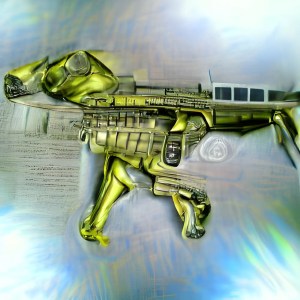
After drones are the small arms in use by Espatiers themselves. These are still divided into categories of rifles and handguns, and still use chemical propellants, in the form of cartridge or caseless ammunition. However, electronics and ballistics have been honed to a fine edge with the former being incorporated organically into every part of the weapon, shielded from outside interference as much as possible, generally improving every aspect of an espatier’s service. Ballistics, while already a robustly developed field of study, are improved most notably by perfecting materials technology, allowing for far higher quality control that we would consider possible. A dud round would be an incredible rarity, and new levels of excellence could come to be common-place as rounds can be manufactured to tighter tolerances and behave in complex yet predictable ways (such as fracturing into specific numbers of pieces or having extreme armor penetration capabilities).
If a ship is vented or espatiers find themselves fighting outside of the ship on the hull or in the void, the biggest problem for a firearm becomes waste heat. Without air to carry heat away, the only methods of its disposal are spent case ejection if applicable and radiation – for a part of the weapon to radiate the heat as light.
While radiator fins are used, the primary method is to limit heat generation; for this reason, weapons have a vacuum-mode where each round is ejected from the gun by a burst of gas, then ignites its primary charge. As the caseless rounds are made in such a way that the outer layer burns slower than the inner, they are able to rocket away, gaining speed over time. This causes a loss of accuracy and immediate lethality, and each bullet is difficult to produce, as they must contain two methods of detonating – one fast and hot for use in an atmosphere, and one slow and controlled for vacuum.
For the reasons of heat, rate of fire is typically much lower on such weapons, though sometimes volley weapons (launching multiple projectiles at once, potentially from multiple barrels) are known to be used to help overwhelm enemy Guardian drones. Needless to say, the terminal ballistics are far above what we are used to with current weapons.
Grenades are a supremely common weapon, due to their effectiveness in confined spaces, and espatiers may carry a dozen or more into combat. This is a double-edged sword, however, as grenades going off inside a ship may lead to hull punctures and the killing of friendly personnel. For this reason, the only grenades used are “smart” grenades, which have a basic ability to recognize enemies and friendlies before detonating (and potentially beaming back images to the thrower). They are not armed until the soldier activates it manually, of course, to prevent enemies from hacking in and detonating the weapons remotely while still being carried!
Other specialist weapons exist. Arc and EM grenades are essentially weaponized batteries that are capable of discharging arcs of electrical current or producing powerful radio interference fields in brief bursts, burning themselves out and exploding in the process. Exhaustive knowledge of adopted communication standards and types of hardware used by the foe make it possible for the EM devices to become formidable tools of electronic warfare on the bleeding edge of the tech arms race. Apart from the primary high-power pulse, such devices can use smarter techniques to jam communications, disrupt sensing equipment, and generally wreak havoc upon the delicate cooperative effort of various electronic devices. These are the best anti-drone weapons available to the standard espatier.
Magnetic accelerators like coilguns enjoy a unique niche, as their projectiles are far too energetic for any Guardian drone to counter. They are able to target key enemy personnel, drones, or equipment and put a hole in them. Their waste heat is a major detriment in practice, and radiator packs or pressurized gas vessels are necessary in a vacuum, which make the espatier glow – and owing to their irresistible weapons, a prime target of enemy fire themselves. A low rate of fire and limited charges are another factor.
Lasers, particle accelerators, and plasma weapons occupy only very obscure niches at most, and are not issued (or even considered) standard circumstances; the latter two have extremely minimal value and all three would be severely prone to overheating in a vacuum. Lasers may have some use against drones, owing to their near instant-hit capability at infantry ranges, however. These may take the form more of emplacement weapons or crawling drones, acting as a mobile form of active protection system.
Due to the short tactical ranges and confined spaces within a typical ship, even assault rifles will be relatively short, handy weapons, taking one more step towards present-day PDWs. Magazine sizes will range from 30-50 rounds, and pistols may have up to 25 rounds of smaller caliber. Smart munitions may be able to detect nearby targets (though with limited ability to detect friend/foe) and self-detonate, allowing targets to be hit around corners or cover – though such shrapnel would be ineffective against the power armor of a standard espatier.
While generally not desirable for any side, close-range melee combat can happen. Large, dramatic weapons for this are not typically carried or utilized (though training with swords is an optional course at the Voidfleet academy), general-purpose knives and stabbing stilettos are issued.
Most forms of martial arts blows are ineffective in microgravity and armor, meaning punches and kicks will do little except propel people apart or set them in a spin. Locks, grapples, and other such maneuvers, especially those that may choke or break bones, would be effective against unarmored targets. By far the most effective method of close-range fighting in a vacuum would be to puncture or damage the enemy’s spacesuit, which is why extremely sharp and hard stilettos are sometimes used. However, even with the most effective melee weapons, it is difficult to pierce armor even in its weakest spots.
To an espatier, their armor is of far greater importance than even today; due to the Guardian drone systems shattering enemy fire, as well as hostile small-caliber fire from drones, the danger of exploding shrapnel rounds, and the threat of exposure to vacuum, each suit of armor must be a fully-enclosed system.
These powered armors are lighter than might be expected, so that if their power is out the soldier is not rendered immobile. While powered, they do increase the functional strength of the user, however, offsetting the resistance of a flexible pressurized suit and allowing them to move more quickly than they might in open areas. They feature fully-contained air supplies and filters for wide varieties of threats, but most important are their hardened outer layers. The armor itself must be able to resist radiation, chemicals, vacuum, heat (both ambient and directed), as well as a near constant scouring of small pieces of shrapnel from destroyed enemy ordinance – without such armor, no Espatier would survive for more than a few seconds before suffering grievous injuries. Indeed, by the end of battle, such armor sets may be scoured clean as if sandblasted, with deep pitting and scarring.
Even joints must be armored to a high degree, though they still allow good mobility – but these remain weak points.
Computers in the armor can link up to a friendly ship’s computers and sensors, allowing instantaneous communication between friendly units, as well as monitoring of enemy movements anywhere friendly sensors exist. This creates a live mini-map showing active enemies and their movements, and at times even “wall hacks”.
To counter the defender’s advantage, novel and expensive – or simply destructive – technologies will have to be invented to burn out or otherwise disable sensors on a hostile ship or hack those systems and turn them back on the defenders. To combat this, ships – who are certainly some level of AI in themselves – will be able to use all manner of small data points to deduce enemy positions, from air movements, to the mysterious openings of doors when no crewmember actually seems present to be opening said door.
Ultimately, all of these technologies are still bound by the laws of physics. A bullet cannot magically home in on a target, nor can waste heat of energy weapons be ignored. The interception of enemy rounds with Guardian drones pushes the limits of potential technology to an extreme which may be impossible, but which I have considered to be unique and plausible *enough* to be worth adding to the setting.
From the viewpoint of a science fiction author and futurist, coming up with these technologies was a very interesting exercise in “where might this all lead?” That drones will become ubiquitous is inevitable. They may, one day, fully replace living soldiers on the battlefield – the only reason this may not occur is due to the desire of living operators to exert control over events on the battlefield directly.
Which, ultimately IS important. While often in sci-fi the question arises “why are people even in these dangerous situations when they could have sent a robot?” every author and futurist must come to their own conclusions for this question. In some, AIs are considered too dangerous. For me, I believe that the reason is that all of what we create exists FOR us. In order to continue to push on and survive, we must value ourselves and how we affect the universe. We cannot stand apart from it, and delegating such tasks to computer minds – while they may be orders of magnitude more efficient and safer in many ways – will still mean that we are no longer controlling our own destinies.
Thus, there may always be a need for squishy, mortal individuals to strap on armor, bring their rifle, and be ready to defend themselves and their homes.
 Other Terrestrial
You must be logged in to post a comment.