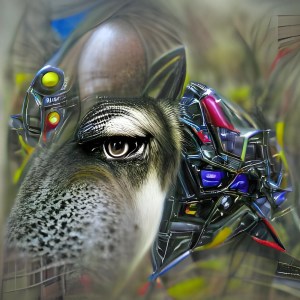
In this week of Other-Terrestrial, we get to meet spacehounds.
This future breed are enhanced genetically and technologically to be at a level of intelligence where they can follow instructions clearly, without specific training, and even communicate in simple sentences with a computer box on their collar.
I am far from the first futurist to suggest uplifting animals, however.
How great would it be to have man’s best friend live longer, be smarter? If you ask him to fetch, he might ask back ‘what do you want?’.
Yet this is obviously much bigger than these sort of lighthearted thoughts.
It’s a big question, ethically, as well as in many other senses. What would it mean to “uplift” an animal, exactly? We still do not fully understand the nature of our own intelligence at this point, so how could we give that to another lifeform? Is it right to do so?
While understanding the true nature of intelligence and sapience is, of course, a huge deal, and worthy of huge amounts of discussion – for right now, let’s stick to the doggos.
There are likely ways to increase dog intelligence; from genetic code tweaking to the incorporation of technology to simple selective breeding aided and controlled on a large scale to produce higher intelligence.
Notably, there are going to be a lot more complicated technologies involved in the whole process – like making sure the animal can get enough calories to be able to do engage in its normal range of behaviors while also fueling its now more metabolically costly brain. But increasing the efficiency of digestion, either with alterations to genes or even the insertion of modified bacteria to gut biome to aid this are also technologies I expect will get a lot of attention. How much easier would it be to feed everyone if people just wasted less calories? And of course we might be able to make more energy-packed foods.
But this wouldn’t answer the question of ethics. On the one hand, it is not too dissimilar to having a baby – creating a new life that cannot consent to having been created. We don’t know what unique mental and physical health problems they get. The process could become a nightmarish affair.
The ethics of humanity and the Sapient Union would, at their current state, probably not engage in this for exactly those reasons. But that does not mean that uplifted dogs or animals wouldn’t exist at all – because they might have already been done in the past.
At that point, you may have animals with far higher intelligence simply existing – and once they exist, they may very much wish to continue to existing. So this may be an inherited aspect of society that humanity must simply accept and deal with.
This is how I imagined it for Other-Terrestrial.
 Other Terrestrial
You must be logged in to post a comment.