Between episodes I decided to share some information on the primary starship of Other-Terrestrial, the Craton!
I don’t know if this will be a regular feature, but there are certainly some basic details about the setting that we should be able to nerd out.
As a result, I’m including in here a sketch I’ve made of the Craton to help you visualize the ship better!
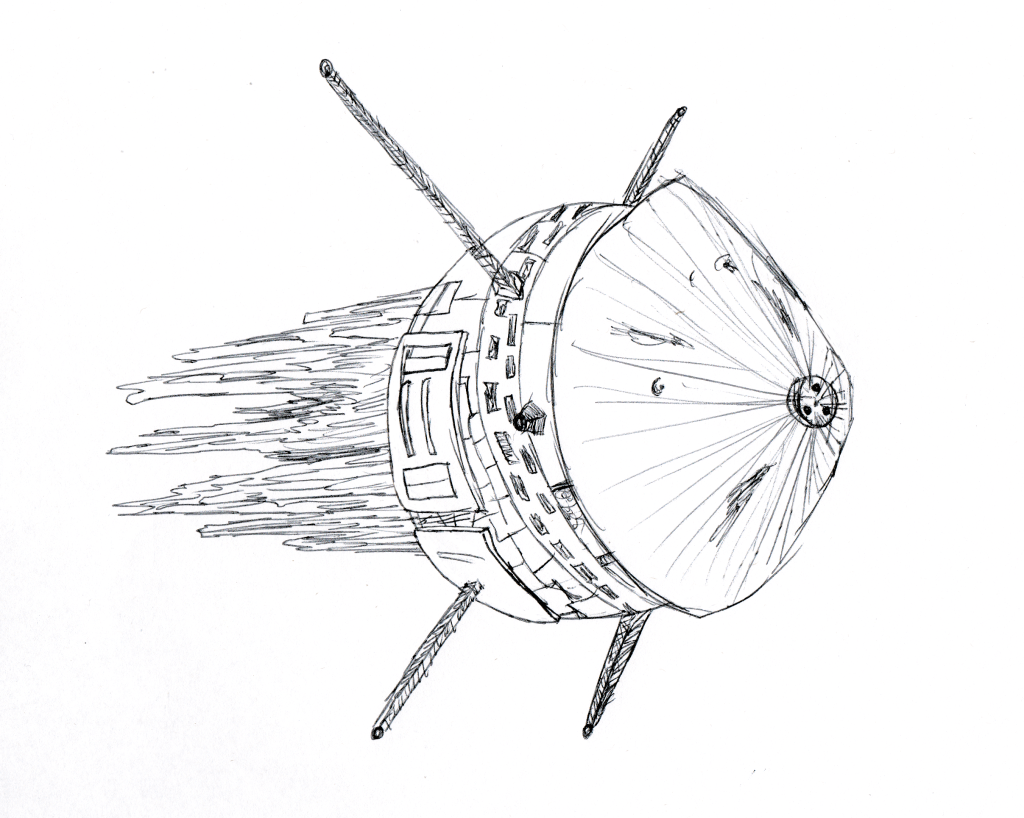
The Craton is a unique ship, the first of her kind in the Sapient Union. Originally an ancient asteroid of a very rare type, she was the first cratonic ship.
With the central asteroid being approximately one kilometer in diameter, the Craton is large enough to be considered a city-ship, and houses not just a sizable crew and their families, but thousands of civilians who live their lives aboard. This collection of beings are not beholden to any single star system and travel through the void, serving the greater needs of the Sapient Union – but also having a large say in their own destinies.
The cratonic asteroids that she was built from are believed to be some of the earliest solid objects to have formed in the universe, and display unusual properties. While dating is difficult, they seem to have come from a time before matter such as silicates, iron, and nickel could have formed.
While composed largely of these common elements, they also contain a quantity of material that is unknown; a greenish rock that is extraordinarily resilient. Equally bizarre, it is more massive than its constituent components suggest it should be; while not currently provable, this suggests that the unknown material (dubbed cratonite) extends into higher dimensional space – possibly even into zerospace itself.
Whatever the reasons, cratonite is a form of so-called tenkionic matter – the term for matter that is believed to contain particles from zerospace. This quality makes cratonic ships much more easily capable of zerospace jumps.
Due to her toughness, cratonic rock is also a superb form of armor; so much so that the Craton retains, in many places, up to 50 meters of the rock. This enables it to withstand impacts from meteoroids and some weapons far better than most other comparably-sized ships.
Despite this, it has been deemed unwise for the Craton to suffer a continual loss of her cratonic rock through micro-meteor impacts while travelling through space. Thus the ship has a large, metal frontal cone that gives her extra defense in her main direction of travel.
All together, the Craton is a hard ship to kill.
Internally, the Craton possesses seven fusion reactors. While a single reactor would be more efficient, having multiples allows for more precise control of energy production and backups against engineering problems or damage.
Trailing ‘behind’ the Craton (she can technically move in any direction, but does have a preferred direction of travel), a number of metal vanes serve to help dissipate heat from the ship as well as aid in long-range communications and scanning.
The Craton‘s zerodrive allows her to move in realspace as well as zerospace. In the latter case, the drive gathers ambient krahteons – a force-carrier pseudo-particle from zerospace. When gathered in sufficient quantities, this matter begins a chain reaction that tears a rift in realspace, allowing entry into another reality.
Zerospace exerts a gravitational attraction that pulls the ship in. Once in zerospace, the gravitational pull of the dimension equalizes across the ship and it will increase in velocity continually, even past c, due to differing spatial laws in the dimension. Normal matter in zerospace typically suffers a ‘matter failure’ event and ceases to exist as we understand it. However, through a powerful external magnetic field, this disaster can be staved off – a major reason for ships having so many redundant fusion generators.
The same zerodrive effect can be used to move the ship in realspace by not fully opening the zerospace aperture. A ‘thinning’ of realspace still occurs, and the gravity of zerospace pulls the ship towards the opening. This can occur rapidly enough to create a smooth sensation of forward travel.
In this way, the Craton escapes the tyranny of physics as we know them, and is able to move without applying Newton’s third law.
While the Craton is not a warship, there are dangers in space that require the ability to defend and attack.
Along points of the hull, the Craton has long towers tipped with powerful lasers. These are standard among many spacecraft, however, and their main purpose is not combat, but defense against meteoroids larger than sand grains. These can, of course, also be used offensively or to ward off enemy missiles.
In the vein of defenses, the Craton is also equipped with multiple clusters of projectors, capable of launching long-range guided missiles. She also possesses numerous machine-gun emplacements to help defend against enemy missiles.
The primary armament of the Craton, however, are three massive magnetic accelerators that run nearly the length of the ship. Capable of slinging an object as large as a bus, they can be precisely controlled to launch shuttles at safe speeds – or tungsten slugs at a fraction of the speed of light.
The Craton also possesses thousands of drones that can serve an offensive or defensive purpose – though largely they serve as the eyes and ears of the ship at longer ranges, as well as low-value tools for inspecting dangerous spaces.
Internally, the Craton is designed to efficiently use its vast volume, allowing maximum space for the amenities that a city must have for its occupants. Along the equatorial axis of the ship, restaurants, shops, and cultural businesses exist for the civilians and crew to enjoy, and on other decks there are also pools, gardens, and even small courts for sports.
These gardens are vital not just to the mental well-being of the crew, but to their food security, as many are efficient vertical hydroponic gardens that produce much of what is eaten on the ship.
Modified specifically to increase flavor and to function well in the environment of a spaceship, these foods include grains like wheat, oats, and rices as well as vegetables and certain fruits.
There are no meat animals on the Craton, but meat is produced artificially in growing vats, indistinguishable from “real” meat down to a molecular level – and according to many, indistinguishable in taste and texture. Of course, some connoisseurs feel otherwise.
The Craton was built at an Earth-controlled shipyard, the original cratonic asteroid having been found by a human exploratory team. All species are welcome aboard the ship, but as with many ships in the SU, keeping largely to one species substantially eases the burden of supply. Not all species prefer the same environmental conditions, most cannot eat each other’s foods safely, or necessarily breathe each other’s atmospheres safely for long-term. Exceptions do exist, however.
Along with the civilian population, a civilian government exists to represent the needs of that population.
At each port stop or even upon meeting another ship, it is not unusual for transfers of civilians to take place, though there are also many who prefer to permanently call the Craton their home. Many officers are in fact natives to the ship, though they must learn at a sanctioned academy before they can become an enlisted officer.
The command staff of the Craton are:
Captain-Mayor Ian Brooks, human male from Earth, Commanding Officer
Executive Commander Zachariah Urle, transhuman male, Executive Officer
Commander Cutter, Bicet (Beetle-Slug), Chief of Engineering
Commander Cenz, Coral, Science Chief Officer
Commander Y, Ehni AI, Chief Medical Officer
Commander Jaya Yaepanaya, human female, Chief of Operations
Commander Kai Yong Fan, human female, Chief of Response
Commander Ham Sulp, spacer human male, Chief of Resources
Commander Zeela Cann, human female, Chief of Administration
Commander Ji-min Bin, human female, Chief of Navigation
Commander Shomari Eboh, human male, Chief of Communications
Commander Rachel Zhu, human female, Chief Flight Officer
I hope you enjoyed! I’m aiming to put out more soon!
 Other Terrestrial
You must be logged in to post a comment.